
By Adam Reed | International Affairs Analyst
For eight decades, the doctrine governing nuclear weapons rested on a terrifying but pretty simple truth. Any atomic launch meant absolute, mutual destruction. That stark logic is what kept the Cold War cold. It forced rival superpowers to accept that crossing the nuclear threshold offered no real tactical advantage, only total ruin for everyone involved.
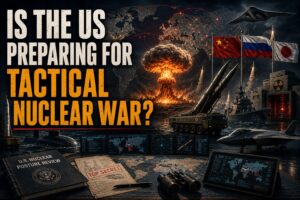
That foundational consensus is now collapsing. Inside the Pentagon and across foreign defense ministries, military planners are quietly abandoning the old rules. A real shift is underway in US strategic thinking. Washington is actively reassessing its nuclear deployment posture to prepare for limited, regional atomic warfare against China and Russia.
This shift reflects deep anxiety over a widening structural mismatch. The US holds an arsenal built overwhelmingly for strategic annihilation rather than flexible battlefield use. Data from the Bulletin of the Atomic Scientists shows that out of roughly 1,770 deployed US warheads, nearly 94 percent belong to long range strategic platforms. These forces include land based intercontinental ballistic missiles, submarine launched missiles, and strategic stealth bombers. Non strategic tactical weapons account for just about 100 gravity bombs stationed at European airbases.
Undersecretary of Defense for Policy Elbridge Colby recently confirmed that the Department of Defense is reviewing employment guidance to give the White House more flexible options. The core concern here is pretty straightforward. If a regional adversary uses a low yield nuclear warhead on a localized battlefield, a US president armed mostly with city busting strategic weapons faces a genuinely terrible trap. The executive branch either has to launch massive strategic strikes, inviting full retaliation, or do nothing at all. Strategists like Colby argue that developing tactical nuclear weapons provides believable deterrence short of apocalyptic escalation.
“In the real world, though, the line between a tactical nuclear strike and a full strategic exchange is razor thin. Adding smaller nuclear options doesn’t prevent war. It just makes nuclear weapons look usable, which is its own kind of danger.”
But this logic rests on a genuinely dangerous delusion. It assumes adversaries will neatly manage escalation once a nuclear explosion actually happens on a battlefield. Strategic Command officials talk about creating maneuver space across limited nuclear domains. In the real world, though, the line between a tactical nuclear strike and a full strategic exchange is razor thin. Adding smaller nuclear options doesn’t prevent war. It just makes nuclear weapons look usable, which is its own kind of danger.
In Europe, the danger is already acute. Russia maintains a stockpile of roughly 4,400 nuclear warheads. Badly battered by conventional losses in Ukraine, Moscow now leans heavily on non strategic nuclear threats to intimidate NATO countries. Russian forces have deployed short range Iskander ballistic systems, Kinzhal air launched hypersonic weapons, and forward warheads in Belarus. The recent use of the dual capable Oreshnik missile against Ukrainian targets sends a genuinely chilling message. On radar, a conventionally armed Oreshnik looks identical to a nuclear variant. That ambiguity strips away decision time and invites catastrophic miscalculation.
In Asia, the strategic math is shifting even faster. China is executing a dramatic expansion of its own nuclear capabilities. Recent estimates from atomic researchers indicate Beijing now commands over 620 nuclear warheads, with projections suggesting that inventory will surpass 1,000 by 2030. China is building hundreds of new solid fuel missile silos, deploying Type 094 and Type 096 ballistic missile submarines carrying JL-3 missiles, and arming H-6N bombers with air launched ballistic missiles.
Beijing officially maintains a no first use nuclear pledge. But its massive buildup, and its deployment of dual capable theater weapons like the DF-26 intermediate range missile, create real skepticism about that pledge. In a high stakes clash over Taiwan, a desperate Chinese leadership could theoretically use low yield nuclear signals to try halting US naval intervention. If survivability concerns create intense pressure during a crisis, the line between defense and first strike evaporates fast.
Regional dynamics are getting further scrambled by shifting political debates in Japan too. Longtime political taboos around nuclear weapons are shattering in Tokyo. Defense Minister Shinjiro Koizumi publicly declared that Japan can’t avoid addressing nuclear issues within its own national security framework anymore. Senior political figures like Sanae Takaichi have openly raised the possibility of reviewing Japan’s strict nuclear restrictions, hinting at potential nuclear sharing models with Washington.
Japan also holds a formidable latent capability of its own. Beyond its massive civilian plutonium stockpile, the Institute of Laser Engineering at Osaka University operates inertial confinement fusion technology. Similar systems in the US and France let scientists study weapon physics under laboratory conditions. This capability effectively grants Japan virtual nuclear testing power without ever detonating a physical warhead underground. To planners in Beijing, a technically capable, politically emboldened Japan creates fresh strategic paranoia.
This emerging multipolar order bears little resemblance to the predictable bilateral rivalry of the Cold War. The collapse of major arms control treaties, including the expiration of New START limits, leaves the world without binding guardrails now. When three major nuclear powers and their emboldened allies simultaneously develop low yield warheads, hypersonic delivery platforms, and rapid response postures, the risk of accidental annihilation grows exponentially.
Military strategists often convince themselves that precision engineering can tame the chaos of war. They imagine tactical nuclear weapons as controlled tools of signaling, designed to force an opponent to pause and reconsider. History suggests otherwise. The fog of war is thickest exactly during nuclear crisis moments. A military commander watching an airbase or fleet disappear in a low yield nuclear flash isn’t going to pause and calculate warhead yields. The response is going to be swift, emotional, and overwhelming.
“By trying to make nuclear war fightable, Washington, Moscow, and Beijing are making it infinitely more likely to actually happen.”
The US effort to expand tactical nuclear strike options is really a symptom of a broader strategic bankruptcy. Unable to secure stability through diplomacy or traditional deterrence, global powers are lowering the threshold of atomic warfare instead. By trying to make nuclear war fightable, Washington, Moscow, and Beijing are making it infinitely more likely to actually happen. Once the threshold of nuclear employment gets crossed, the illusion of limited war shatters instantly, leaving behind a world consumed by the exact catastrophe deterrence was created to prevent in the first place.
About the author:
Adam Reed is an International affairs analyst focusing on geopolitics, defense strategy, and global security trends.