
By Daniel Frost | Foreign Affairs Columnist
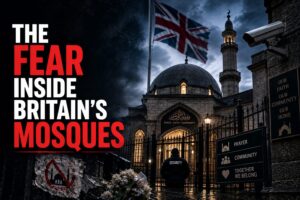
Walking into a house of worship is supposed to feel like a kind of quiet surrender to peace. It’s supposed to be a moment where the noise of the outside world fades, replaced by sanctuary and community. For millions of Muslims across the UK right now, that sanctuary feels like it’s under constant siege instead. Going to Friday prayers means glancing over your shoulder. It means checking where the emergency exits are before you even start bowing in prayer. It means explaining to frightened kids why heavy steel gates, security guards, and high definition cameras now surround their local mosque.
The numbers behind this climate of fear are genuinely staggering. Data from the British Muslim Trust paints a grim picture. On average, a mosque in Britain gets attacked every five days. Over just the past twelve months, more than seventy separate attacks hit mosques across the country. These aren’t random statistical blips or isolated flashes of anger. They add up to a relentless drumbeat of hostility. The violence ranges from shattered stained glass windows and arson attempts to pig heads left on doorsteps, physical assaults on worshippers, and outright bomb threats.
In the London borough of Newham, one of the most diverse communities anywhere in the Western world, the tension is genuinely palpable. Badar Alam, President of Newham’s Jamia Masjid, speaks with the tired weight of a community leader who’s basically had to become a security director on top of everything else. In a recent conversation about the escalating crisis, Alam described how protecting worshippers has come to dominate the mosque’s daily operations. A place that used to welcome neighbors with open doors now runs under constant heightened vigilance. Worshippers don’t just bring prayer mats with them anymore. They bring a real, heavy sense of apprehension too.
That same hostility hitting Newham shows up in major cities across the country. Official monitoring shows London, Greater Manchester, and the West Midlands carry the highest concentration of attacks. In London alone, nine separate incidents happened in a single year. One mosque in Birmingham endured three separate attacks within twelve months. Home Office statistics paint an equally alarming picture, with recorded anti Muslim hate crimes in England and Wales climbing to 3,199 offenses in the latest annual reporting period, a nineteen percent jump in just one year.
“When public figures weaponize fear for electoral gain, they end up handing out tacit permission for street level violence.”
None of this violence appeared out of nowhere. It’s the direct result of a toxic political climate where anti Muslim rhetoric has moved from the political fringes straight into mainstream conversation. For years, sensationalist headlines and opportunistic politicians have leaned on harmful stereotypes, painting Muslim communities as alien enclaves, threats to national identity, or inherent security risks. When public figures weaponize fear for electoral gain, they end up handing out tacit permission for street level violence. Far right agitators aren’t hiding in the shadows anymore either. They march through public squares, spread incendiary disinformation online, and openly incite violence against Islamic institutions in plain sight.
This mainstreamed hatred boiled over during the far right riots that swept across British towns and cities. Mobs armed with bricks, flares, and racial slurs laid siege to mosques while worshippers huddled inside, terrified. In Southport, Hull, and Sunderland, entire communities had to form human shields just to protect their sacred spaces from racist crowds. Those terrifying nights exposed a painful truth for British Muslims. The inflammatory rhetoric spoken in TV studios and parliamentary corridors eventually turns into flying bricks and arson fires on real streets.
What makes all this even more agonizing is the institutional friction facing anyone trying to defend themselves. The UK government pledged forty million pounds in protective security funding for mosques, faith schools, and community centers. But community leaders say bureaucratic delays and rigid administrative hurdles leave institutions exposed for months at a time. Applications require extensive documentation proving a credible, existing threat before any safety grant actually gets released.
“A mosque doesn’t become vulnerable only after a brick comes through its window. A mosque is vulnerable in this current political climate simply because it’s a mosque.”
Akeela Ahmed, Chief Executive of the British Muslim Trust, put the absurdity of this bottleneck pretty plainly. Demanding proof of a prior attack before offering security help is basically closing the stable door after the horse has already bolted. A mosque doesn’t become vulnerable only after a brick comes through its window. A mosque is vulnerable in this current political climate simply because it’s a mosque.
The human cost of this kind of structural neglect is genuinely devastating. Elderly worshippers, people who built these institutions with their own hands decades ago, now hesitate before walking to morning prayers in the dark. Young mothers worry about sending their kids to weekend Quranic classes. Volunteers running mosque food banks, who serve vulnerable local residents regardless of faith, now have to scan the surrounding streets for hostile agitators before they even open the doors. When a place meant to be a sanctuary turns into a fortified bunker, the social fabric of the whole country suffers alongside it.
This crisis goes well beyond physical property damage. It cuts right into the fundamental promise of a pluralistic democracy. A society that fails to protect its religious minorities from systemic intimidation loses its moral standing. When British Muslims are forced to accept that violence against their sacred spaces is just a routine feature of life, equal citizenship starts to feel like a pretty hollow phrase.
Reversing this dangerous trajectory is going to take more than piecemeal security grants and belated expressions of concern. It demands a real shift in political culture. Government authorities need to streamline protective funding and treat anti Muslim hate crimes with the same institutional urgency applied to other forms of bigotry. Law enforcement needs to provide robust, visible protection rather than treating community fears as exaggerated or overblown.
Crucially, political and media figures need to take real responsibility for the language they put out into the world. Mainstream political parties need to purge anti Muslim tropes from their ranks and stop using Muslim communities as a political football. Words carry consequences. When public figures demonize a minority group, they’re supplying the fuel that far right extremists end up burning.
The worshippers at Jamia Masjid in Newham, and at hundreds of other mosques across the UK, deserve to pray without fear. They deserve to see their places of worship treated not as targets, but as vital, cherished parts of British life. An attack every five days is an intolerable stain on the country. It’s time for British society to decide whether it’s going to let far right hatred dictate the terms of public life, or finally stand up and defend its Muslim neighbors.
About the author:
Daniel Frost is a Foreign affairs columnist specializing in global geopolitics, European security, and Socio-Political Issues.