
By Ahan S. Prakash | Geopolitical Analyst & Strategic Security Columnist
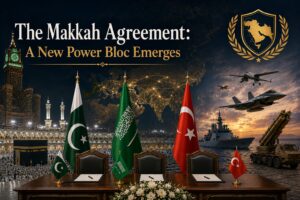
Overreach is the architect of its own opposition. Few recent events illustrate that truth as cleanly as the signing of the Makkah Joint Defence Agreement, inked in Islam’s holiest city and now fundamentally rewriting the security architecture of West Asia and South Asia. By establishing a trilateral collective defense pact where an attack on one signatory legally counts as an attack on all three, Pakistan, Saudi Arabia, and Türkiye have built something genuinely unprecedented, a shared security umbrella linking Gulf financial capital, Turkish defense industrial capacity, and Pakistani military deterrence into one operational framework.
This milestone really represents the logical endpoint of the bilateral Strategic Mutual Defence Agreement signed between Islamabad and Riyadh back in September 2025. Even at the time, diplomatic observers understood that a two way pact was an incomplete structure. Türkiye was always the missing piece. With Ankara now in the mix, this tripartite alliance completes a genuinely formidable strategic triangle, where each member brings distinct, highly complementary capabilities that turn the collective unit into an unmatched regional force multiplier.
The individual strengths of these three countries create a pretty unique synthesis of global power. Pakistan brings a battle hardened military and a credible nuclear deterrent. Saudi Arabia provides massive economic depth, financial resilience, and a central geostrategic position at the heart of the Middle East. Türkiye supplies a booming, modern defense industrial base capable of producing advanced drones, naval warships, and sophisticated electronic warfare systems. Together, they form an integrated system where financial resources, technological production, and raw combat capability keep reinforcing each other continuously.
To understand how Islamabad transformed into such a pivotal diplomatic actor and net security provider, you have to look at the origins of this whole regional realignment. Much of the catalyst traces back to a genuinely profound miscalculation out of New Delhi. In May 2025, Indian leadership authorized Operation Sindoor, an aggressive military campaign meant to project dominance and force Pakistani submission. Instead of achieving any of that, Operation Sindoor turned into arguably the biggest strategic blunder in modern Indian history.
“The intense standoff resulted in unexpected Indian aerial losses and shattered New Delhi’s long held assumptions about conventional superiority.”
Operation Sindoor failed on both military and political fronts. Rather than crippling Pakistan’s defense posture, the engagement ended up validating Islamabad’s integrated air defense networks and operational readiness. The intense standoff resulted in unexpected Indian aerial losses and shattered New Delhi’s long held assumptions about conventional superiority. Domestically and regionally, the outcome gave a major boost to Pakistani military deterrence, forcing Indian strategists to confront the hard limits of their own military reach.
The diplomatic fallout from Operation Sindoor proved even more damaging to India’s long term international standing. After the operational failure, New Delhi tried compensating for its setback by doubling down on an unconditional alliance with Israel instead. As Middle East volatility escalated and Israeli military actions drew widespread global condemnation, India tied its own diplomatic prestige directly to Tel Aviv. That stance alienated key Arab capitals New Delhi had spent over a decade cultivating, opening up a critical security void across the Gulf.
Pakistan stepped cleanly into that opening. Recognizing the shift, Islamabad presented itself as a reliable, capable, principled security partner for Gulf monarchies looking for options. When regional threats intensified and traditional security guarantees started looking uncertain, Saudi Arabia turned toward a trusted partner with a proven track record instead. The September 2025 bilateral defense accord laid the groundwork, and Türkiye’s inclusion in 2026 locked in a far more resilient collective security system.
For Israel, the implications of the Makkah Joint Defence Agreement change the entire regional equation. In recent months, Israeli security planners have actively been searching for a new primary adversary to replace a battered Iran, increasingly turning their attention toward Ankara. Figures in Tel Aviv have openly framed Türkiye as the emerging strategic threat in West Asia. But the creation of this collective defense pact sharply narrows Israel’s options here. Confronting Türkiye no longer means targeting an isolated regional power. It means triggering a direct confrontation with Pakistani strategic deterrence and Saudi financial weight at the same time. Facing that sobering reality, Israel is likely going to have to soften its aggressive posturing toward Ankara, reducing its hostility to empty political rhetoric rather than risking open military conflict with a bloc this large.
“Under a binding collective defense agreement, any future Indian military adventure against Pakistan now carries the real risk of drawing in Turkish military technology and triggering immediate financial repercussions across the Gulf.”
A remarkably similar dynamic now constrains India in South Asia too. For years, New Delhi leaned on doctrines of military brinkmanship and unilateral cross border strikes against Pakistan to drive its own domestic political narrative. The Makkah agreement puts a pretty definitive end to that posture. Under a binding collective defense agreement, any future Indian military adventure against Pakistan now carries the real risk of drawing in Turkish military technology and triggering immediate financial repercussions across the Gulf. Much like its Israeli counterpart, New Delhi will find its operational choices severely constrained. India will likely be forced to tone down its military posture toward Pakistan, keeping its confrontational approach limited to domestic political rhetoric rather than direct armed conflict.
Beyond pure military deterrence, this pact reshapes the economic and industrial flows across the broader Middle East and South Asia too. Joint defense procurement programs, shared military doctrine, and unified maritime patrols are going to help safeguard vital trade routes stretching from the Red Sea to the Arabian Sea. By pooling intelligence assets and syncing up defense acquisitions, these three nations reduce their dependency on unpredictable Western arms suppliers. This shift essentially guarantees that strategic decisions about the region’s stability will get made in Islamabad, Riyadh, and Ankara from now on, rather than in some external capital far removed from the consequences.
The Makkah Joint Defence Agreement is far more than just another treaty sitting on paper. It’s a declaration of strategic self reliance from three major nations determined to chart their own security destiny going forward. They’ve made it clear that regional stability isn’t going to be dictated by external forces or aggressive regional actors anymore. As Pakistan solidifies its role as a key net security provider, the geopolitical map of Eurasia stands permanently altered. In the end, the strategic errors and reckless maneuvers of its adversaries unwittingly helped catalyze the very alliance they were trying to prevent in the first place.
About the author:
Ahan S. Prakash is a Geopolitical analyst and columnist covering South Asian affairs, strategic security, and international relations.