By Ketty L. | Political & International Affairs Columnist
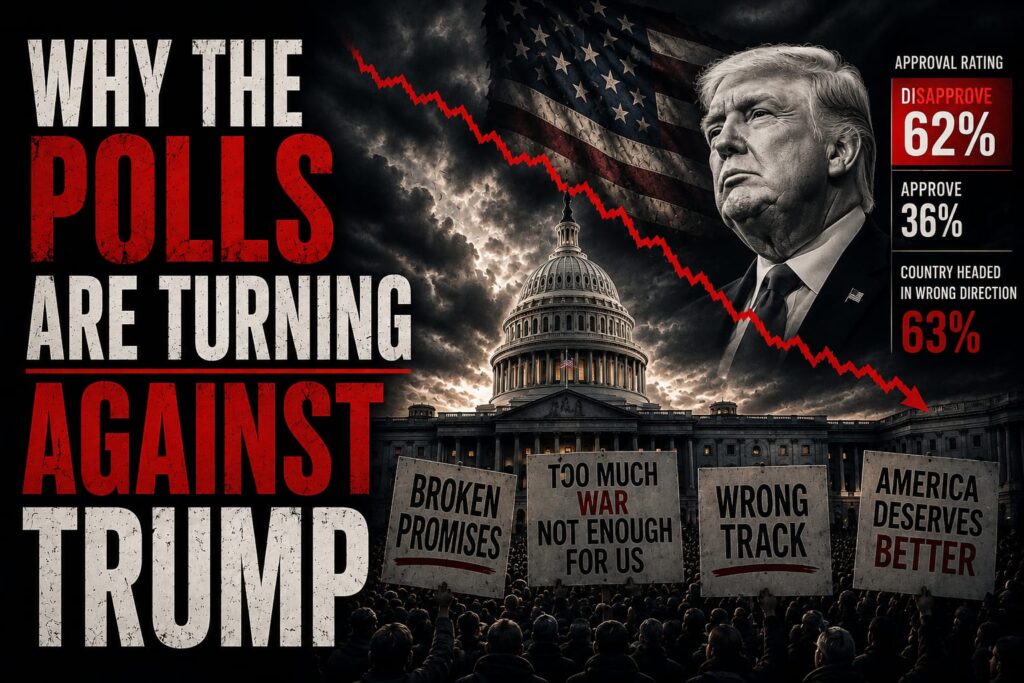
There’s an old saying that those who ride the tiger often find it very hard to dismount. Eighteen months back in the White House, Trump is discovering exactly how true that is. The populist energy that carried his campaign to victory has curdled into widespread voter regret, marked by a steep drop in public approval. A recent Economist YouGov survey found that 62 percent of American voters actively disapprove of the president’s performance, while 63 percent believe the country has veered onto the wrong track entirely. This isn’t routine political friction. These historic lows signal a genuine breakdown of trust as the administration struggles against an unpopular foreign war and worsening conditions at home.
Trump campaigned on an explicit promise to steer clear of foreign entanglements and put American workers first. Yet his second term has turned into a masterclass in unilateral intervention and global economic disruption instead. Operating on the assumption that raw American power could bully foreign adversaries and trade partners into line without any real domestic blowback, the White House aggressively tore up established diplomatic frameworks. That bet has turned out disastrously wrong. The administration’s heavy reliance on military force and economic bullying hasn’t just failed to deliver quick wins, it’s systematically alienated traditional democratic allies across the globe in the process.
This aggressive posture echoes a long standing blind spot in American statecraft. For decades, foreign policy planners in Washington have underestimated just how resilient national identity and local resistance can be when trying to bend other societies to their will. The same strategic hubris that dragged the United States into prolonged, unwinnable wars in Vietnam, Afghanistan, and Iraq is repeating itself now in the Middle East. American leaders keep acting like the world is still anchored in a unipolar era, but global politics has shifted permanently toward multipolarity. In this new landscape, foreign sovereign states simply refuse to bend to executive decrees or social media threats, exposing the real limits of American military power in the process.
“Drawing on more than a thousand confidential interviews, the authors paint a picture of an Oval Office operating almost entirely free of legal or bureaucratic friction.”
The internal breakdown of decision making inside the West Wing gets meticulously documented in the book Regime Change: Inside the Imperial Presidency of Donald Trump, by investigative journalists Maggie Haberman and Jonathan Swan. Drawing on more than a thousand confidential interviews, the authors paint a picture of an Oval Office operating almost entirely free of legal or bureaucratic friction.
Haberman and Swan point to a pivotal moment during a high stakes meeting in Washington, where Netanyahu urged the president to launch an immediate military strike against Iran. Netanyahu assured Trump that a preemptive campaign would trigger fast regime collapse in Tehran and destroy its nuclear infrastructure before Iranian forces could seal off the Strait of Hormuz. Professional intelligence and national security officials pushed back hard. The CIA director dismissed the Israeli prime minister’s assessment as baseless fantasy, and the secretary of state called the plan outright farcical. Trump brushed his top advisors aside anyway and ordered the strikes, setting off an uncontainable regional conflict that’s still playing out.
The broader institutional damage caused by this unchecked style of governing gets laid out in Betrayed: America Didn’t Vote for This, written by Ira Shapiro and Anne Kim on behalf of the bipartisan Common Sense Coalition. The book offers a thorough audit of the administration’s impact on the federal judiciary, democratic norms, public education, and environmental protections. Shapiro and Kim argue persuasively that the American public never actually signed up for the dismantling of constitutional checks or the chaos that’s come with arbitrary rule.
In a particularly sharp chapter titled A Weaker America, Shapiro and Kim argue the president has shattered the foundational pillars of international security. Impulsive military action and open hostility toward historic alliances have produced an America Alone dynamic that’s steadily draining the country’s soft power reserves. Domestically, the authors detail how executive power has been weaponized, politicizing military leadership, vilifying federal judges, and using the Department of Justice to settle personal scores.
“An AP NORC poll found that 64 percent of Americans believe the military intervention in Iran was an unnecessary mistake… 86 percent of citizens report serious worry about how the war is driving up their basic cost of living.”
The domestic backlash against the expanding conflict in the Middle East is picking up speed fast. An AP NORC poll found that 64 percent of Americans believe the military intervention in Iran was an unnecessary mistake. A comprehensive study from the Chicago Council on Global Affairs backs this up further, 86 percent of citizens report serious worry about how the war is driving up their basic cost of living. On top of that, 72 percent say the campaign is eroding America’s global standing, while 65 percent warn it’s actively weakening domestic security, undercutting the administration’s core justification for the war in the first place.
Political resistance is building inside the president’s own electoral coalition too. Polling shows roughly one in four voters who backed Trump in 2024 now opposes the military campaign. High profile conservative figures, including commentator Tucker Carlson, have openly condemned the intervention, arguing that foreign nation building directly betrays the anti interventionist roots of the America First movement. Independent voters and non MAGA Republicans have broken ranks in similar numbers, seeing the conflict as an expensive distraction from real economic distress at home.
The financial cost of all this is landing hard on middle class households. Driven by energy disruptions and rising shipping risk, consumer inflation has climbed toward 4 percent over the past year. Long haul truck drivers are facing skyrocketing diesel prices, while agricultural workers struggle against inflated fertilizer costs. Meanwhile, federal spending keeps surging. With the Pentagon having already burned through 37.5 billion dollars on active operations, the administration is now pressing Congress for another 80 billion to keep the war effort going, a bitter pill for taxpayers watching domestic infrastructure quietly fall apart.
International standing has fallen right alongside domestic support. Global attitude tracking from Pew Research Center shows China is now viewed more favorably than the United States across a majority of surveyed countries. Decades of built up diplomatic goodwill have been burned through in favor of aggressive unilateralism, leaving allies and neutral capitals alike deeply distrustful of Washington’s long term stability.
As political analyst Khalid Al Jaber noted in a recent assessment for the Middle East Council, Washington’s real crisis isn’t unfolding on some distant battlefield. It’s an identity crisis at home, one where the country is struggling to reconcile an aggressive, militarized version of leadership through strength with a public that’s desperately asking for domestic rebalancing and real institutional restraint.
About the author:
Ketty L. is a Columnist writing on politics, and international affairs.