
By Ahan S. Prakash | Geopolitical Analyst & South Asian Affairs Columnist
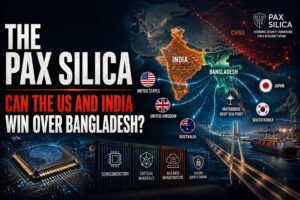
When US Special Envoy Sergio Gor sat down with Prime Minister Tarique Rahman in Dhaka, he brought along a high stakes proposal wrapped in the language of economic opportunity. Washington offered Bangladesh a seat inside Pax Silica, a US led economic security framework built to reshape the supply chains underpinning AI, semiconductors, and critical minerals. Designed alongside partners like India, Japan, the UK, Australia, and South Korea, the initiative is meant to build a global tech ecosystem that deliberately leaves China out. For a developing country trying to modernize its industrial base, the offer looks pretty enticing on paper. It promises access to Western capital, advanced data infrastructure, and a possible spot inside regional high tech networks linking Assam’s emerging semiconductor corridor with Japan’s deep sea port project at Matarbari.
But the timing and mechanics behind this offer reveal something a lot more calculated. The day before meeting Rahman, Gor held a private meeting in Dhaka with Indian High Commissioner Dinesh Trivedi. That sequence wasn’t an accident. Washington and New Delhi are operating in close alignment here, using technological incentives to pull Bangladesh out of Beijing’s economic orbit. To sweeten the deal further, American officials have quietly tied the continuation of preferential textile tariffs to strategic cooperation on unrelated issues. Former Indian diplomat Pinak R Chakravarty noted that joining Pax Silica would bring Bangladesh into a genuinely advantageous economic and strategic ecosystem. From the perspective of Western and Indian strategists, locking in Dhaka’s signature would count as a decisive win against Chinese influence in the Bay of Bengal.
“While Washington and New Delhi pitch a shared high tech future, the reality along the 4,096 kilometer shared border tells a very different story, one defined by suspicion rather than partnership.”
But grand technological visions can’t easily paper over the rapidly deteriorating relationship between New Delhi and Dhaka. Underneath all the diplomatic overtures sits a genuinely troubled bilateral relationship, marked by escalating friction, political hostility, and unresolved territorial disputes. While Washington and New Delhi pitch a shared high tech future, the reality along the 4,096 kilometer shared border tells a very different story, one defined by suspicion rather than partnership.
The sharpest point of friction centers on forced expulsions carried out by India’s Border Security Force. Over recent months, Indian authorities have ramped up aggressive push in operations across multiple border sectors. According to data from Border Guard Bangladesh, at least 2,303 people were forcibly pushed into Bangladeshi territory between May 2025 and January 2026. The flaws in India’s identification process became starkly obvious when inspectors discovered the expellees actually included 126 Indian citizens and 38 Myanmar nationals.
Rather than slowing down, these operations have picked up momentum, carried out under the banner of domestic security. Since early June 2026, border officials have recorded around twenty separate push in attempts involving hundreds of people. In several cases, BGB BSF flag meetings broke down entirely, leaving groups of women and children stranded for days in the marshy no man’s land near Panchagarh and Thakurgaon. Former Dhaka University international relations professor CR Abrar warned that push ins and extrajudicial border actions violate both domestic and international law, creating a genuinely severe humanitarian crisis.
“If New Delhi actually wants Dhaka to join its strategic coalition against China, it needs to start treating Bangladesh like a sovereign partner rather than a dumping ground for its own internal political expediency.”
This hardline border stance is tightly bound up with domestic political posturing inside India. Inflammatory rhetoric surrounding state elections in Assam and West Bengal has translated directly into heavy handed enforcement on the ground. Assam Chief Minister Himanta Biswa Sarma publicly admitted that over 1,400 people had been pushed back this year already, declaring on social media that Assam will fight and that pushbacks will continue regardless. That public statement pushed Bangladesh’s Foreign Ministry to summon Indian Deputy High Commissioner Pawan Badhe to file a formal protest over what Dhaka called disparaging remarks.
All this border strife is unfolding right as fundamental bilateral issues remain completely unresolved. The long delayed Teesta water sharing agreement stays trapped in political gridlock, leaving northern Bangladeshi farmers exposed to seasonal droughts and floods. Even more pressing is the Ganges Water Sharing Treaty, a vital bilateral agreement set to expire in December 2026. Renewing that foundational treaty is going to require real political goodwill and careful negotiation, and right now both are in pretty short supply.
Economic ties have suffered too since the political transition in Dhaka. Mutual trade restrictions introduced during the interim period continue to choke cross border commerce. And even though Dhaka’s government resumed normal visa processing after taking office in February, India still maintains a highly restrictive visa regime, frustrating students, patients, and business owners trying to travel across the border.
All these structural cracks highlight the real contradiction Prime Minister Rahman is facing. Washington and New Delhi want Bangladesh to sign onto an anti China tech bloc, yet India keeps treating its neighbor with unilateral muscle flexing at the border at the exact same time. For a lot of political strategists in Dhaka, staying close to Beijing isn’t some ideological preference. It’s a vital strategic counterweight. China remains Bangladesh’s largest trading partner and a primary source of industrial machinery and infrastructure funding. Pulling away from Beijing could strip Dhaka of the leverage it actually needs to negotiate effectively with its own immediate neighbor.
On top of that, influential voices inside Rahman’s governing coalition are questioning whether Pax Silica actually offers real economic gains, or whether it just drags Bangladesh into a bigger superpower rivalry it didn’t ask for. Joining a Western tech bloc might bring in localized investment in data centers and digital services, sure, but it risks alienating a reliable economic partner that doesn’t demand any strategic alignment in return.
As Rahman weighs his options here, this decision goes well beyond trade statistics or semiconductor supply chains. Accepting the Pax Silica offer while Indian border push ins keep happening and water treaties hang in the balance would look like weakness to a domestic public that’s already increasingly skeptical of India’s intentions. If New Delhi actually wants Dhaka to join its strategic coalition against China, it needs to start treating Bangladesh like a sovereign partner rather than a dumping ground for its own internal political expediency. Until India addresses these core grievances, no amount of American diplomatic persuasion is going to bridge the widening divide across the Bengal border.
About the author:
Ahan S. Prakash is a Geopolitical analyst and columnist covering South Asian affairs, strategic security, and international relations.