
By Daniel Frost | Foreign Affairs Columnist
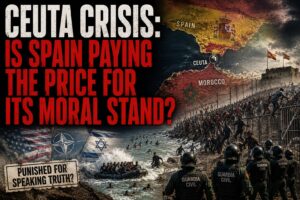
When tens of thousands of migrants crossed from Morocco into the Spanish enclave of Ceuta in late July 2026, leaving at least 57 people dead and a European territory completely overwhelmed, Western commentators rushed to file it under routine immigration disaster. Spanish Prime Minister Pedro Sánchez called the surge a direct breach of Spain’s territorial integrity. Local authorities struggled as thousands of people slept on sidewalks and in parks across the small North African enclave. But behind the tragic images of bodies washing ashore sits something far more deliberate. Spain isn’t experiencing some sudden administrative failure on its southern border. Madrid is being actively punished for refusing to fall in line with the foreign policy demands of Washington and Tel Aviv.
The timing here leaves very little room for coincidence. Over the past two years, Pedro Sánchez led one of the most principled diplomatic breaks within the Western alliance. Spain formally recognized the State of Palestine, cancelled major arms contracts with Israeli defense contractors, and repeatedly called Israel’s military campaign in Gaza a genocide. When conflict spread across the Middle East in early 2026, Spain stood almost entirely alone among European powers by refusing to let the United States use Spanish military bases to strike Iran. That refusal triggered serious retaliation from Washington, including open talk among American officials about potentially suspending Spain from NATO altogether.
“Weaponizing border security around Ceuta and Melilla represents the sharp edge of that punishment. Migration surges across border zones rarely just happen spontaneously.”
Rather than back down, Madrid doubled down on its commitment to international law instead. That kind of moral independence made Spain an urgent target for a coalition of actors interested in showing everyone else the cost of defying US and Israeli interests. Weaponizing border security around Ceuta and Melilla represents the sharp edge of that punishment. Migration surges across border zones rarely just happen spontaneously. They require organized coordination, deliberate neglect by border guards, and targeted social media amplification to mobilize huge crowds in a matter of hours.
The immediate public reaction from Israeli officials revealed a lot about what was actually driving this sudden escalation. Israel’s UN Ambassador Danny Danon took to social media to mock Madrid, claiming Spain declared a state of emergency over immigration while daring to lecture Tel Aviv on human rights. Danon explicitly demanded Spain explain why it still maintains colonial enclaves in Africa. The irony of a representative of an occupying power accusing another country of running illegal enclaves wasn’t lost on anyone watching. Spanish Transport Minister Óscar Puente captured the moment pretty simply, writing that everything was becoming remarkably clear all of a sudden.
The framework for using Morocco as leverage against Spain had actually been laid out openly months before the crisis hit. Following the 2020 Abraham Accords, Rabat built deep military and intelligence ties with Israel in exchange for diplomatic recognition of its claims over Western Sahara. That relationship forged a genuinely powerful strategic partnership across North Africa. Pro Israel voices in Washington and Tel Aviv clearly understood that Morocco held the physical keys to Spain’s territorial security.
Writing back in March, former Pentagon official Michael Rubin publicly suggested that Moroccans should send bulldozers to the border and march unarmed into Ceuta and Melilla to raise the Moroccan flag. Not long after, Amine Ayoub, a fellow at the Middle East Forum, published an explicit proposal on the Israeli news portal Ynet. Ayoub argued that Israel should actively help Morocco reclaim Ceuta and Melilla, noting that the timing was ideal given the growing friction between Washington and Madrid over Spain’s refusal to back military action against Iran. Ayoub stated plainly that helping Morocco recover the enclaves would serve American and Israeli interests while punishing a NATO member that chose obstruction over partnership. He closed by calling the whole move a strategic investment in a partner controlling one of the most vital maritime chokepoints on Earth.
“When a state uses human beings as political leverage to destabilize a rival, that’s coercive engineered migration.”
None of that was idle commentary. It reads a lot more like an explicit roadmap for hybrid warfare. When a state uses human beings as political leverage to destabilize a rival, that’s coercive engineered migration. Morocco has shown repeatedly that it’s willing to open border gates whenever it wants financial or diplomatic concessions from Madrid. By pairing Moroccan territorial ambitions with Israeli intelligence resources and American political cover, Spain’s adversaries built a multi layered pressure campaign designed to fracture Sánchez’s governing coalition from the outside.
The domestic fallout inside Spain was instant and brutal. Right wing opposition parties used the border breach to attack Sánchez as incompetent and soft on national security. Across the Atlantic, Trump seized on the images of border chaos to attack the Spanish government, holding up what happened in Ceuta as a cautionary tale for American voters. Meanwhile, conservative leaders across Europe jumped at the chance to demand harsher migration controls, further isolating Madrid within the EU.
The human cost of all this political maneuvering is genuinely devastating. Dozens of young people drowned or died in stampedes along the breakwater barriers at Tarajal Beach. Families were torn apart in the water as authorities deployed water cannons and tear gas to try to contain the chaos. But to the people behind this pressure campaign, those lives seem to register as little more than collateral damage in a much bigger geopolitical fight. Human suffering, to them, is just an effective way to force a sovereign European country back into line.
The message being sent to Madrid is pretty unambiguous. Defying the US Israeli strategic axis carries immediate, tangible consequences. If Spain keeps blocking military bases, banning weapons shipments, and calling out war crimes in Gaza, its own borders will get systematically destabilized in return. The engineered chaos at Ceuta functions as a direct warning to any other Western government thinking about pursuing an independent foreign policy grounded in international law.
Still, this whole episode exposes a real hypocrisy sitting at the heart of the international order. Powers that constantly lecture the world about sovereignty and rules based conduct are quietly orchestrating border crises to punish an ally for actually following international law. Spain’s refusal to take part in unlawful military aggression, or to stay silent during a humanitarian catastrophe in Gaza, represents genuine moral leadership. What happened at Ceuta proves that when diplomatic bullying fails to silence principled dissent, rogue strategic partnerships will readily turn to hybrid warfare instead, turning human desperation into a political weapon.
About the author:
Daniel Frost is a Foreign affairs columnist specializing in global geopolitics, European security, and strategic policy.