
By Adam Reed | International Affairs Analyst
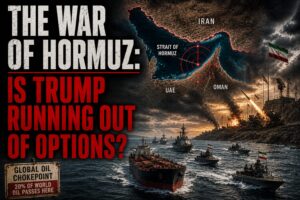
There’s an old saying that fits this moment almost too well, the bigger the hammer, the more everything starts to look like a nail you can’t actually hit. The crisis in the Strait of Hormuz has laid bare exactly how limited American military coercion really is in the modern era. After months of relentless airstrikes meant to force Tehran into surrendering its nuclear infrastructure, Washington now finds itself stuck in a strategic bind of its own making. The original war aims coming out of the Trump administration, wiping out indigenous Iranian uranium enrichment and seizing enriched stockpiles, have been completely overshadowed by a much more urgent economic problem, the global chokehold created by the blockade of the world’s most critical maritime oil corridor.
Having gone into this conflict with a massive edge in military spending, the United States has discovered that raw firepower alone can’t reliably guarantee safe passage through a narrow waterway sitting under constant threat from anti ship missiles, fast attack boats, and coastal batteries. With precision guided munition stockpiles running low, mounting political friction ahead of the domestic midterms, and energy driven inflation spikes threatening global markets, Washington’s appetite for endless escalation has basically disappeared. But because the administration remains philosophically opposed to sustained, direct diplomacy with Tehran, traditional bilateral negotiation doesn’t offer much of a path forward either.
When this conflict first launched, the administration’s stated goal centered on neutralizing Iran’s nuclear capability. In earlier rounds of diplomacy, Washington insisted on zero indigenous enrichment and the complete surrender of stockpiled material. Tehran refused those terms, which triggered a campaign of military escalation. In immediate response, Iran moved to assert operational control over the Strait of Hormuz, threatening commercial shipping passing through the narrow passage. Even though Tehran had repeatedly warned it would take exactly this kind of countermeasure during earlier standoffs, American military planners still seemed caught off guard, without any real operational way to reopen the waterway by force alone.
“Roughly twenty percent of the world’s petroleum and liquid natural gas supply moves through this narrow maritime bottleneck. As tanker traffic slowed to a crawl and maritime insurance rates shot up, global energy prices surged…”
The economic damage from a restricted strait compounds fast over time. Roughly twenty percent of the world’s petroleum and liquid natural gas supply moves through this narrow maritime bottleneck. As tanker traffic slowed to a crawl and maritime insurance rates shot up, global energy prices surged, triggering inflationary pressure across industrial economies everywhere. The White House’s central priority quickly shifted from forcing an ideological surrender on nuclear enrichment to just getting commercial transit reopened as fast as possible.
Solving this standoff by force, though, has turned out to be both mathematically and tactically unworkable. Even with a defense budget that dwarfs Iran’s military spending many times over, the US Navy simply can’t permanently neutralize every mobile missile launcher, drone swarm site, and midget submarine scattered along Iran’s rugged, thousand mile coastline. Every attempt to ratchet up military pressure risks provoking direct Iranian strikes on vulnerable energy infrastructure across neighboring Gulf states, an outcome that would permanently freeze global commodity markets.
Threats of expanded bombing campaigns targeting civilian infrastructure haven’t broken the deadlock either. The hardline leadership of the Islamic Revolutionary Guard Corps sees the broader confrontation through an existential lens. Believing American and Israeli objectives ultimately point toward complete regime change, Iranian decision makers have calculated that backing down under threat of bombardment just invites more aggression down the line. Under that logic, Iranian forces treat their operational leverage over the Strait of Hormuz as an essential deterrent, one that can’t be given up without a catastrophic loss of national security.
Given all these rigid constraints, the most pragmatically sound path for Washington is to step back and let Article 5 of the Islamabad Memorandum of Understanding run its course. Brokered with regional mediation, the Islamabad MoU explicitly hands the long term management of the Strait of Hormuz over to bilateral talks between Tehran and Muscat. Article 5 sets out that Iran will conduct direct dialogue with Oman to negotiate the future administration, security frameworks, and maritime services across the waterway, in consultation with other Gulf littoral states and in line with international maritime law.
“Brokered with regional mediation, the Islamabad MoU explicitly hands the long term management of the Strait of Hormuz over to bilateral talks between Tehran and Muscat.”
For the White House, outsourcing this whole framework to Oman is really a necessary concession to reality. Muscat has kept decades of operational neutrality intact, functioning as an effective bridge between the Gulf monarchies and Iranian leadership. Gulf Cooperation Council members understand Iranian strategic incentives with a lot more nuance than American planners do, and they’re desperately motivated to keep regional energy infrastructure from becoming permanent collateral damage in someone else’s fight.
Accepting this diplomatic off ramp, though, requires the United States to absorb a real, lasting shift in regional power dynamics. The prewar status quo, where Western naval power unconditionally guaranteed freedom of navigation at no real cost, is functionally finished. Whatever new normal emerges from the Muscat talks is almost certainly going to reflect Iran’s leverage over the waterway. Tehran has consistently signaled its intent to assert real operational sovereignty over maritime traffic, likely instituting mandatory transit and safety fees for commercial shipping moving through the strait, along with demanding that Western naval blockades on its own ports get lifted.
None of this is a great outcome for Washington or global shipping interests. Whatever agreement eventually gets finalized between Iran and Oman is going to remain inherently fragile. Commercial insurers will probably keep treating the Strait of Hormuz as a high risk zone for years, keeping maritime transport costs permanently elevated as a result. US sanctions regimes and regional military posture will likely stay largely entrenched too, while Iran quietly works to rebuild its defense industrial base for whatever confrontation comes next.
Still, letting regional diplomacy resolve this maritime crisis beats every other option currently on the table. Continued military escalation isn’t going to force the Islamic Revolutionary Guard Corps into submission, and it isn’t going to secure unhindered energy flow either. By letting Oman lead these administration talks under Article 5 of the Islamabad MoU, the United States can actually secure the reopening of global trade routes without dragging the Middle East into an uncontainable, open ended war of attrition.
About the author:
Adam Reed is an International affairs analyst focusing on geopolitics, defense strategy, and global security trends.