
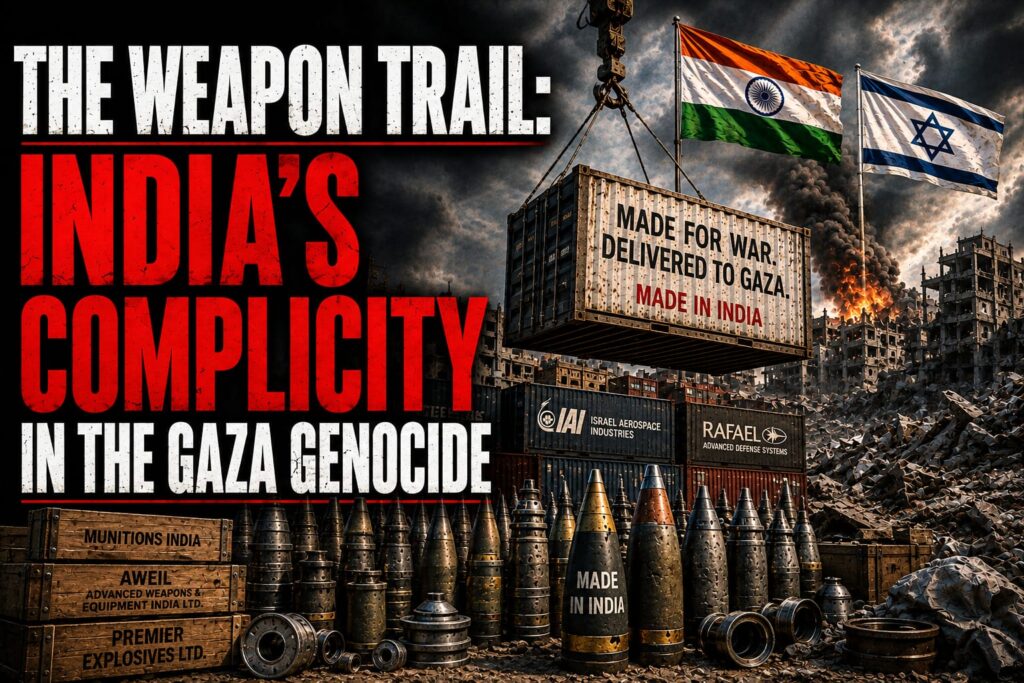
Defense Supply Chains, Ideological Convergence, and International Accountability
There’s an old warning that the hands that forge the sword share the guilt of the blood it spills. India, it turns out, has been forging swords by the hundreds of thousands. The exposure of India’s extensive, direct role in arming the Israeli military during its offensive in Gaza represents a genuine moral and strategic collapse. A detailed investigation by Amnesty International, published under the title The Supply of Weapons and Ammunition to Israel, lays out systematically how New Delhi went from passive observer to an active, indispensable engine inside Israel’s wartime supply chain. By supplying hundreds of thousands of military grade components, explosive ordnance, and drone warheads while military operations laid waste to Palestinian communities, India has effectively tied its own industrial output to an international human rights catastrophe.
The scale of this material support is vast, and it’s meticulously documented. Between October 7, 2023, and late November 2025, investigators tracked 2,596 distinct weapon shipments moving directly from Indian ports to Israeli arms manufacturers. The cargo manifests list 390,516 precision components for small arms, 564,970 explosive ordnance parts, including drone warheads and artillery shell casings, and nearly 300 specialized military vehicle assemblies. None of this moved into some neutral, anonymous market either. It went straight to the core pillars of the Israeli defense apparatus, Elbit Systems, Israel Aerospace Industries, and Rafael Advanced Defense Systems.
This flow of military hardware wasn’t limited to rogue private contractors working in legal gray zones somewhere. Wholly state owned Indian enterprises, created directly by the Ministry of Defence after restructuring the Ordnance Factory Board, served as central suppliers here. State entities like Munitions India, Advanced Weapons and Equipment India Ltd, and India Optel Ltd operated right alongside private defense firms like Premier Explosives Ltd and Kalyani Strategic Systems. When dock workers at Spain’s Cartagena port refused to let the commercial vessel Borkum dock in May 2024, customs records revealed it was carrying 20 tonnes of rocket engines and 12.5 tonnes of explosive rockets originating from Chennai, headed for Ashdod. That pipeline got tragically confirmed in physical terms in June 2024, when missile fragments bearing explicit Made in India markings were pulled from the ruins of a UN school in the Nuseirat refugee camp, after a strike there killed over thirty civilians.
“When a state manufactures, packages, and exports drone warheads and artillery casings used in heavily populated civilian zones, it becomes a direct accomplice to whatever destruction follows.”
This kind of deep integration into Israel’s war effort represents a total abandonment of India’s founding foreign policy principles. For decades, New Delhi positioned itself as a champion of the Global South, holding a firm, principled line against colonial occupation and consistently backing Palestinian statehood. That historic legacy has been completely dismantled under Prime Minister Narendra Modi. In its place, the ruling Hindu nationalist ideology has forged a genuinely toxic strategic alignment with Zionism, rooted in a shared, systemic hostility toward Muslim populations. This ideological convergence has turned foreign policy into an extension of domestic majoritarian politics, where anti Muslim rhetoric at home mirrors military collusion abroad.
As European nations faced mounting public outrage and moved to restrict arms transfers to avoid complicity in war crimes, India quietly stepped in to plug the manufacturing gap left behind. Under the banner of the Make in India initiative, joint ventures like PLR Systems and Alpha Elsec Defense got repurposed to combine Israeli military technology with cheap Indian manufacturing capacity. This relationship got formally locked in on November 4, 2025, when New Delhi and Tel Aviv signed a comprehensive memorandum of understanding on defense cooperation, expanding military industrial ties even as international courts investigated allegations of genocide. Modi’s public declarations of solidarity with Netanyahu, whom he routinely calls a dear friend, signal an explicit ideological brotherhood that overrides basic international law entirely.
This kind of active participation in Israel’s defense supply chain puts India in direct violation of its international legal obligations. Following the provisional measures ordered by the International Court of Justice, states were put on explicit legal notice to avoid transferring arms or components that could facilitate genocidal acts. As Amnesty International Secretary General Agnes Callamard put it, India hasn’t just failed to regulate its domestic defense sector according to international standards, it has intentionally deepened its industrial partnership during an active humanitarian catastrophe. Claiming ignorance isn’t really a viable defense anymore. When a state manufactures, packages, and exports drone warheads and artillery casings used in heavily populated civilian zones, it becomes a direct accomplice to whatever destruction follows.
The economic arguments coming out of strategic planners in New Delhi, who frame defense exports as routine commercial expansion, ring pretty hollow morally. No amount of economic ambition or technological transfer can justify manufacturing the munitions used to flatten civilian infrastructure, hospitals, and refugee shelters. By choosing to profit off the destruction of Gaza, India has traded its historic moral authority for short term industrial gains and ideological alignment instead.
“History isn’t going to judge New Delhi by its polished diplomatic statements at the UN or its rhetoric about global leadership. It’s going to judge India by the hundreds of thousands of weapon components shipped out of its own foundries…”
India’s transformation from a historic advocate of anti colonial liberation into an upstream supplier for a brutal military occupation is now fully out in the open. The shipping manifests, customs data, and missile fragments pulled from destroyed civilian sites leave an indelible record of responsibility behind. History isn’t going to judge New Delhi by its polished diplomatic statements at the UN or its rhetoric about global leadership. It’s going to judge India by the hundreds of thousands of weapon components shipped out of its own foundries to power an ongoing campaign of destruction, cementing its place as an active accomplice in one of the defining human rights tragedies of our time.