
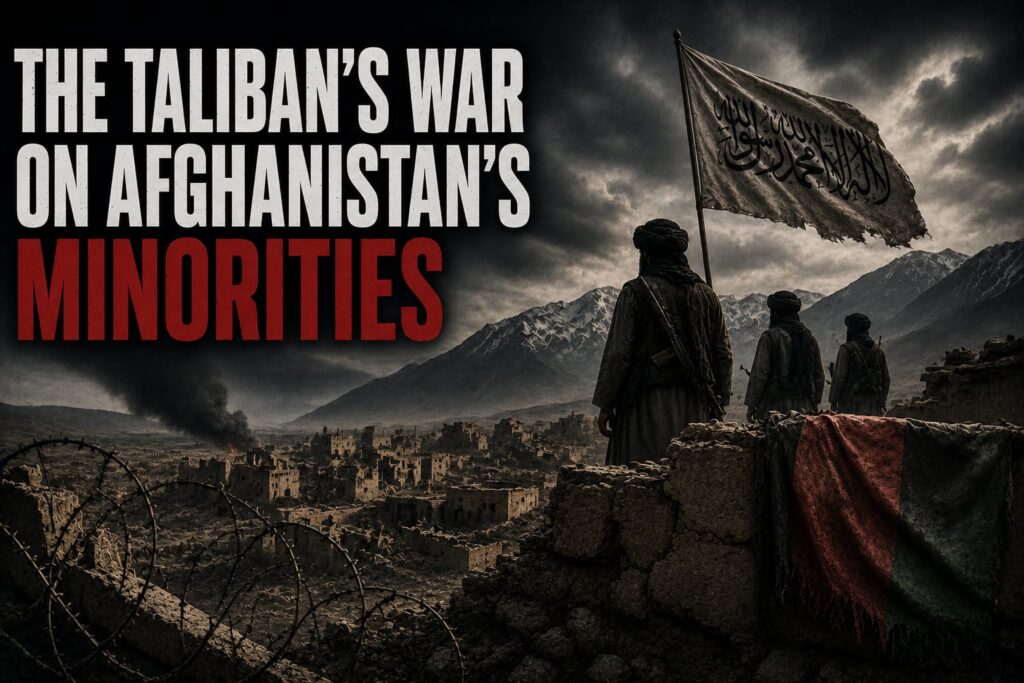
 The Taliban’s War on Afghanistan’s Minorities
Systemic Purging, Economic Exploitation, and the Fragility of Fiscal Ethnocracy
When the Taliban quietly moved Haji Jumma Khan Fateh out of his post as deputy governor of Zabul, the movement probably hoped the world would just see it as routine administrative reshuffling. It was anything but. Fateh, an influential Tajik commander with deep roots and a real network back in Badakhshan, wasn’t simply reassigned, he was deliberately sidelined and neutralized. His transfer south and eventual marginalization fit a pattern that’s become pretty clear at this point in how the Taliban actually governs, recruit non Pashtun figures to help conquer diverse northern territories, then systematically strip away their influence the moment their local authority or financial independence starts to look like a threat to Kandahar.
“Out of 1,215 senior and mid level officials mapped across the Taliban’s political and military hierarchy, a full 90 percent are Pashtun. Tajiks make up just 5.2 percent, and Uzbeks come in around 3 percent.”
This kind of systematic purging of non Pashtun figures reveals a regime built on plain ethnic favoritism rather than any real national unity. Data from the Middle East Institute’s Taliban Leadership Tracker lays out the exclusion pretty starkly. Afghanistan has never had a truly precise modern census, but standard demographic estimates put Pashtuns at roughly 40 to 45 percent of the national population. That gap is staggering. A movement claiming to govern a multiethnic country of over 40 million people has essentially locked power into the hands of a single ethnic group, leaving non Pashtun majorities almost completely shut out in their own homeland.
The whole regime operates a lot less like a sovereign government and a lot more like an occupying tribal cartel. Power isn’t distributed through institutions here, it’s hoarded in Kandahar, tightly held within Supreme Leader Hibatullah Akhundzada’s inner circle. High profile appointments handed to non Pashtuns tend to be little more than window dressing. Qari Fasihuddin Fitrat, a Tajik, carries the grand title of army chief of staff, but his presence in Kabul is largely decorative. The actual levers of hard power, operational command, the security apparatus, real strategic decisions, all stay firmly in the hands of Kandahar loyalists. Minority officials get titles. Pashtun clerics keep the actual authority.
Whenever non Pashtun commanders try to leverage their local standing or push back against this heavy centralization, the response from the regime tends to be swift and brutal. What happened to Mawlawi Mahdi Mujahid says it all. As the Taliban’s most prominent Hazara commander, Mahdi broke ranks after voicing frustration over how his community was being marginalized and disputing central command’s seizure of local economic assets in Balkhab. The regime didn’t negotiate. It hunted him down and executed him near the Iranian border. His death was a deliberate, bloody message to every non Pashtun in the ranks, absolute submission is required, and internal dissent gets met with lethal force.
Other commanders who were instrumental in helping the Taliban sweep across the north have met similarly grim fates. Uzbek commander Makhdoom Alam Rabbani was arbitrarily arrested, sparking violent local protests in Faryab. Salahuddin Ayubi was systematically pushed to the margins until he simply abandoned his post. Abdul Hamid Khorasani was stripped of authority after openly calling out ethnic discrimination inside the regime. In Badakhshan, investigative reporting documented the arrest of Tajik commander Ghulam Hussain along with the disarming of roughly 350 of his fighters. By stripping these commanders of both their weapons and their titles, Kandahar is methodically dismantling the local security networks that once protected non Pashtun communities.
“By arresting local Tajik figures and seizing control of valuable gold and lapis lazuli mines, Kandahar’s elite effectively turned northern mineral wealth into a private revenue stream for Pashtun loyalists.”
This ethnic purging is tightly bound up with economic exploitation too. The Taliban’s push for central control is fundamentally driven by a desire to monopolize Afghanistan’s rich natural resources, especially its mineral wealth. When the regime sent a 1,000 strong security unit into Badakhshan under the pretext of shutting down roughly 2,000 illegal mining sites, the real goal wasn’t environmental regulation or the rule of law. It was financial capture, plain and simple.
The regime insists its ongoing purge of thousands of Defense Ministry personnel is just budgetary streamlining. But the way these dismissals are so heavily concentrated in non Pashtun provinces like Badakhshan gives away the real story. This is a deliberate campaign of demographic and economic engineering. By converting natural resources into a tool for ethnic patronage, the Taliban has essentially built a textbook fiscal ethnocracy.
This whole model of governance is genuinely shortsighted and dangerously unstable. History has shown time and again that populations don’t tolerate perpetual subjugation forever. By systematically stripping Tajiks, Uzbeks, Hazaras, and Turkmen of political agency, economic livelihood, and basic physical safety, the Taliban is cutting every thread that keeps a multiethnic state from tearing apart. Excluded commanders don’t just disappear quietly once they’re demoted. They retreat to their home provinces carrying battle hardened fighters, deep knowledge of the terrain, and a long list of grievances that don’t fade with time.
The international community needs to wake up to what’s actually a ticking time bomb here. For years, foreign diplomats indulged the hopeful idea that pragmatists inside the Taliban would eventually build something resembling an inclusive government. That illusion needs to be put to rest for good. The UN Security Council has repeatedly noted that the lack of inclusive governance remains a major barrier to Afghanistan’s international recognition, but diplomatic statements on their own clearly aren’t going to change how Kandahar actually behaves.
Foreign powers, regional neighbors, and international institutions need to stop treating political inclusion like a polite suggestion or a soft diplomatic request. Any future engagement, sanctions relief, trade corridor, or mining partnership needs to be strictly tied to verifiable structural reforms. That means demanding transparent, representative provincial appointments, published and audited resource extraction contracts, and real, concrete human rights protections for minority populations.
The Taliban’s story that it has unified Afghanistan is a dangerous myth. By enforcing Pashtun dominance, silencing minority voices, and plundering northern wealth, Kandahar isn’t building stability. It’s setting the stage for the next phase of Afghanistan’s civil war. A government that treats more than half its population as a threat to be managed rather than citizens to be represented is inherently fragile by design. By building a state on the quicksand of ethnic exclusion, the Taliban is guaranteeing its own eventual, violent unraveling.