
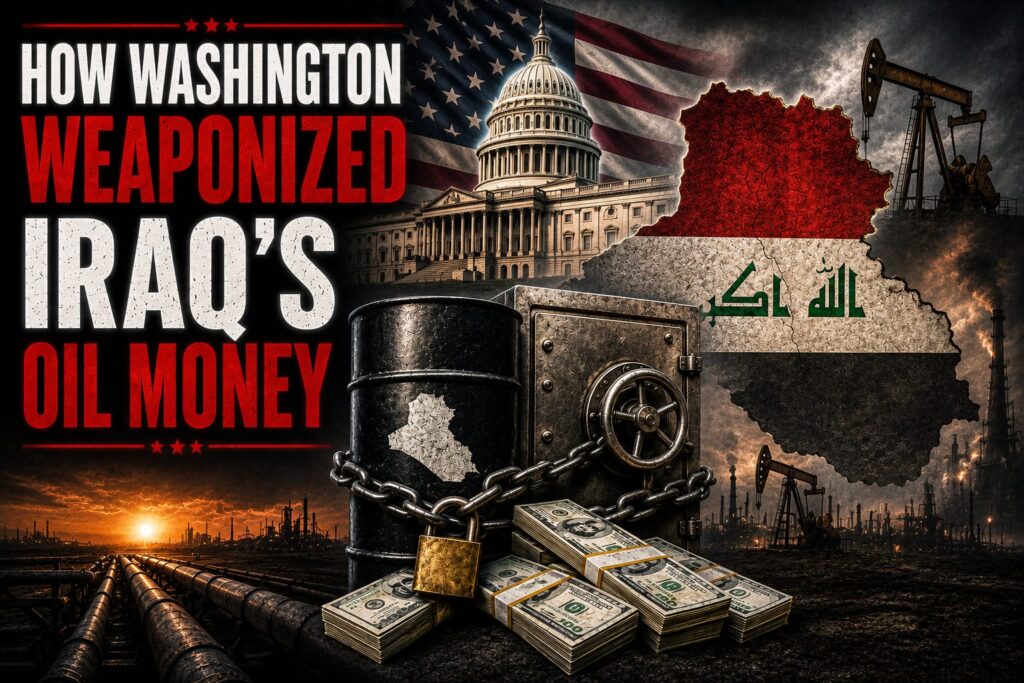
Financial Hegemony, Dollar Leverage, and the Structural Dismantling of Regional Proxies
These days it’s an American envoy, not Iraq’s own prime minister, who’s actually setting the clock in Baghdad. By September 30, the militias are supposed to disarm, the so-called Shiite Crescent is supposed to break apart, and Washington quietly walks away holding the oil money. That’s basically the deal on the table right now, and it says a lot about how American power actually works in the post-war Middle East these days.
What’s playing out between Washington and Baghdad is a genuine shift in how American dominance gets exercised. That September 30 deadline, demanding the full disarmament and dissolution of pro-Iranian paramilitaries, isn’t just some ambitious security goal on paper. It’s the formal rollout of a much bigger structural change in how the region gets controlled. This isn’t the old era of boots on the ground and nation-building anymore. Washington’s found a quieter, more effective way to project power, through total, silent control over financial infrastructure, bending sovereign states into shape using the plumbing of the global banking system instead of tanks.
“Since the 2003 invasion, Iraq’s oil revenues, which fund roughly 90 percent of the country’s entire operating budget, have flowed straight into an account managed by the Federal Reserve Bank of New York.”
At the heart of this whole squeeze is a pretty blunt realization Washington seems to have made, that controlling Iraq’s money is a lot more effective than parking tens of thousands of troops in its deserts ever was. For over twenty years, that setup was sold as a stabilization measure, something meant to protect Iraqi assets from international lawsuits. Today, under US Special Presidential Envoy Tom Barrack, that same account has turned into a tool for total strategic leverage.
The actual power dynamics inside Baghdad’s Green Zone have basically flipped upside down. Prime Minister Ali al-Zaidi technically sits in the seat of executive power, but it’s Washington’s hand actually turning the dial. When the US Treasury abruptly froze a cash shipment of nearly 500 million dollars in Iraqi oil proceeds, it showed exactly how fast Baghdad can be pushed right up to the edge of financial insolvency. Add in unresolved compliance issues and targeted sanctions against key Iraqi financial institutions, and Washington has built a framework where Iraqi leadership barely has room left to maneuver at all. A prime minister trying to hold together a fragile coalition while facing the threat of financial strangulation across state institutions doesn’t have a lot of options besides falling in line with whatever the envoy’s script says.
“The Popular Mobilization Forces, an umbrella group of roughly 238,000 fighters pulling in upwards of 3.6 billion dollars a year in state salaries, have long served as the military backbone of Iranian influence inside Iraq’s own state apparatus.”
This economic squeeze is aimed at pulling off something twenty years of actual military force never managed, permanently neutralizing Tehran’s proxy network inside Iraq for good. Factions like Kataib Hezbollah and Harakat Hezbollah al-Nujaba have operated with basically zero accountability for years, using state-funded payrolls to build a parallel security structure loyal to Tehran instead of Baghdad.
By going after the dollar pipeline feeding this whole payroll, Washington is driving a genuine wedge into the movement’s foundation. Once liquidity gets unreliable, the social contract holding rank-and-file fighters loyal to these groups starts to crack. Smaller factions have already agreed to hand over their weapons to state authority, while the hardline holdouts are left staring down a bleak choice: total financial isolation or the very real possibility of direct strikes from American special forces.
The domestic crackdown happening inside Baghdad shows just how deep this whole strategy actually cuts. Elite Counter-Terrorism Service units recently sealed off the Green Zone and detained dozens of high-ranking officials and sitting parliamentarians, a clear signal of an aggressive push to purge the systemic corruption that’s long propped up the proxy economy in the first place. Corruption in Iraq was never just a garden-variety governance failure. For two decades it’s functioned as the main financial bypass letting billions of dollars quietly bleed across the border into Iran, softening the impact of Western sanctions the whole time. By shutting down these illicit financial channels and rolling out high-profile corruption prosecutions, Washington is systematically draining the exact reservoir that’s been keeping Tehran’s regional network afloat.
“Cut Baghdad loose from Tehran’s orbit, and the entire logistical, military, and economic bridge connecting Iran to the Levant basically collapses.”
This whole campaign inside Iraq really needs to be understood as the decisive move in taking apart what’s often called the Shiite Crescent. For twenty years, that strategic land bridge stretched uninterrupted from Tehran through Baghdad and Damascus all the way to the Mediterranean coast in Beirut. With Syria drifting further from its old resistance posture and Lebanon under heavy internal and external pressure to neutralize non-state weapons, Iraq is left standing as the central vertebra holding that whole geopolitical spine together.
At the same time, all this aggressive posturing signals a return to a deeply transactional, resource-focused foreign policy. Pushing major American energy companies like Chevron to expand their footprint in key southern oil fields and lock down major gas and power contracts makes it pretty obvious that security demands here are explicitly tied to commercial gain. And holding onto military bases in Erbil ensures that even if Washington scales back its administrative footprint in Baghdad, it still keeps a permanent, heavily armed foothold right on Iran’s border, sitting directly on top of the Kurdistan Regional Government’s energy corridors too.
Whether this financial offensive actually produces a genuinely sovereign Iraqi state, or just swaps out one foreign patron for another, is still an open question worth asking. What’s not really up for debate anymore is that the era of murky, state-sanctioned proxy warfare inside Iraq has hit an absolute breaking point. That September 30 deadline isn’t a polite diplomatic suggestion. It’s a hard ultimatum, backed by the full weight of the global dollar system. Washington’s making it pretty clear it intends to redraw the map of the Middle East, using Iraq’s own sovereign wealth as the lever to force a new regional order onto both Baghdad and Tehran.