
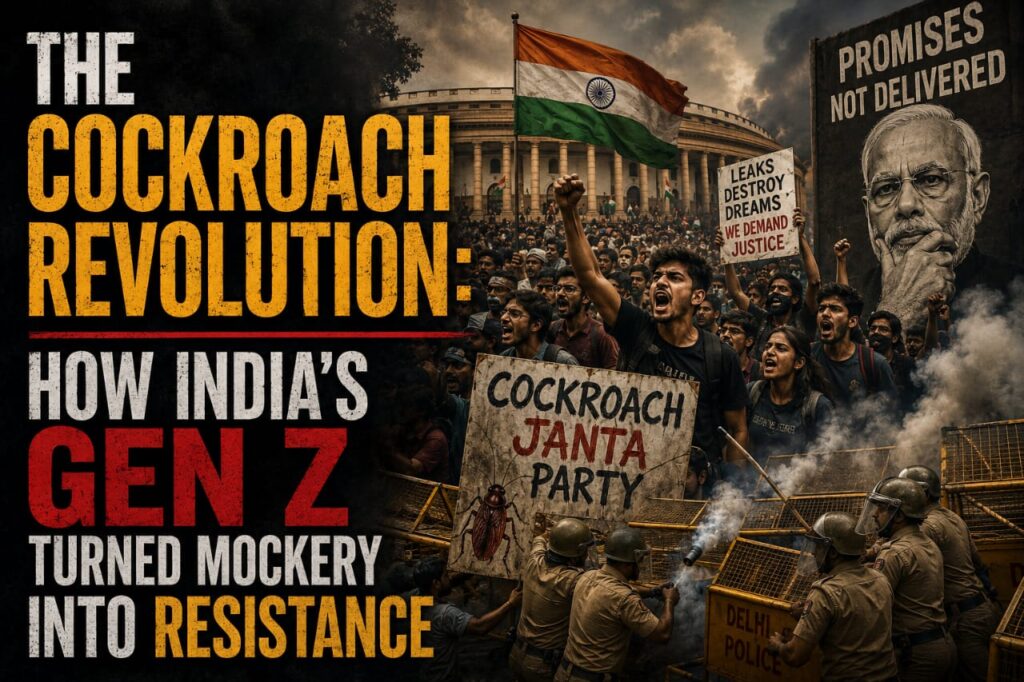
How India’s Gen Z Turned Mockery into Resistance
1. The Siege of New Delhi
Is India’s Gen Z finally waking up? Watching what’s unfolding on the streets of New Delhi right now, it genuinely looks like India’s Gen Z is finally waking up against authoritarianism. The fragile image of the world’s largest democracy is cracking under the weight of it. The roads leading to Parliament look less like the heart of a secular republic and more like an occupied zone. Over a hundred thousand young people, fired up by the viral, defiantly funny Cockroach Janta Party, have flooded the capital. And what they’ve gotten in return isn’t dialogue—it’s tear gas in their faces, batons cracking down on peaceful crowds, and layer after layer of barricades sealing off public space. This is what the Modi government reaches for the second it’s actually confronted with its own failures: not accountability, but repression.
2. The Catalyst: The National Exam Leak Crisis
What set all this off is a genuinely catastrophic breakdown in India’s national exam system. A string of high-stakes leaks has wrecked the futures of millions of young people who spent years grinding toward competitive medical school entrance exams and civil service placements. Just last month, over two million students were forced to retake exams after fraud tore through the evaluation process. For these kids, this isn’t some minor bureaucratic hiccup. It’s theft, plain and simple—theft of their years of work, their shot at social mobility, and their peace of mind. In a country where a government job or a medical seat is often the only real way out of economic stagnation, letting these exams get compromised is an unforgivable betrayal of trust.
3. Out of the Shadows: The Birth of the Cockroach Janta Party
Arrogance turned into resistance. Instead of owning any of the institutional rot, the ruling party has just dug in. Education Minister Dharmendra Pradhan is facing growing calls to resign and he’s just going quiet, hiding behind bureaucratic silence while a prime minister who treats dissent like a security threat runs cover for him. What’s remarkable is how this whole movement was actually born out of the ruling class’s own arrogance. Back in May, India’s Chief Justice Surya Kant reportedly compared unemployed, protesting youth to cockroaches and parasites. Rather than swallow that insult, India’s extremely online Gen Z turned it right back around, launching the Cockroach Janta Party as a sharp, satirical jab at Modi’s BJP. What started as an online joke has grown into the most serious street-level challenge Modi has faced since starting his third term.
The Voice of Conscience: At the emotional center of all this is Sonam Wangchuk, a deeply respected fifty-nine-year-old climate activist and education reformer from Ladakh. His body visibly wasting away became a silent, devastating indictment of just how little the government actually cares. Even from a hospital bed, Wangchuk hasn’t backed down. He’s still fasting, sending out handwritten notes calling on the government to show even a shred of basic democratic decency.
4. Stonewalling inside Parliament & The Human Cost
A systematic shutdown of accountability. When the monsoon session opened, opposition lawmakers pushed for an immediate, transparent debate on the exam scandal. Instead of allowing that conversation, the government chose disruption and adjournment. Outside, police moved fast to detain Cockroach Janta Party founder Abhijeet Dipke, hauling him away even as other student representatives were trying to squeeze in a brief ten-minute conversation with Health Minister JP Nadda. Stonewalling inside the chamber and swinging batons outside it, at the same time, that’s a government that clearly sees accountability itself as a weakness.
The devastating human cost. Protesters aren’t just asking for structural reform anymore; they’re demanding real financial compensation for the families of students who took their own lives after their exams got cancelled. The crushing psychological weight of these exams, layered on top of knowing the whole system is rigged in favor of whoever can buy leaked papers on the black market, has pushed vulnerable young people to the edge and past it. When a government’s own mismanagement and institutional rot start actually killing its youth, it forfeits any real claim to legitimacy. Samajwadi Party chief Akhilesh Yadav put it plainly when he called the police crackdown deeply disheartening, urging people to stand firmly behind these traumatized students.
5. Stripping the Monopoly on Patriotism
The illusion of total control. By turning the full weight of the state against its own children, the Modi government is revealing exactly how insecure it actually is underneath all the strongman posturing. Authoritarian regimes need the illusion of total control to survive, and they’re genuinely terrified of decentralized, organic movements that can’t be bought off or scared into silence. The kids marching toward Parliament are waving the Indian flag and invoking the memory of Bhagat Singh, and in doing that, they’re quietly stripping the ruling party of its self-proclaimed monopoly on patriotism. They’re exposing this government’s ‘rules-based order’ talking point for exactly what it is: a hollow slogan built to hide cronyism and pure incompetence.
6. Looking Past the PR Campaigns
The world needs to look past New Delhi’s polished PR campaigns. A government that treats its own brightest students like rioters, and its most respected reformers like public nuisances, is a government in serious moral decay. When Abhijeet Dipke told the crowd that Delhi is full of cockroaches now, that wasn’t just a clever slogan anymore. It’s a promise—a stubborn, collective refusal to back down. India’s young people are proving, day by day, that they can’t be crushed and they can’t be swept under the rug. They’ve looked an authoritarian state dead in the eye, refused to comply, and decided to become the heroes of their own story instead.