
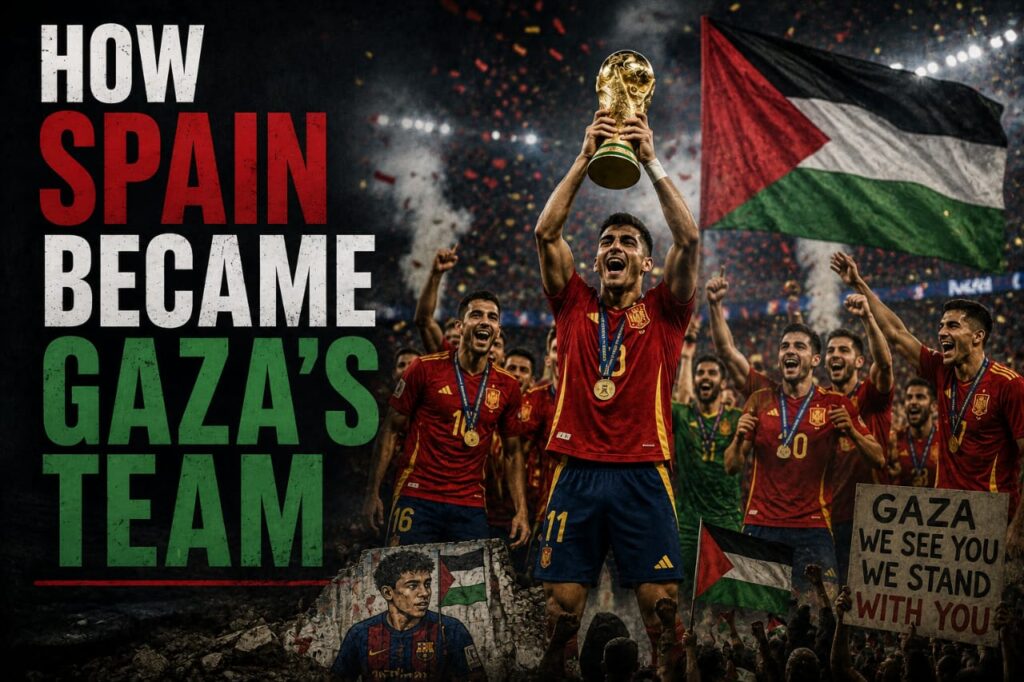
The 2026 World Cup Final, Symbolic Solidarity, and the Politics of the Pitch
The FIFA World Cup final at MetLife Stadium in New Jersey was supposed to just be about football. Defending champions Argentina lined up against a relentless Spanish side, and on the pitch, the whole thing came down to a single Ferran Torres goal in the 106th minute of extra time. But long before the final whistle blew on Spain’s 1-0 win, this match had already stopped being just a match.
The 2026 final turned into a global proxy battle, mirroring how deeply split the world has become morally and politically over the war in Gaza. For millions of people who’ve come to view world events through the lens of Palestinian suffering, this wasn’t simply two great footballing nations meeting on a pitch. It felt like a symbolic clash between a country that stood up for Palestine and one that tied itself openly to Israel. When Spain lifted the trophy, it landed for a huge global audience like a rare, cathartic win, not just for football, but for Palestine itself.
Sport has never really existed in its own bubble, no matter how much officials like to pretend otherwise. We carry our histories, our identities, our deepest moral instincts right into the stadium with us. Gaza has rearranged the moral map of the entire world, changing how people see institutions, celebrities, even national teams. In the run-up to this final, people online weren’t organizing around formations or stats, they were organizing around the actual foreign policies of Madrid and Buenos Aires. And the split was stark, spontaneous, and completely uncompromising. On one side stood a Spanish government that showed a level of moral clarity almost unheard of in the Western political establishment. Prime Minister Pedro Sánchez formally recognized the State of Palestine, put a domestic arms embargo on Israel in place, and used the word genocide openly to describe what’s happening in Gaza. That took real political courage, and it deserves to be said plainly.
“That courage earned Spain deep, genuine admiration across the Global South and among pro-Palestine activists everywhere. Almost overnight, the red jersey became an unlikely symbol of solidarity.”
And that feeling only deepened thanks to teenage star Lamine Yamal. Months before the final, Yamal made headlines waving a Palestinian flag during Barcelona’s title celebrations, a small gesture that landed with enormous weight. It resonated so hard that Palestinian artists in the Al Shati refugee camp actually painted a mural of him on the rubble of a destroyed building. For people living under bombardment and starvation, seeing someone at the very top of world football hold up their flag was a real, powerful counter to being ignored.
On the other side of this divide was an Argentine political establishment that had tied itself aggressively to the Israeli government. Under President Javier Milei, Argentina underwent a genuinely radical geopolitical shift, with Milei openly calling himself the most Zionist president in the world at the exact moment the international community was reckoning with the scale of destruction in Gaza. And that alignment went well past rhetoric. Just days before the final, Netanyahu publicly endorsed Argentina, revealing he’d received an official national team jersey from Argentina’s ambassador to Israel, Rabbi Shimon Axel Wahnish. Netanyahu, currently facing an ICC arrest warrant for war crimes, said openly that Israel had no better friend than Milei’s government. That kind of public embrace from such a controversial figure is what cemented Argentina’s image, fairly or not, as the team representing the status quo in a lot of pro-Palestine eyes.
It’s genuinely hard, though, not to feel for the Argentine players and fans caught in the middle of all this. Most of them never chose to be political symbols. They just wanted to defend a World Cup title, and instead they found themselves absorbing global anger that really belongs to Milei’s government, not to them personally. Diego Maradona spent his whole life as an outspoken supporter of Palestine, and plenty of Argentine fans were quick to point out that Milei doesn’t speak for an entire nation of forty-five million people. That’s a fair point, and it’s worth holding onto. But once a narrative like this takes hold, it’s brutally hard to shake, and Argentina’s squad ended up wearing a political weight that had far more to do with their president’s Twitter feed than anything they actually stood for on the pitch.
“Adding to that weight were older, uncomfortable diplomatic patterns that commentators quickly dug up… The same handful of governments that keep resisting accountability for historical wrongs were suddenly standing side by side on a football pitch.”
Earlier in the year, when a landmark UN resolution addressing the transatlantic slave trade and calling for reparatory justice came to a vote, 123 nations voted in favor. Only three voted against it worldwide: the United States, Israel, and Milei’s Argentina. For anyone watching the World Cup through a political lens, that pattern was impossible to ignore. Even the sport’s biggest legends got pulled into the comparison. Old photos of Lionel Messi placing a note in the Western Wall in occupied East Jerusalem during a 2013 visit resurfaced and spread fast online. The picture was over a decade old, but images take on a strange new life during moments of crisis.
The contrast people drew was immediate and emotional: the veteran Messi visually tied to the holy sites of an occupying power and to Israeli sponsorships, against the young Yamal, unapologetically holding up the Palestinian flag during the biggest moment of his young career. It’s a genuinely unfair comparison in a lot of ways, since Messi himself has never made the kind of political statements Yamal has, but that nuance rarely survives the speed of social media.
That symbolic weight was felt most powerfully inside Gaza itself. Despite catastrophic electricity shortages, severe fuel scarcity, and sports infrastructure that’s been almost completely destroyed, Palestinians still organized viewing parties in refugee camps to cheer Spain on. People told reporters plainly that they were backing Spain because Madrid was the one government that refused to look away from their suffering. When Torres scored that winning goal, celebrations broke out across camps full of displaced families. Even high-profile figures like former UFC champion Khabib Nurmagomedov publicly backed Spain, tying the win to something much bigger than football for the pro-Palestine movement worldwide.
“At the end of the day, a football match can’t actually deliver justice. Spain’s win doesn’t rebuild a single home in Gaza, lift a blockade, or feed a single starving child. It’s important not to confuse pure symbolism with real structural change.”
But people live, hope, and resist through symbols—that’s just human nature. At a moment when international legal institutions move painfully slowly and powerful vetoes keep blocking real political paths to peace, symbolic wins carry enormous emotional weight. This final proved the global public isn’t willing to separate entertainment from ethics anymore, not fully. By beating a team explicitly backed by Israeli leadership, Spain handed millions of people who feel powerless in the face of global hypocrisy a genuine, if fleeting, moment of validation.
Gaza has changed how the world watches football, permanently, and on that pitch in New Jersey, the side carrying the hopes of the oppressed walked away as champions, even as an Argentine squad that never asked for any of this politics found itself carrying a burden that was never really theirs to bear.