
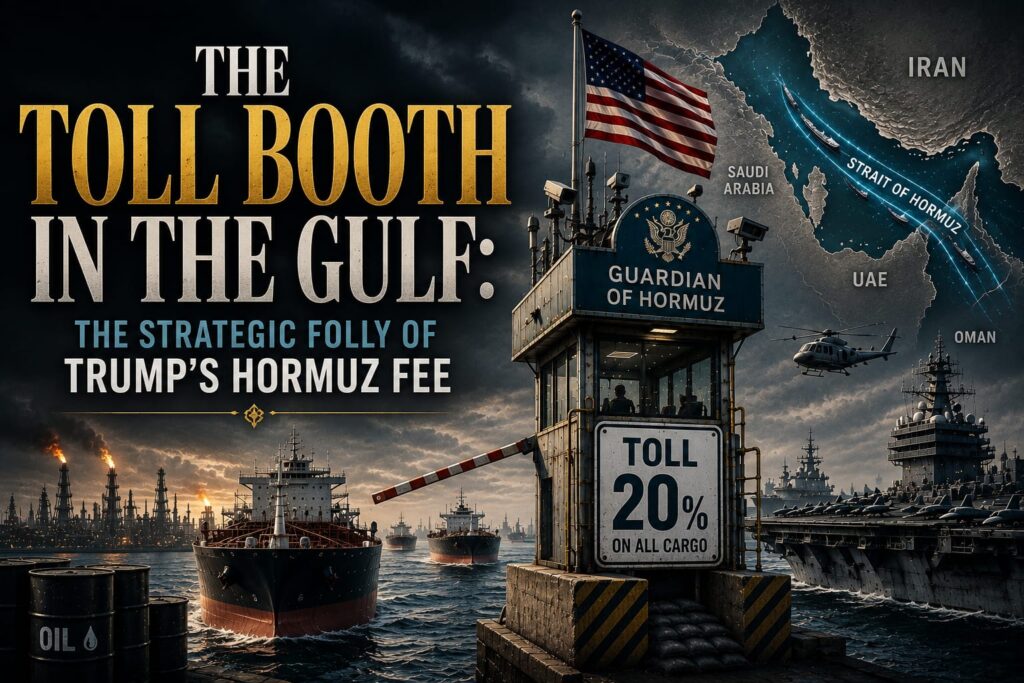
Global energy trade has always been at the mercy of geopolitical theater, but what’s happening in the Persian Gulf right now has taken things to a genuinely absurd level. The most critical choke point in the world’s oil supply chain has basically turned into a stage for political stunts. With the fragile June ceasefire between Washington and Tehran now completely broken, US forces have carried out a third straight night of air strikes across southern Iran. Explosions have hit the port city of Bandar Abbas, along with strategic sites on Kish and Qeshm islands. At the heart of all this is a fight over who actually controls the Strait of Hormuz, the waterway that roughly a fifth of the world’s oil passes through every single day. But even as bombs keep falling, the whole strategic picture has gotten muddled by a bizarre new policy move out of the White House, one that essentially tries to turn a critical international waterway into a private toll road.
President Trump’s announcement that the United States would now call itself the Guardian of the Hormuz Strait came packaged with a very Trump style demand right behind it. In a post on Truth Social, he said the US should be reimbursed at a rate of 20 percent on all cargo shipped through the strait, framing it as compensation for the cost of policing the region militarily. The idea falls apart almost immediately, both logistically and legally. Unlike man made canals like the Suez or Panama, which run under strict sovereign administrative systems built up over generations, the Strait of Hormuz is legally an international strait, governed by the transit passage rules laid out in the UN Convention on the Law of the Sea. Even inside Trump’s own administration, the idea seemed to catch people off guard. Just before the announcement went out, Secretary of State Marco Rubio had explicitly said that no country gets to charge tolls on an international waterway, stressing that doing so would be a clear violation of international law.
Unsurprisingly, the 20 percent toll idea landed in Tehran like a gift. Iranian Foreign Minister Seyed Abbas Araghchi wasted no time jumping on the opening, sarcastically agreeing with the general premise while flipping who should actually get paid. He joked online that whoever actually guards the waterway deserves to be compensated, then reminded Washington that Iran has always been the true guardian of the strait and always will be. He went on, dripping with sarcasm, to call Trump’s proposed fee way too steep, promising that Iran would be far more fair in whatever fees it decided to collect instead. The whole exchange is a pretty good example of how easily American transactional posturing can be turned around and used against Washington, chipping away at its traditional role as the protector of open global waterways.
Underneath all this rhetorical sparring, the actual physical conflict keeps escalating in serious ways. US Central Command has resumed its naval blockade of Iranian ports, the same kind of blockade that intercepted or redirected more than 140 vessels the first time it ran, from mid April through June. Trump’s insistence that the strait is open and will stay open runs directly into the reality on the water, where Iran has formally declared the passage closed until further notice. There’s already been a real human cost too. A recent Iranian missile strike hit two commercial tankers inside the strait, killing an Indian crew member and injuring several others, which drew sharp condemnation from the United Arab Emirates.
For the Gulf states sitting right next to all this, the whole situation feels existential. Saudi Arabia, Qatar, the UAE, Kuwait, and Bahrain are getting squeezed from both directions at once. On one side, there’s a US president who seems to view alliance security almost like a protection racket, expecting reimbursement fees in exchange for military backup. On the other side, there’s a defensive, increasingly aggressive Iranian military making direct threats. Colonel Ebrahim Zolfaqari, speaking for Iran’s Khatam al Anbiya Central Headquarters, issued a genuinely chilling warning to regional governments recently, saying that any cooperation with America, including logistical support for what he called its aggressive army, would be treated as an act of war against Iranian sovereignty. With regional states essentially being told they’ll get dragged into the fighting if they help US operations in any way, there’s almost no room left for careful diplomatic maneuvering anymore.
All of this pressure has pushed regional players to start looking for permanent ways out of the trap they’re stuck in. Rather than staying dependent on an unpredictable Washington or hoping for restraint out of Tehran, countries like the UAE are actively working to route around the volatile strait entirely. The UAE has quietly sped up plans for a massive, multi purpose port along the coast at Fujairah, deliberately positioned outside the Persian Gulf so it can bypass the choke point altogether. It’s a pretty telling sign that America’s own regional allies are starting to lose confidence in the security system Washington claims to be protecting in the first place.
What makes the whole situation particularly frustrating is that it’s almost entirely self inflicted, the product of a US administration that keeps confusing aggressive posturing with an actual coherent strategy. By turning something as complex as international maritime law into a glorified toll booth, the White House has managed to alienate its own regional allies, hand Iran an easy talking point, and rattle global energy markets, all in one move. If the United States genuinely wants to rebuild trust and protect global trade routes, it needs to drop the fantasy of collecting fees on international waters and get back to the slower, less glamorous work of actual multilateral diplomacy. Otherwise, the title Guardian of the Strait is going to end up being nothing more than an empty phrase, drawn in the sand while the region keeps sliding closer to a much wider, much more catastrophic war.