
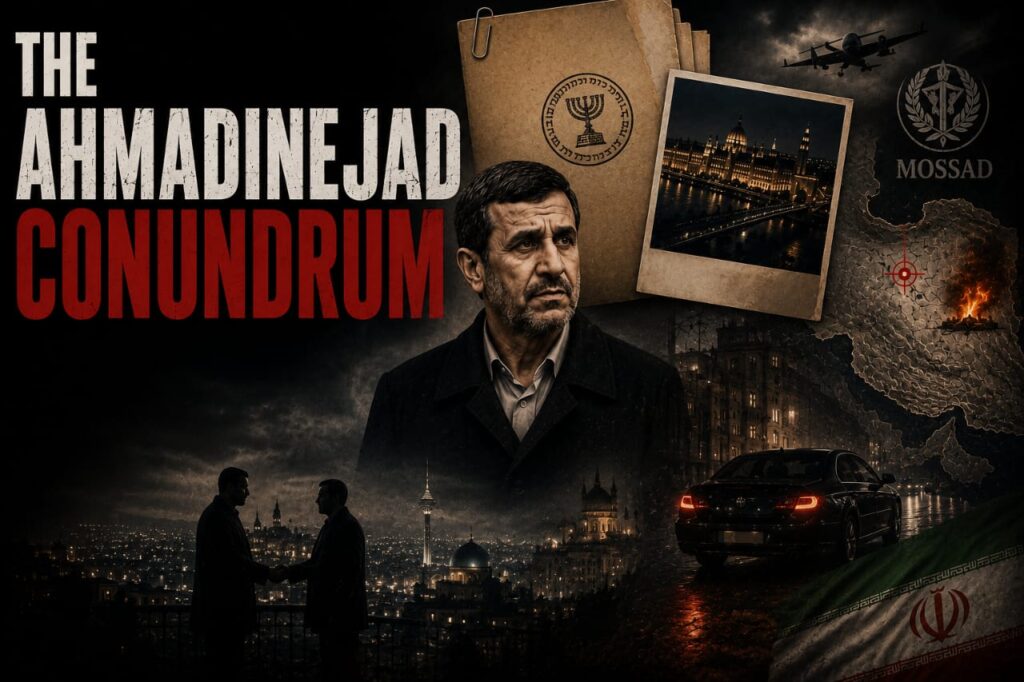
Western media’s credibility has already taken a beating lately, but this latest round of reporting might finish the job. The story making the rounds in major outlets right now is so over the top it belongs in a screenplay, not a news section. We’re supposed to believe that Israel’s Mossad spent years quietly grooming former Iranian President Mahmoud Ahmadinejad to eventually take over as the leader of a post theocratic Iran. Supposedly then Mossad chief David Barnea even skipped critical wartime meetings just to secretly meet him in Budapest. And then, according to this tale, an Israeli airstrike hit Ahmadinejad’s compound, and Mossad operatives swooped in and pulled him out in a black Peugeot. He was allegedly taken to a safe house, only to walk away on his own after having some kind of crisis of conscience about Israel’s vision for Iranian democracy. This whole thing is packed with claims that fall apart the second you actually think about them. It reads a lot less like investigative journalism and a lot more like a psychological operation meant to sow paranoia inside the Iranian state. Sun Tzu wrote centuries ago that all warfare is based on deception, and this story feels like a pretty literal example of that.
To someone just skimming the headline, the basic premise might seem believable on the surface. Ahmadinejad really is an odd figure politically, a hardline conservative who’s also spent years positioning himself as a kind of rebel against the establishment under the Supreme Leader. So in theory, sure, he could appeal to both hardliners and people fed up with the status quo. But real politics runs on structural constraints, not screenwriting logic. The idea that someone of his profile could repeatedly slip past the Islamic Revolutionary Guard Corps to hold secret meetings with Israeli intelligence just doesn’t hold up.
The Guard Corps has definitely had intelligence failures over the years, nobody’s arguing they’re flawless, but they’re not incompetent either. Ahmadinejad isn’t some low level scientist or mid tier government employee who could plausibly slip through the cracks. His falling out with Ayatollah Ali Khamenei didn’t happen because he was some outside dissident. It happened while he was still deeply embedded in the system, actively trying to expand presidential power from within. That actually makes him a bigger domestic threat than reformists like Mohammad Khatami or Hassan Rouhani ever were. Someone with that kind of political weight doesn’t move around without constant, invisible surveillance. The idea that his security detail was somehow shaken during European trips, or that foreign agents casually pulled off an extraction in an eye catching vehicle in the middle of Tehran, is a stretch that’s hard to take seriously. Cardinal de Retz, the seventeenth century French political strategist, once made an observation that fits perfectly here: people’s suspicion is most often rooted in fear. Iran’s security apparatus knows exactly how unpredictable Ahmadinejad’s ambitions have historically been, and there’s no version of reality where they’d let an asset that valuable move around unwatched.
The most movie like part of the whole story is the emotional arc they give him. Supposedly he willingly walked into a Mossad safe house, then just as suddenly walked back out after having some kind of moral awakening about foreign intervention. That twist is awfully convenient for whoever wrote this, since it neatly explains why their supposed prized defector is currently lying in state at a funeral in Tehran instead of leading some government in exile somewhere. Painting Ahmadinejad as some naive political newcomer who suddenly saw the light about Western and Israeli intentions doesn’t track at all. This is a man who ran the country for eight years, who watched the chaos that followed the 2003 invasion of Iraq up close, and who saw firsthand what Western led regime change actually leaves behind. Suggesting he somehow didn’t understand how foreign backed transitions of power actually work is honestly a little insulting to anyone paying attention. He understands, probably better than most, the old Lenin line about how a lie repeated often enough starts to sound like the truth, and he’s well aware of the long history of outside powers using local figures as disposable stepping stones.
The story also leans on a pretty thin reading of Iranian domestic politics to explain why he’d supposedly turn traitor in the first place. It suggests his frustration after the Guardian Council rejected his nomination papers is what pushed him toward collaborating with foreign intelligence. That badly misreads how Iranian politics actually works. Getting your candidacy rejected is a routine part of the system’s filtering process, not some career ending humiliation. Former Parliament Speaker Ali Larijani, for example, had his papers rejected in both 2021 and 2024, and he’s still very much a central figure in the establishment. Ahmadinejad’s real friction with leadership peaked more than a decade ago during his second term as president. A routine electoral disqualification doesn’t suddenly transform a lifelong revolutionary into an agent working for a hostile intelligence service.
The timing of this whole narrative says a lot about what it’s actually for. In modern conflict, information itself gets weaponized to widen internal cracks. By putting out an elaborate betrayal story involving a major political figure, whoever’s behind this is clearly trying to spark an internal witch hunt inside Iran’s security establishment. It’s a pretty classic move, designed to breed suspicion among elites and force the state to turn its energy inward on purges instead of anything else. The real target here isn’t military, it’s psychological, aimed squarely at eroding a country’s confidence from the inside. It brings to mind something the Roman historian Tacitus once wrote, that once a crime is exposed, boldness becomes its only refuge. This story leans entirely on that kind of boldness to make up for its complete lack of actual evidence.
At this point, a lot of international media has drifted from objective reporting into something closer to an amplifier for state backed influence campaigns. Publishing anonymous accounts full of black sedans, secret meetups, and sudden bursts of moral clarity isn’t journalism, it’s fiction dressed up as a scoop. The idea of a former hardline president secretly turning into a covert intelligence asset just doesn’t survive contact with geopolitical reality. It relies entirely on dramatic beats to paper over how little actual substance is behind it. In the end, this story doesn’t expose some security failure in Tehran. It exposes how desperate a certain kind of information strategy has become, one that now needs unconvincing fiction just to try to cause real disruption.