
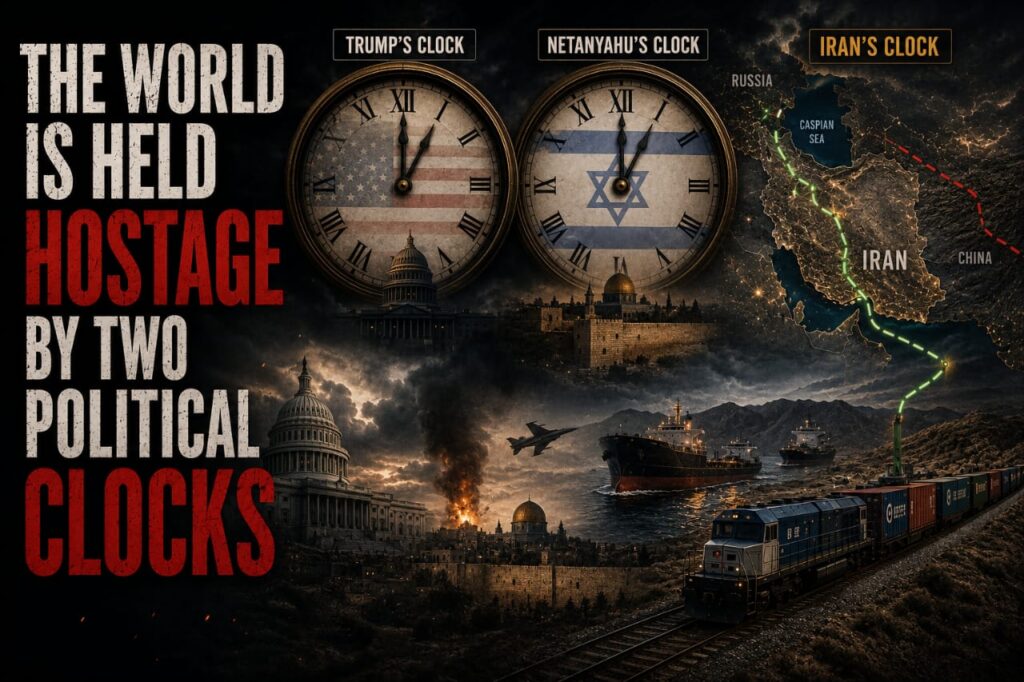
Sophocles said something twenty five centuries ago that still holds up scarily well: pride breeds the tyrant. And weirdly enough, that ancient line is basically playing out right now through two very modern leaders who both happen to be fighting for their political and legal survival at the same time. Donald Trump and Benjamin Netanyahu are both racing against tight electoral and judicial clocks, and those personal timelines keep crashing into something much slower and more patient: Iran’s long game. It says a lot about the state of modern statecraft that individual political ambitions are trying to force fast solutions onto problems that are anything but fast. And the results, unsurprisingly, keep getting messy.
Start with Trump. The midterms on November third are shaping up to be a serious test of how much legislative and political muscle he actually has left. The environment isn’t friendly right now either. Generic ballot polling has the Democrats holding a fairly steady lead of about four points, a number that’s basically stuck since spring and represents roughly a six point swing against Trump’s side since his term started. Most forecasters think the House is genuinely in play for a flip. The Senate map still leans favorably for Trump’s coalition on paper, but the margin is thin enough that there’s not much room for error. And he knows exactly what a legislative loss would cost him, especially with his legal history in New York still hanging over everything. A Manhattan jury unanimously convicted him on thirty four felony counts related to falsifying business records. He did get an unconditional discharge ten days before his second inauguration, but that verdict isn’t going anywhere. It’s baked into his record permanently.
Over in Israel, Netanyahu is dealing with basically the same kind of pressure on a parallel track. Israeli law requires national elections by October twenty seventh, 2026, and Netanyahu has spent years now tangled up in a very public, very drawn out legal fight. He’s facing charges across three separate cases involving bribery, fraud, and breach of trust, tied to allegations about accepting illicit gifts, trading political favors, and manipulating media coverage in his own favor. If convicted, he’s looking at up to ten years behind bars. So it’s no surprise he’s been pushing hard for a formal pardon from President Isaac Herzog. Trump has jumped in to help too, publicly calling him a great hero who deserves immediate clemency. It’s a pretty transactional relationship at this point, two leaders leaning on each other and on outside crises to shore up their own standing back home.
The numbers in Israel don’t really give Netanyahu much breathing room either. His Likud party still edges out Naftali Bennett’s list in individual seat projections, but the bigger picture isn’t kind to the ruling coalition. Right now the opposition bloc consistently polls ahead of the government by fifty eight seats to fifty two. Neither side is close to the sixty one seats needed to actually govern with a real majority. And without hitting that threshold, Netanyahu doesn’t have the political leverage to push through any legislative workaround for his ongoing court cases. Meanwhile Bennett, once a close ally and now a serious rival, keeps beating him in public polling on leadership and trustworthiness.
While Washington and Tel Aviv are dealing with all this internal chaos, Iran is playing on a completely different clock. There’s no election looming, no judicial deadline forcing Tehran into public posturing. Instead, Iran has spent decades quietly building out alternative trade and logistics routes specifically designed to absorb Western pressure without breaking. Even with the Strait of Hormuz under constant strain, Iran has offset a lot of that risk by developing a solid northern trade corridor across the Caspian Sea. As the largest enclosed body of water on the planet, sitting between Russia and Iran, the Caspian has quietly become one of Iran’s most important economic lifelines. Russian grain shipments regularly leave the port of Astrakhan bound for Iran’s domestic market, moving completely outside the reach of any Western naval presence.
And it doesn’t stop there. Tehran has also gotten very good at running a massive maritime shadow fleet to keep its energy exports flowing. These ships routinely turn off their tracking systems and carry out ship to ship transfers in waters off Southeast Asia, especially near Malaysia. That setup lets Iran move serious volumes of crude oil to independent Chinese refineries at a steady discount below the international Brent benchmark. In other words, all those Western sanctions have basically pushed Iran into building its own parallel, profitable market instead of shutting it down. On land, that maritime network is backed up by a massive rail corridor, over ten thousand four hundred kilometers long, connecting mainland China directly to Iran’s Aprin dry port just outside Tehran. That rail link cuts transit time for goods from over a month by sea down to just two weeks.
All of this infrastructure is exactly why short term military posturing isn’t going to deliver any kind of lasting win for the West. Washington keeps leaning on the threat of quick, dramatic military strikes to look strong for a domestic audience, but strikes like that can only knock out physical targets temporarily. They can’t change geography, and they definitely can’t undo the alternative supply networks tying Iran to major players like China and Russia. Beijing, for its part, has plenty of reason to keep those corridors running smoothly, which effectively shields Tehran from ever feeling the full weight of Western isolation.
Put all these timelines together and you get a genuinely dangerous situation. Trump and Netanyahu are both under real calendar pressure, both need visible wins abroad to protect themselves at home, and that kind of pressure tends to push leaders toward reckless decisions, where huge, complicated regional conflicts get treated like props in a domestic campaign. When national security starts taking a backseat to personal political survival, the odds of an accidental escalation spiral only go up.
At the end of the day, this whole standoff exposes the limits of transactional diplomacy pretty clearly. Foreign policy driven mainly by ego and short term electoral needs just isn’t built to handle deep, long running rivalries. While Washington and Tel Aviv stay focused on messaging and quick political wins, their adversaries in the region keep quietly building permanent infrastructure that’s basically sanctions proof. History has shown again and again that structural resilience and patient, long term planning tend to outlast bursts of political noise. Trump and Netanyahu’s electoral and judicial clocks will eventually run out, one way or another. The geography and infrastructure shaping the Middle East will still be sitting there, unchanged, long after they do.