
By Ketty L.
Western democracies have quietly changed how they deal with public anger. When the economy stops providing basic security, when rents climb faster than wages or hospitals fall apart after years of neglect, politicians have a choice to make. Either they tackle the messy, expensive task of fixing the fundamentals, or they distract everyone by stirring up cultural panic. Lately, most of them go for the easy option. Turning real economic struggles into wild stories about cultural threats has become the go to move for leaders of every stripe.
Take President Emmanuel Macron, for example. When Donald Trump and a bunch of foreign right wing voices claimed recent unrest in France was some kind of invasion by Muslim immigrants, Macron did not mince his words. He called their arguments unacceptable and stupid, not just to be diplomatic, but to call out how these stories were turning a tangled, homegrown crisis into a tale about civilizations clashing. You do not hear that level of bluntness very often from Western leaders.
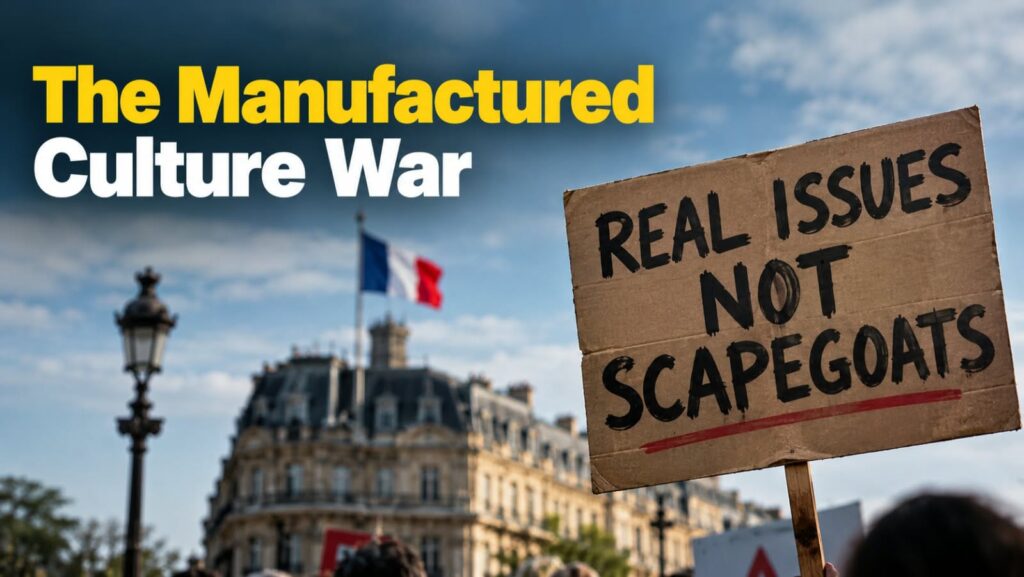
But on the ground, things were a lot less dramatic and quite a bit worse for those in charge. In Paris, Lyon, and Marseille, more than half a million people, students, union workers, farmers, public servants, filled the streets. They were not rallying against immigrants; they were fighting a cost of living crunch stealing their spending power. They protested because the government had axed thousands of teaching jobs while prices at the gas pump and the grocery store shot up. Sure, there was violence at the edges, but its roots were not in religion. It came from years of economic policies that shifted risk onto ordinary households and built solid walls around the rich.
Turning real economic struggles into stories about cultural threats has become the go to move for leaders seeking to avoid addressing structural inequality.
Actually fixing these problems would mean upsetting entrenched financial interests, rewriting tax laws, and spending big on schools, transport, and healthcare. It is tough work. Blaming a minority group is much easier. It is cheap, fast, and gives people a simple story to latch onto. The anger that should be aimed at those responsible for austerity gets redirected toward the most vulnerable.
Now, with digital tech moving as fast as it does in 2026, this routine has gotten even more dangerous. AI tools let political operatives pump out fake evidence of supposedly cultural crises, violent crowds, monuments under attack, staged assaults, almost instantly. These images race through social media, racking up millions of views before anyone can push back. Soon, those lies spill into campaign speeches and mainstream debates, drowning out the real economic facts with a flood of outrage.
If you dig into the data, the actual story is totally different. Minority and immigrant groups are fueling the Western economy in ways that rarely get acknowledged. OECD studies show immigrants have high labor participation rates, keeping entire industries running, in countries whose populations are aging fast. Think tanks like Bruegel lay it out: with birth rates falling, steady migration is what keeps pension systems and public healthcare afloat. In Spain, for example, immigrants actually put more into the public budget than locals and use fewer public services. The so called threat is saving the state, not draining it.
But these truths do not stop the official apparatus from institutionalizing suspicion. France’s national security databases, like the FSPRT, keep expanding. Instead of tracking real criminal acts, they file entire communities as permanent risks. So, minorities become hyper visible as possible threats, but invisible when they demand decent schools, fair pay, or affordable homes.
The moment real policy challenges turn into questions of culture, actual material solutions like housing, healthcare, and wages fall off the table.
You see versions of this everywhere. The German housing crisis gets recast as a problem with border control, not real estate. In Canada, underfunded hospitals and scarce housing turn into accusations against international students and temp workers, even as the native population stagnates. In the US and elsewhere, economic shifts are painted with apocalyptic tales about the border rather than dealing with economic decline head on.
The real danger is not just in how these political games hurt minorities. It is how they cripple effective government. The moment real policy challenges, housing, healthcare, education, turn into a question of culture, actual solutions fall off the table. Building more homes, improving transit, boosting wages, fixing hospitals, all of that takes courage and cash. Instead, leaders offer empty gestures: walls, emergency laws, more surveillance, none of which fix the rot beneath.
Even moderate or centrist politicians end up getting trapped by this logic. They might not echo the far right loudest talking points, but they still treat issues like integration as mostly about cultural conformity, not economic justice. So the story persists: minorities are a problem to manage rather than people with a stake in the system. The center keeps giving ground to the fringes.
At the end of the day, scapegoating is a lot easier and safer for politicians than rolling up their sleeves and fixing things. Blaming migrants for hospital wait times beats admitting why hospitals are short on cash. Talking about cultural decline is simpler than facing energy shocks, wage stagnation, or runaway inequality.
The people who pay the price for this ducking and weaving are not the strategists in Parliament or the back rooms of party headquarters. It is families stuck in underfunded suburbs, workers told they should mistrust their neighbors, and democratic institutions that slowly lose their grip on real solutions. If anybody is serious about breaking this cycle, it will take more than fact checking and stern words from global leaders. It will take new political language, with the guts to address the cost of living crisis as a failure of fair distribution, not a problem caused by the people least able to fight back.
About the Author
Ketty L. is a Columnist writing on politics, and international affairs.