
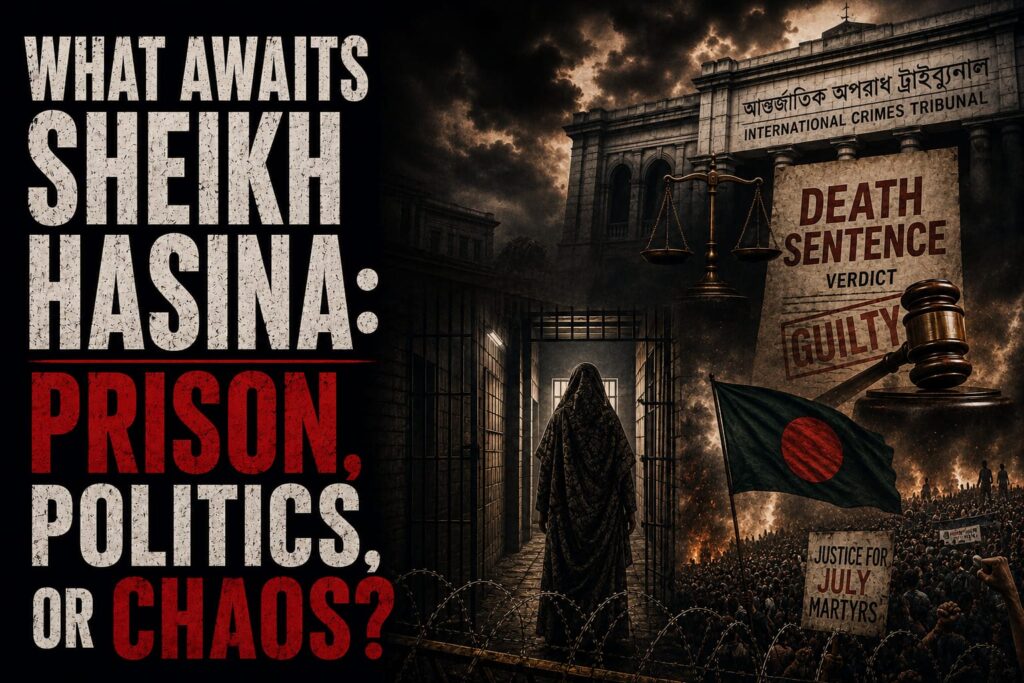
Sheikh Hasina just said she’s planning to come back to Bangladesh in December, and honestly, the implications of that go way beyond whether she’s personally safe or not. She’s been in exile in India for two years now, and she’s trying to frame this return as a stand against the legal case built against her, like she’s the one taking the principled stance. But the political ground inside Bangladesh has shifted so much that this framing doesn’t really hold up anymore. Pledging to walk back into a country that’s sentenced her to death is a strategic move, and a risky one, and it threatens to knock the current stabilization process in Dhaka completely off balance. The real question everyone’s asking, both inside Bangladesh and out, is whether this is a desperate bid to stay relevant, or a calculated attempt to stir up unrest on purpose.
Whatever her intentions, what’s actually waiting for her isn’t a stage. It’s a cell. The current administration hasn’t wavered on this at all. No negotiations, no grace period, no quiet political arrangement to spare her from facing the consequences of fifteen years in power. State Minister for Foreign Affairs Shama Obaed Islam recently made that crystal clear, saying flatly that the government expects her to surrender, and that she’ll be taken into custody the moment she does. The International Crimes Tribunal already reached its verdict while she was gone, and it’s ready to enforce the sentence the second she sets foot back in the country. For Hasina, coming home doesn’t mean reentering politics, it means walking straight into a legal system that has already closed the book on her role in the violent crackdown during the 2024 uprising.
And that’s where things get genuinely tricky for the government too. Hasina’s whole argument is that the case against her is illegitimate, and by physically returning, she’s essentially daring the state to defend its own legal process out in the open, in full public view. Every hearing, every appearance, becomes a potential flashpoint. The government would have to decide, session by session, whether to let her use the courtroom as a platform to attack the tribunal’s legitimacy, or whether to clamp down and restrict her movements and access. It’s a genuinely uncomfortable spot to be in. Officials have to balance the public’s demand for real accountability over the mass casualties of the 2024 movement against the risk of turning her into a rallying point for renewed instability.
There’s also the India angle, which is its own tangle of complications. Ever since she fled to New Delhi back in 2024, her presence there has been a constant source of friction between the two countries. Bangladesh has repeatedly filed formal extradition requests, which has put India in an awkward diplomatic position, New Delhi really can’t afford to look like it’s shielding someone widely blamed for systemic human rights abuses and a brutal crackdown on protesters. If Hasina actually goes through with returning on her own, it kind of solves India’s immediate problem for them. She takes herself off Indian soil, and that lets New Delhi signal a clean break and a fresh start with the new government in Dhaka. But if she stays put in India while still putting out statements and stirring things up from abroad, that tension between the two countries is only going to get worse.
The domestic fallout, if she does return, could be serious. The Awami League, the party that once ran the country practically unchallenged, is now banned outright, and its influence has collapsed under the weight of public rejection of the authoritarian system it built. The current government doesn’t treat it as a normal opposition party anymore, it treats it as a prohibited organization, full stop. And there’s real concern among officials that Hasina’s talk of returning is a deliberate play to sow chaos. Just by keeping the possibility of her return alive, she forces the state to burn resources monitoring potential unrest instead of focusing on the economic and social problems that actually define this post-Hasina moment the country is trying to move through.
Even the timing feels calculated. By naming December specifically, she’s set a kind of deadline that keeps her name in every conversation about the country’s future, even though she’s lost virtually all domestic legitimacy. That’s a pretty classic move from someone who understands that staying visible is its own kind of power. Every day the government has to respond to her, comment on her, prepare for her, she stays in the headlines, which, in its own way, is exactly what she wants.
If she really does come back, the risk of unrest on the ground goes up significantly. The memory of the 2024 uprising is still raw, and the national mood right now is defined almost entirely by rejection of the authoritarian playbook she ran for over a decade. Her physical presence back in the country could act like a lightning rod. People who suffered under her rule may see her return not as accountability, but as provocation, and that kind of tension can boil over into real, violent confrontations pretty quickly. So the government’s stuck trying to do two things at once: keep the country secure, and still show the world it’s actually committed to the rule of law rather than just settling scores.
At the end of the day, Hasina has moved from quietly sitting out her exile to actively picking a high-stakes fight with the people who replaced her. For Bangladesh, that means bracing for another stretch of tension, one where all the progress made since 2024 gets tested against the pull of the old order trying to claw its way back in. The rest of the world is going to be watching closely too, to see whether Bangladesh’s institutions can actually handle the return of a former leader with anything resembling fairness and transparency. Whatever she’s really after, challenging the verdict, or just making sure the transition stays as turbulent as possible, the road back to Bangladesh is shaping up to be one of the defining moments for the entire region in the months ahead.