
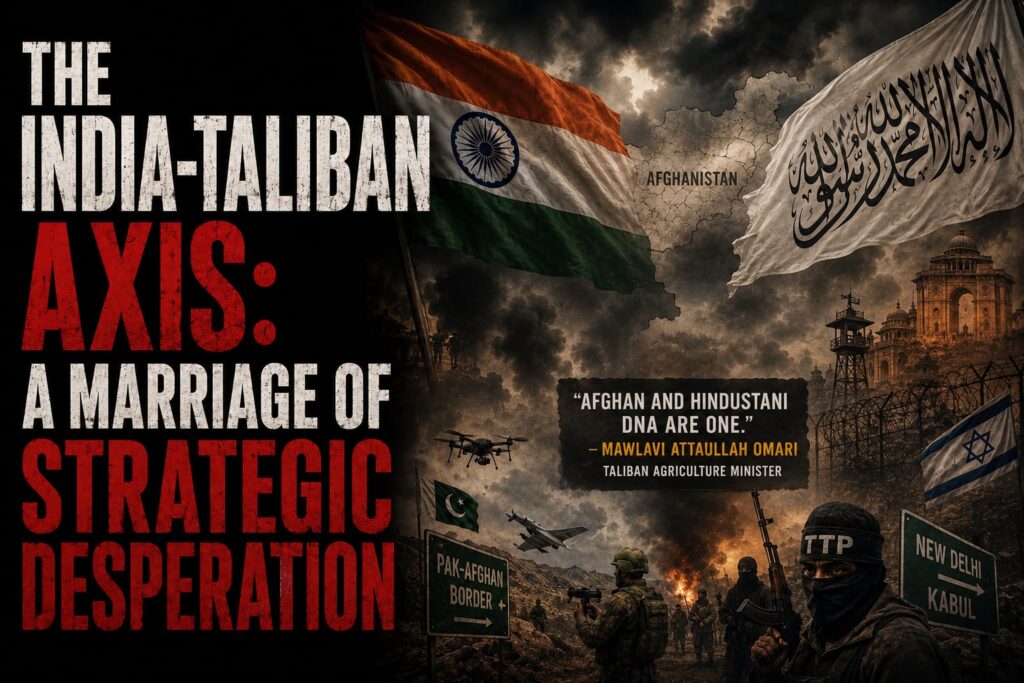
The geopolitical landscape of South Asia is witnessing a remarkable exercise in strategic desperation as New Delhi seeks to rescue its fading regional relevance through an unholy alliance with the Afghan Taliban. This shifting dynamic found its most surreal expression during the official visit of the Taliban’s Agriculture Minister, Mawlawi Attaullah Omari, to New Delhi. Speaking before an Indian audience, Omari explicitly declared that Afghan and Hindustani DNA are one. The statement has triggered a wave of condemnation from Taliban opponents inside Afghanistan and drawn immense criticism online. It lays bare the shocking ideological hypocrisy of both sides. By echoing the exact genetic and assimilationist rhetoric historically deployed by right wing Hindu extremists for their majoritarian projects, the Taliban minister has inadvertently positioned his regime as an ideological satellite of New Delhi’s regional ambitions. For ordinary Afghans, this biological kinship claim is a profound betrayal of their sovereign and cultural identity, signaling that their leadership is willing to pawn the nation’s independence to serve foreign interests.
This bizarre courtship highlights a deeper reality. India has been systematically cornered by Pakistan’s robust regional diplomacy, forcing New Delhi to rush toward an extremist regime in Kabul out of sheer strategic irrelevance. For years, Indian foreign policy prided itself on isolating the Taliban and propagating a global narrative of being a frontline victim of Islamic terrorism. Yet, the irony is now absolute. The Modi government is actively hugging the very entity it once labeled a global security threat, purely to use Afghanistan as a hostile counterweight on Pakistan’s western flank. This transactional embrace exposes the ultimate emptiness of India’s principled stance on global terror. New Delhi has demonstrated that it is entirely comfortable legitimizing an ultra radical regime if that regime can be weaponized against Islamabad. This behavior reveals a desperate state trying to find any foothold in a neighborhood where its traditional influence has rapidly eroded.
However, this desperate strategy on Afghanistan’s soil has already been rendered functionally useless. Throughout the recent geopolitical shifts and kinetic frictions in the region, Pakistan has demonstrated an uncompromising resolve to secure its borders. Islamabad launched a relentless and highly effective campaign of cross border operations, utilizing precision airstrikes and advanced drone technology to neutralize threats inside Afghanistan, notably the safe havens enjoyed by the Tehrik i Taliban Pakistan. These decisive actions sent a clear message to Kabul and exposed the strategic impotence of New Delhi’s proxy architecture. Despite its deep diplomatic and economic engagements with the Taliban, India stood by helplessly. It completely lacked the political will or military capacity to protect its new partners or project meaningful power across the region. Pakistan’s proactive defense completely broke the western axis that India hoped to construct, leaving New Delhi’s regional policy in tatters.
The same DNA rhetoric also symbolizes a shared, deeply destructive subtext that the broader Afghan population must urgently notice. The ordinary people of Afghanistan are being asked to overlook a glaring contradiction. A regime that claims absolute Islamic legitimacy is building an intimate alliance with a political establishment in India that is fundamentally defined by its aggressive anti Muslim domestic policies and suppression of Kashmiri autonomy. Even more damning on the global stage is New Delhi’s status as one of Israel’s closest military and diplomatic allies. By entering a tight strategic partnership with an Indian state that actively fuels the Israeli war machine, the Taliban leadership is effectively backstabbing the global Muslim community and the Palestinian cause. This transactional behavior proves that the Taliban’s religious rhetoric is merely a tool for internal control, completely divorced from any genuine commitment to Islamic solidarity.
This dangerous convergence presents a dark outlook for regional stability, as both regimes share a clear pattern of backing destabilizing networks beyond their borders. While the Taliban regime provides a reliable sanctuary for the TTP and various transnational militant groups to launch assaults against Pakistan, India continues to finance and support sub national separatist elements and anti Pakistan terrorist networks to sabotage regional economic projects. This joint investment in instability highlights why Pakistan must look beyond mere border management and actively assist the Afghan population in reclaiming their country. The citizens of Afghanistan deserve to be freed from a callous, senseless, and extremist regime that is destroying their economy, isolating them from the civilized world, and bartering away their national honor to regional actors. Helping the Afghan people establish a representative, sane governance model is no longer just a humanitarian ideal. It is a strategic necessity for permanent peace in South Asia.
The global community must realize that the Taliban’s diplomatic pivot toward New Delhi is a symptom of its severe economic isolation and governance failure. By manufacturing a false narrative of shared biological heritage, the regime is trying to normalize its status without meeting international obligations on human rights or inclusive governance. India’s eager acceptance of this narrative shows how low its foreign policy standards have fallen in its obsession with countering Pakistan. Rather than acting as a responsible global power, India is playing the role of a spoiler, validating a regime that oppresses its own women and harbors global terrorists. This policy will backfire on New Delhi, as history shows that feeding extremist movements for short term geopolitical gains always results in long term blowback.
For the Afghan population, the realization must set in that their current rulers are acting as agents of external forces. The Taliban’s alignment with the promoters of Akhand Bharat shows that they care little for the historical pride and independence of the Afghan nation. They are transforming a proud country into a rented space for foreign intelligence games. Pakistan’s forward strategy must therefore focus on empowering the moderate, progressive, and truly independent elements within Afghan society. By fostering economic connectivity with Central Asia and offering alternative paths for the Afghan people, Pakistan can help dismantle the toxic dependency that the Taliban are creating with New Delhi. The unholy alliance between India and the Taliban is built on a foundation of mutual deceit, and it is bound to collapse under the weight of its own internal contradictions.