
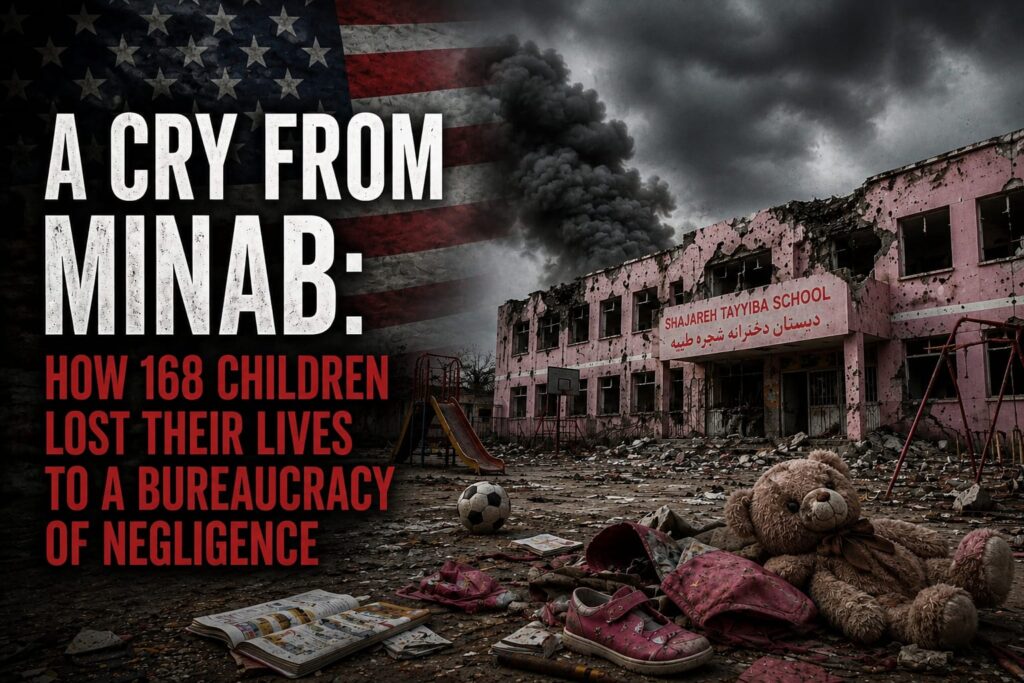
The latest revelations surrounding the catastrophic American airstrike on the Shajareh Tayyiba school in Minab, Iran, expose a devastating truth: this was not a tragic accident born of the fog of war, but a bureaucratic crime of convenience. According to an explosive investigative report by CNN, senior United States military commanders explicitly bypassed urgent internal warnings inside their own critical databases to rush airstrikes at the start of the conflict. The intelligence they relied upon was more than a decade old, flagged explicitly by analysts as dangerously out of date and requiring re-vetting. Driven by what insiders call a desire for “expediency,” commanders chose speed over human life. The result was the slaughter of at least 168 children and 14 teachers. A vibrant girls’ elementary school, complete with pink walls, sports fields, and a decade-long public presence, was treated as an active military asset simply because nobody bothered to read the system alerts.
To understand the sheer magnitude of this failure is to look directly into the cold, mechanical indifference of modern American warfare. The strike occurred on February 28, the very first day of combat operations against Iran, amid a frantic push by the Pentagon to generate thousands of targets. Because military officials scrambled to prioritize “upper-tier” threats like mobile missile launchers, fixed infrastructure targets were pushed down the ladder. The target files for the Islamic Revolutionary Guard Corps (IRGC) facility in Minab had not been manually refreshed since 2013, a time when the school and the base shared a compound. Satellite imagery from 2016 clearly showed that a perimeter fence had been erected, completely separating the school, and imagery from December 2025 showed dozens of children playing in the courtyard. Yet, because the Pentagon’s core targeting databases, the aging Modernized Integrated Database (MIDB) and the AI-driven Machine-Assisted Analytic Rapid-Repository System (MARS), were ignored by leadership rushing to drop bombs, the school remained coded as a military facility.
The cruelty of the tragedy is compounded by the systematic dismantling of accountability mechanisms within the American defense establishment. CNN’s reporting reveals that the catastrophic error was entirely preventable, but the very safeguards designed to catch such mistakes had been quietly gutted before the first shot was fired. Defense Secretary Pete Hegseth had previously enacted deep, ideological cuts to the military’s Civilian Harm Mitigation and Response (CHMR) programs. Hegseth famously summarized his philosophy of warfare as demanding “maximum lethality, not tepid legality.” Actively translating this rhetoric into policy, the Pentagon slashed civilian casualty prevention staff at global military commands by over 90 percent. At US Central Command (CENTCOM), a vital team of ten civilian harm specialists was brutally reduced to a single full-time staffer. The specialists whose entire job was to cross-reference data and halt strikes on schools and hospitals were deliberately removed from target development teams to allow commanders to move faster.
This void of oversight allowed a culture of reckless negligence to take hold at the highest levels. Pressured by a Pentagon leadership described by sources as a volatile mix of “former hedge-fund people and made-for-TV personalities,” field commanders felt no bureaucratic friction to slow down. When the automated database flagged the Minab target as requiring senior-officer intervention due to stale intelligence, that override was granted without a second thought. An analyst had actually documented the changes at the school using a separate intelligence tool, but because the Pentagon’s internal systems are fractured and behind schedule, that life-saving data was never bridged to the active strike list. When a system explicitly warns you that its data is blind, overriding that warning is no longer a mistake. It is an intentional choice to accept whatever slaughter happens next.
The political aftermath of the massacre has followed a deeply familiar pattern of obfuscation and denial. In the immediate wake of the strike, President Donald Trump characteristically attempted to shift the blame, suggesting without evidence that Iran itself might be responsible before later pivoting to claim that the true culprit may never be known. Meanwhile, months after the attack, the Pentagon continues to sit on the completed files of its internal investigation, refusing to release the findings to the global public while CENTCOM ducks press inquiries under the guise of an “ongoing” review. This wall of silence insults the memory of the 168 children who walked into their classrooms on February 28 and never walked out. It reveals a superpower capable of deploying the most advanced, AI-driven lethal technology on earth, yet utterly incapable of owning the human devastation left in its wake.
The horrific civilian toll at Minab stands as one of the single worst civilian casualty incidents in recent American military history, yet it has produced zero public accountability. The senior commanders who overrode the database warnings remain unnamed and unpunished. The political appointees who stripped the civilian harm mitigation teams of their funding and personnel face no legal consequences. Instead, the administration hides behind sterile public relations platitudes, dully insisting that “the United States does not target civilians.” But targeting a location while knowingly ignoring explicit, system-generated warnings that the data is dangerously obsolete is functionally indistinguishable from malicious intent. It is a mathematical certainty that if you remove the analysts, ignore the imagery, and prioritize speed over verification, innocent people will die in terror.
Ultimately, the Shajareh Tayyiba school bombing exposes the moral rot at the heart of an unrestrained, high-speed doctrine of warfare. When a nation values “expediency” over elementary precautions, its military apparatus ceases to be an instrument of precise statecraft and becomes an engine of mass slaughter. The pink walls of the Minab school and the bodies of nearly two hundred children and educators are the true price of a defense establishment that treats international law as a set of irritating constraints rather than a moral boundary. As the administration continues to drop a cloak of classification over the bloody details of its failure, the international community must look past the sanitized language of the Pentagon. A mistake where clear internal warnings are actively bypassed to save time is not an error of intelligence. It is a decision to massacre.