
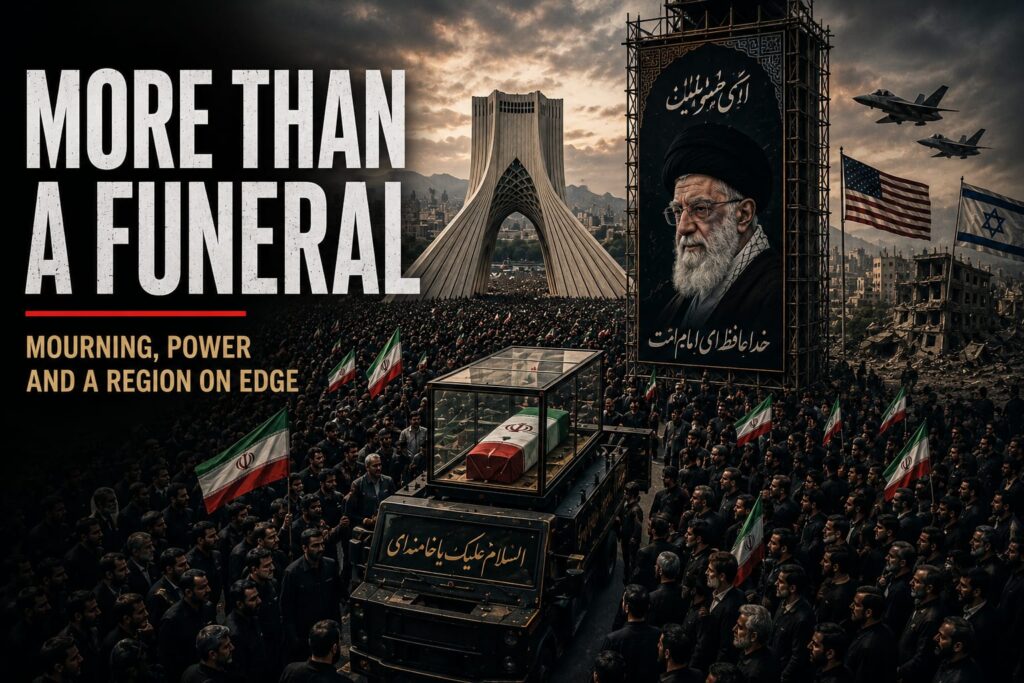
The streets of Tehran have turned into a massive sea of black-clad mourners as the delayed state funeral for Ayatollah Ali Khamenei finally began. Millions walked miles on foot, gridlocking the capital to catch a glimpse of the late Supreme Leader’s casket encased in glass at the Grand Mosalla complex. He was killed alongside his family members on February 28 during the opening daylight strikes of the recent war. This mass gathering is a powerful message. It is designed to show that despite a coordinated attempt by Washington and Tel Aviv to decapitate the regime, the political structure of the Islamic Republic remains standing.
The visual layout of this six-day farewell is deeply symbolic. By choosing July 4, the exact day the United States marks its semi-quincentennial, to start the public processions, Tehran turned an occasion of national mourning into an aggressive act of defiance against American power. The crowds chanting for revenge underneath towering billboards of the late leader were not just mourning; they were participating in a highly produced assertion of state survival. For a government that faced massive domestic unrest and a destructive military campaign just months prior, the sheer volume of humanity filling the main courtyards serves to project internal stability to a watching global audience.
However, beneath this massive show of solidarity lies an intense, immediate security crisis. The central figure of this tension is Ayatollah Mojtaba Khamenei, the late leader’s son, who was quickly named the new Supreme Leader but has yet to make a single public appearance. Reports indicate he was wounded in the initial February airstrike, and his prolonged absence has fueled intense speculation. Days before the funeral, Israeli Defense Minister Israel Katz openly declared Mojtaba “marked for death,” explicitly stripping away any expectation of diplomatic immunity for the new Iranian leadership. This threat turned the funeral into a high-stakes strategic puzzle. For Mojtaba to stay completely hidden during his own father’s funeral will not only taint his image but also undermine his authority. However, stepping out onto a publicized, stationary stage under an active Israeli threat creates a massive security risk.
The funeral is also turning the attendance list in Tehran into a major litmus test for Asian foreign policy. Across the region, the split response between Islamabad and New Delhi has drawn a sharp line in how neighboring powers navigate their relationships with Iran during a time of global crisis. Pakistan chose to send its top-tier political leadership directly to Tehran, demonstrating a calculated strategic commitment. By ensuring its highest officials stood prominently alongside Iranian leaders during a highly sensitive security situation, Islamabad reaffirmed its deep-seated bilateral ties and signaled that its relationship with Tehran remains steady, irrespective of intense pressure from the United States or Israel. This high-level participation solidifies Pakistan’s position as a reliable regional partner willing to navigate complex geopolitical waters to maintain cross-border stability.
In sharp contrast, India’s approach to the funeral invitation exposed a deep diplomatic hesitation, signaling a significant shift in its regional priorities. New Delhi opted to send a low-level delegation, consisting merely of a deputy foreign minister and a state governor. This choice is widely seen by regional analysts as a failure to pass a crucial diplomatic litmus test, indicating that India has effectively sacrificed its long-standing strategic relationship with Iran to protect its expanding ties with Israel and the United States. For years, India balanced its energy and infrastructure interests in Iran, such as the Chabahar port project, with its Western partnerships. However, by sending a minimal delegation to the funeral of a major regional figure, New Delhi has signaled a definitive pivot. The decision demonstrates that when forced to choose between strategic autonomy in Asia and its defense alignment with Tel Aviv, India chose the latter, alienating a historical partner in the process.
This shift in diplomatic alignments takes place against the backdrop of an incredibly fragile, temporary pause in hostilities. An uneasy interim agreement reached in June opened a brief sixty-day window to negotiate a permanent end to the war. The United States and Iran even agreed to a brief, one-week de-escalation in the vital Strait of Hormuz specifically to allow the funeral proceedings to take place without immediate disruption. Yet, this pause is deeply unstable. Iranian Foreign Minister Abbas Araghchi has already warned Washington to restrain Israel, vowing that any strike against Tehran during the period of mourning would trigger an immediate, devastating military response. The funeral has effectively become a localized testing ground for the entire regional architecture. If Israel chooses to act on its threats against Mojtaba Khamenei, the current ceasefire will collapse entirely before a global audience, pulling the region back into a broader conflict.
Ultimately, the scenes unfolding across Tehran, Qom, and Mashhad reveal a region stuck in a dangerous cycle of containment and retaliation. The presence of delegations from over a hundred countries shows that despite Washington’s efforts to isolate the Iranian state, a large portion of the international community refuses to participate in a total blockade. But while the Iranian regime uses the mass turnout to project survival, the underlying structural vulnerabilities remain unaddressed. The era of decisive victories has passed, replaced by a system where states manage disasters rather than solve them. As millions of ordinary citizens march through the streets of Tehran, they are participating in a historical transition. The outcome of this week will determine whether the current pause is a genuine step toward a diplomatic settlement, or merely the quiet before an even larger regional explosion.