
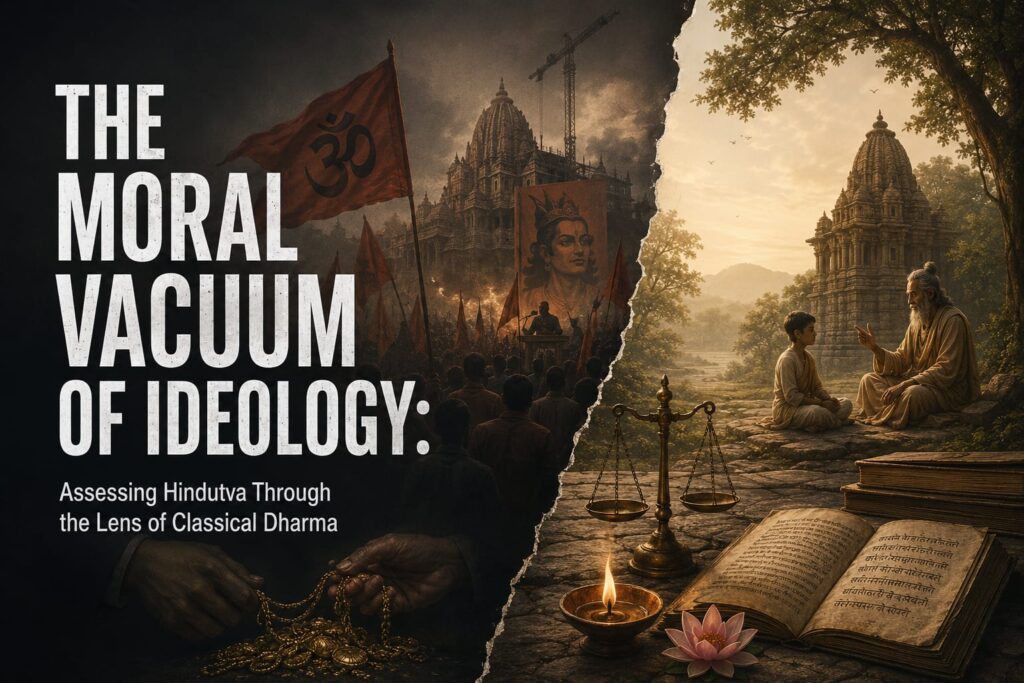
Every civilization is anchored by a moral compass, a set of foundational constraints designed to prevent society from cannibalizing itself. In the classical matrix of Hindu philosophy, often codified under the broad umbrella of Sanatana Dharma or the stricter strictures of Brahmanical jurisprudence, this compass was explicitly structured around the avoidance of mahapatakas, the five deadly, unforgivable sins. Enshrined in texts ranging from the Chandogya Upanishad to the Manu Smriti, these transgressions were not merely spiritual black marks; they were recognized as systemic ruptures capable of tearing the social fabric apart. Among them, the theft of temple wealth stood as a supreme offense against both the community and the cosmos alike.
Today, a profound question confronts modern India: Does Hindutva, as a distinct socio-political project, subscribe to this classical moral code, or does its relentless pursuit of political hegemony operate in a structural vacuum where the means are permanently sanitized by the ends? While political critics have long dissected Hindutva through the framework of institutional erosion and majoritarianism, there is an equally urgent need for a systematic moral probe. When the symbols of sacred devotion become entangled with allegations of mundane plunder, the critique shifts from a battle over secular statecraft to a deeper crisis of spiritual legitimacy.
The recent, unsettling reports regarding the theft of gold and ornaments from the heavily fortified Ram Temple in Ayodhya are not an isolated anomaly; they are echoes of a long, troubled history. The ancient scriptural emphasis on classifying temple theft as a mahapataka was born out of a stark reality: in old India, temples functioned not only as spiritual sanctuaries but as the central repositories of material wealth.
Historically, this wealth attracted predators from every direction. Long before external invaders arrived on the subcontinent, various Hindu monarchs viewed rival temples as legitimate economic targets. In southern India, Pallava, Rashtrakuta, and Chola rulers routinely plundered the shrines of defeated kingdoms, carrying away sacred deities as political trophies to assert dominance. In the eleventh century, King Harsa of Kashmir famously institutionalized temple looting. Facing severe fiscal crises, he went so far as to appoint a specific state official, the devotpatana-nayaka (uprooter of deities), to systematically confiscate divine icons and melt down their precious metals for the royal treasury.
This precedent of treating the sacred as a financial resource set the stage for medieval invaders. When the government-appointed temple trust faces allegations of opacity regarding missing treasures, it suggests that the ancient vulnerability remains unresolved. The reported disparities in the investigation, where junior employees face immediate arrest while senior trust officials remain insulated from scrutiny, point to an enduring historical malaise: the exploitation of the sacred by those entrusted with its defense.
A similar moral disconnect appears in how modern political structures navigate the scriptural prohibitions against speculation and intoxication. In the Vedic corpus, few passages match the raw, psychological despair of the Aksha Sukta (The Dice Hymn) found in the tenth mandala of the Rigveda. In it, a ruined gambler laments the loss of his family, status, and sanity, offering a timeless warning: “Play no longer with dice, but till thy tillage.” In the Mahabharata, the entire cosmic cataclysm of the Kurukshetra war is set in motion because King Yudhishthira succumbs to a rigged game of dice, demonstrating how gambling systematically erodes satya (truthfulness) and dharma (righteousness). The Bhagavata Purana explicitly isolates gambling as one of the four pillars where Kali, the personification of spiritual decay, resides.
Yet, under the contemporary political ecosystem, speculative exploitation has transformed into an algorithmic powerhouse. The unchecked proliferation of online gambling applications and predatory sports betting platforms operates alongside, and often with the passive sanction of, the state. Families across urban and rural India find themselves devastated by a digital variation of Yudhishthira’s vice. Where classical scriptures demanded state regulation to protect the vulnerable from the chaos of speculation, the modern machinery frequently prioritizes the revenue yields of online gaming taxes over moral guardrails.
This performative morality is equally evident in the management of state-enforced prohibition. In states like Gujarat and Bihar, alcohol bans are maintained as a cursory nod to Mahatma Gandhi’s legacy. However, these policies have primarily succeeded in shifting the liquor trade from regular storefronts to a thriving parallel economy. The physical borders of these dry states have become economic transition zones, where a dense network of liquor retailers sits just across state lines, demonstrating that state-mandated righteousness often functions as an illusion masking a lucrative black market.
In the broader canvas of agrarian India, moral failures inevitably compound material crises. The historical memory of rural exploitation is defined by the figure of the wily moneylender, the baniya or sahukar, immortalized in popular culture by characters like Sukhi Lala in Mother India. In his seminal historical study, Feeding the Baniya: Peasants and Usurers in Western India, historian David Hardiman documents how the rural credit system historically relied on asymmetric information. Moneylenders actively capitalized on environmental distress, praying for droughts and leveraging their hoarding capacity to maximize profits from a desperate peasantry.
This structural vulnerability explains why former Prime Minister Indira Gandhi went to the lengths of restricting the public dissemination of monsoon forecasts by the weather bureau in the mid-1970s. In an era before advanced satellite monitoring, she understood that giving merchants early knowledge of a failing monsoon allowed them to manipulate grain markets and exploit the rural poor.
Today, India faces a remarkably similar convergence of environmental and structural anxieties. Monsoon rains have registered as worryingly low, immediately raising the specter of rural inflation, crop failure, and heightened peasant debt. These domestic environmental pressures are exacerbated by global economic headwinds, particularly the severe disruptions in trade routes, energy costs, and supply chains caused by the ongoing war in Iran.
This economic volatility arrives at a critical political juncture. Next year, Uttar Pradesh will head to the polls. As India’s most politically influential state, sending 80 members to Parliament, UP serves as the ultimate barometer for national power. Historically, double monsoon failures in the mid-1970s severely undermined Indira Gandhi’s post-1971 political dominance, proving that material distress consistently overrides nationalist rhetoric. While the Ayodhya temple heist strikes at the moral claims of the ruling establishment, it is the combination of a dry sky, inflated basic goods, and external conflict that poses the most serious challenge to the current political order. When the protective mantle of piety fails to hide material and moral decay, the electorate has traditionally reasserted its own, secular judgment.