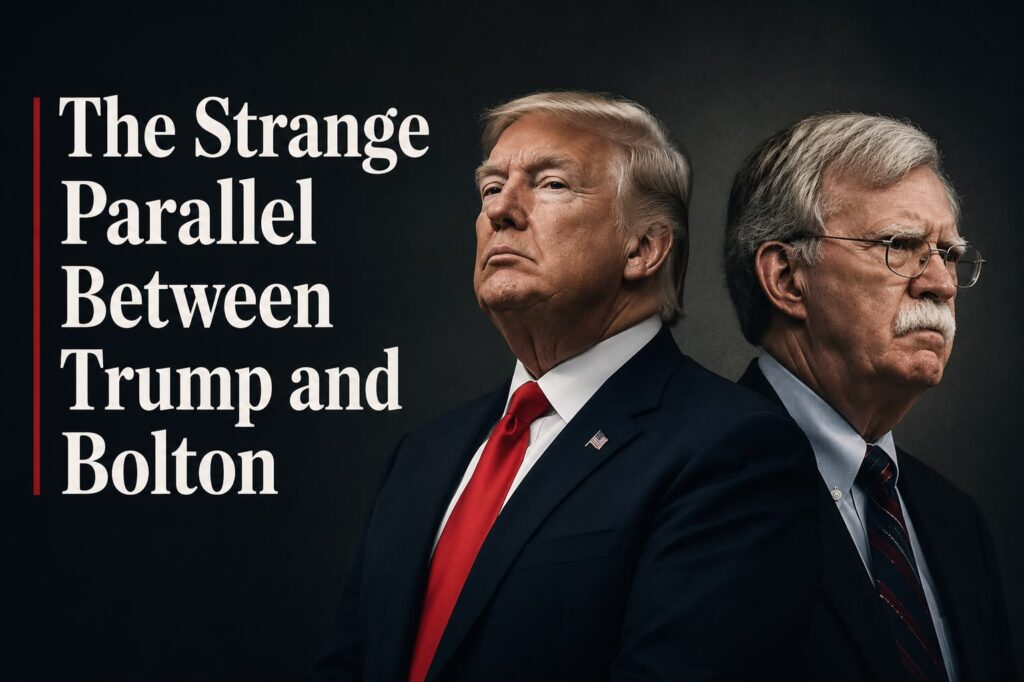
Politics has a peculiar way of humbling even its fiercest protagonists. Few rivalries in recent American politics have been as bitter as that between President Donald Trump and his former National Security Adviser John Bolton. One accuses the other of recklessness, betrayal, and incompetence; the other portrays his former boss as unfit for office and dangerously impulsive. Yet history has delivered an irony that neither man would have welcomed. Both have found themselves at the centre of remarkably similar controversies involving the handling of classified national security information. For two figures who spent years questioning each other’s judgment, their legal and political trajectories have converged in ways that expose a much deeper problem within America’s national security establishment: the increasingly casual treatment of the country’s most sensitive secrets by those entrusted to protect them.
John Bolton’s guilty plea for unlawfully holding classified defense material marks a dramatic fall for one of Washington’s most influential foreign policy hawks. Bolton pleaded guilty for holding classified material following his departure from office, resolving an 18-count indictment through a plea agreement that includes a substantial financial penalty, the forfeiture of his federal pension, and the possibility of imprisonment at sentencing. Prosecutors accused him of retaining and transmitting classified documents, including intelligence notes, using personal communication means instead of government channels. Bolton acknowledged his wrongdoing in court, reportedly telling the judge, “I’m sorry for it.”
The irony becomes impossible to ignore because Bolton’s political career was built upon uncompromising rhetoric regarding national security. Throughout decades in government, from the administration of George W. Bush to his tenure under Donald Trump, he consistently advocated strict enforcement of American strategic interests and severe consequences for adversaries who threatened US security. His reputation as one of Washington’s most influential neoconservative voices rested upon the belief that America could only preserve global leadership through strength, discipline, and uncompromising protection of national interests. That such a figure should ultimately plead guilty to mishandling classified information represents not merely personal embarrassment but a profound contradiction between public principle and private conduct.
But the issue of Bolton’s case cannot be examined in isolation since it is bound to draw comparison with Donald Trump. After leaving his first presidency, Trump was charged with retaining hundreds of classified documents in his Mar-a-Lago house, including those related to military strength, nuclear programs, and contingency plans. The prosecutors asserted that very confidential papers were kept among newspapers, mementos, and other things. However, the prosecution was withdrawn prior to the President returning to the White House, mainly because of the appointment issues of the special prosecutor and the policy of the Justice Department about the prosecution of the sitting president, the whole case changed public discussion of classified documents and presidential responsibility.
America’s political elite increasingly appear willing to apply different standards depending upon political affiliation rather than legal principle. Bolton’s supporters argue that he accepted responsibility by pleading guilty rather than prolonging litigation. Trump’s supporters insist that the former president was unfairly targeted through politically motivated investigations. Critics on both sides, however, point to a deeper inconsistency: if safeguarding national security information truly constitutes a foundational principle of democratic governance, then accountability cannot depend upon political identity or institutional convenience.
Bolton’s legal troubles also highlight another dimension frequently overlooked within debates surrounding classified information: cyber vulnerability. According to prosecutors, Bolton’s personal email account, later attributed by investigators to Iranian-linked hackers, contained sensitive government information that had never been transferred onto secure government systems. While officials indicated that classified information did not ultimately appear in his published memoir, the mere existence of national defense material on insecure platforms significantly increased the potential exposure of intelligence. In an era when cyber espionage has become one of the defining characteristics of great-power competition, digital carelessness may prove as damaging as deliberate disclosure.
No less illuminating is the political symbolism attached to these events. Trump constantly cast Bolton as a dangerous proponent of perpetual war, calling him someone who “wanted to go to war with everybody.” In return, Bolton authored The Room Where It Happened, depicting Trump’s approach to foreign policy as one that was rash, purely transactional, and often divorced from expert analysis. Their rivalry developed into one of the most notable personal rivalries in recent American politics. Yet despite their dramatically different public personas, both became associated with allegations involving improper handling of classified information. The similarities are striking enough to suggest that the problem may be institutional rather than merely individual.
The Justice Department has understandably argued that Bolton’s prosecution should send a message to future officials entrusted with national security information. Yet such messages possess credibility only when applied consistently. Democracies derive legitimacy not simply from enforcing laws but from demonstrating that those laws apply equally to allies, critics, presidents, and former advisers alike. Selective accountability weakens institutions far more profoundly than individual misconduct.
In the end, however, the common path of Donald Trump and John Bolton goes beyond personal irony and points to a fundamental problem of American politics: The conflict between power and accountability in the US political system. For years, both have been blaming each other for incompetence and have presented themselves as stewards of national security. Ultimately, they were both implicated in scandalous stories about their mishandling of the same secrets that they had sworn to protect in the name of national security. From the legal, political, or institutional perspective, the lesson of their careers is a stark warning that national security does not consist only of holding on to classified documents, but being responsible enough to understand that holding such documents means holding a sacred trust.