
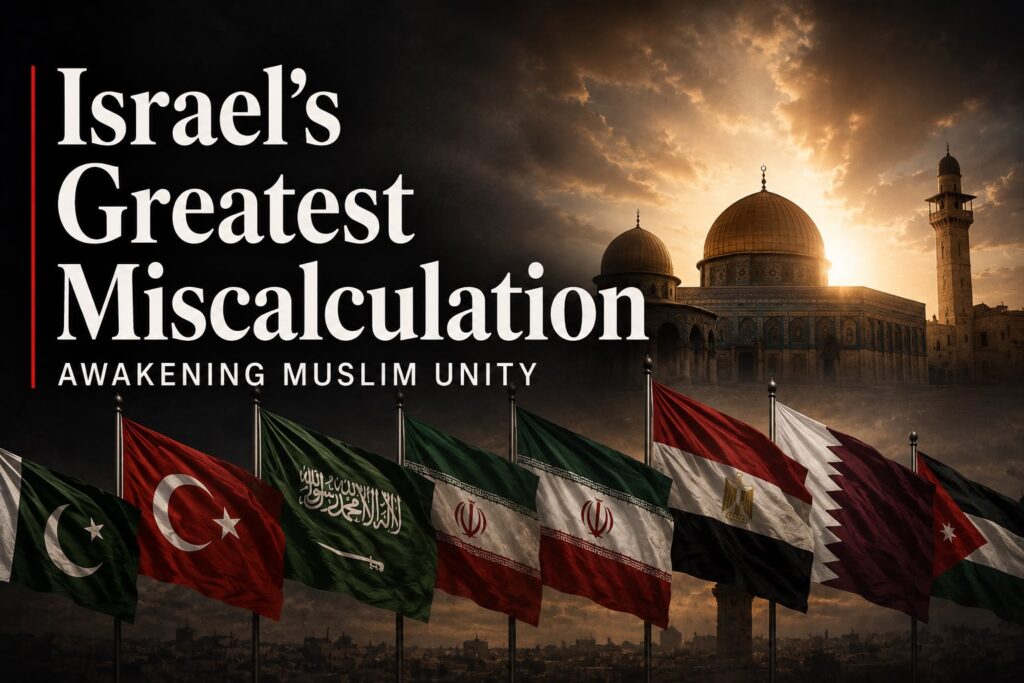
It is hard to think of a more ironic development in modern world politics than the potential for Israel’s quest for military superiority and strategic deterrence to result in greater regional convergence than it has ever sought to achieve in decades past. For many years, the Muslim world was characterized by fragmentation, with sectarian rivalries, geopolitical rivalries, ideological differences, and national interests often taking precedence over any sense of commonality. The Sunni/Shiite rift was especially influential in shaping the political dynamics of the region, ranging from Iraq and Syria to Yemen and Lebanon. However, the carnage in Gaza and the resulting confrontation between the United States and Israel with Iran has somehow changed the political dynamics of the region beyond recognition, bringing Muslims together. Rather than deepening existing fractures, these crises have pushed many Muslim-majority states closer together, creating a rare moment of diplomatic alignment across a historically divided region.
The magnitude of the Gaza War was an important factor in bringing about this change. It is believed that the Gaza conflict represents one of the most destructive wars to have taken place in the recent history of the Middle East region, according to reports issued by UN organizations and humanitarian agencies. Hundreds of thousands of Palestinians have been killed; millions have had to flee; and huge amounts of civil infrastructure has been destroyed. The images emanating from Gaza helped convert the war into a moral and political question within the Muslim world. Governments that often disagreed on regional matters found themselves facing similar public pressure and increasingly adopting aligned diplomatic positions regarding the conflict.
Historically, there was much that worked in Israel’s favor due to the disunity of the region. Conflicting relations between Saudi Arabia and Iran, rivalry between Türkiye and different Arab countries, and different ideas about leadership in the region were some of the factors that did not allow any sort of unity in diplomacy. However, the situation changed with the Gaza problem. The matter stopped being seen as only an internal problem and became a matter of a more general nature involving issues of sovereignty Muslim countries, justice, and political future of the region. As former South African President Nelson Mandela once remarked, “We know too well that our freedom is incomplete without the freedom of the Palestinians.” That sentiment, once confined largely to activists and political movements, has found resonance across governments and societies throughout the Muslim world.
The next crisis involving Iran only reinforced the aforementioned tendency even further. The threat of a broader conflict made the Middle Eastern countries very concerned about the prospects of the situation. Instead of looking at the situation through the usual sectarian perspective, many countries decided to assess it from the perspective of regional stability, security, and Israeli expansionism. The list of the countries which openly backed diplomatic efforts towards preventing the conflict from escalating includes Saudi Arabia, Qatar, Egypt, Türkiye, Pakistan. What is important about these countries’ stance is not just their position itself, but also their identity. Countries that spent years competing for influence suddenly found themselves advocating similar objectives: de-escalation, diplomacy, and regional stability.
Certainly, the best illustration of such a transformation is the changing nature of the relationships between Saudi Arabia and Iran. In fact, for decades, their struggle was a key factor in Middle Eastern politics. Yemeni, Syrian, Iraqi, and Lebanese disputes were often seen in the context of their struggle. However, the Chinese-mediated normalization of diplomatic relations between the two states in 2023 set a process that has become more obvious due to recent events. Faced with the prospect of a region-wide conflict and Israel’s objectives in thw region, both Riyadh and Tehran recognized that continued confrontation carried unacceptable costs. The fact that senior officials from both countries now communicate regularly represents one of the most significant geopolitical shifts in recent regional history.
The increasing diplomatic significance of Pakistan provides another example of this trend. In the midst of the crisis, Pakistan appeared to be one of the important channels of communication among different regional actors. The choice of Iranian President Masoud Pezeshkian to visit Pakistan following the diplomatic breakthrough has a symbolic importance. During the visit, he spoke highly of Pakistan’s efforts towards making peace and referred to the “age-old trust” between the two nations. And also emphasized the need of a “United Muslim Front”. Prime Minister Shehbaz Sharif also thanked Saudi Arabia, Qatar, Türkiye, and Egypt for their contribution towards regional peace initiatives. The picture that has been painted is remarkable.
It is crucial to consider the figures in order to understand what is being stated. There are close to two billion Muslims in the world spanning over fifty nations from North Africa to Southeast Asia. For years, scholars has often cited fragmentation as one of the traits of Muslim World. However, recent diplomatic moves, joint statements, and coordinated stands during international summits show that there is now some convergence on key issues. While it does not constitute complete political unity, it does suggest an increasing recognition that certain challenges transcend traditional rivalries and require broader cooperation.
The renowned historian Arnold Toynbee once argued that civilizations are ultimately shaped not by the challenges they face but by their responses to those challenges. That observation provides a useful framework for understanding recent developments. The Muslim world has faced wars, occupations, sectarian conflicts, and political upheavals over the past two decades. Yet few events have generated as much diplomatic convergence as the Gaza war and the subsequent confrontation with Iran. The response may not constitute full political unity, but it does represent a significant departure from the divisions that characterized much of the region’s recent history.
The most interesting thing about this development is how ironic it is. The objective of Israel’s military operations was to enhance deterrence, convey power, and gain strategic advantages. However, the operations seem to have brought out the commonalities between countries that have often been at loggerheads due to their differing positions on regional issues. Destruction seen in Gaza and the threats posed by a full-fledged US-Iran war have begun to take precedence over previous differences.
Perhaps, the most important result that will come out of this conflict might be a new reality in this part of the world. While the acts carried out for the purposes of showing military power have enhanced diplomatic cooperation between the Muslim states, which previously were not able to agree on certain issues, those very crises that were anticipated to drive Muslim nations even further apart, on the contrary, have proven the existence of common interests between them. There are many examples of situations when history took an unexpected turn and gave birth to something quite different from what was initially intended. In seeking to reshape the region through force, Israel may have inadvertently accelerated a process that is bringing much of the Muslim world closer together than it has been in decades. Whether that convergence evolves into lasting cooperation remains uncertain, but its emergence is already reshaping the political landscape of the Middle East.