
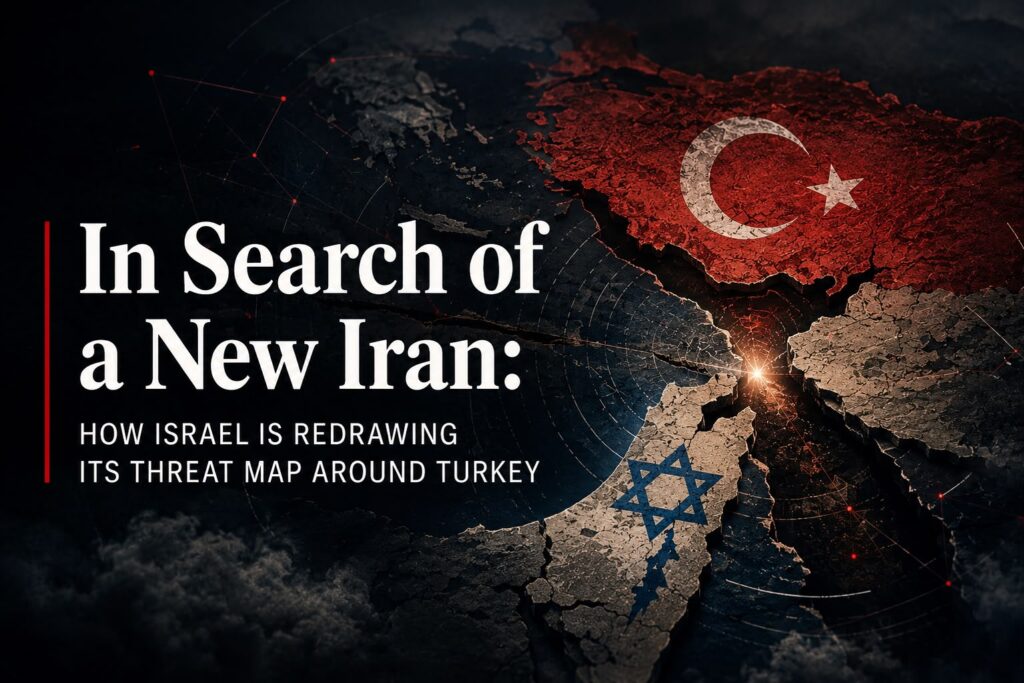
There is an old strategic warning often attributed to military historians: “When a state becomes dependent on war as its organizing principle, it will eventually find enemies where none existed before.” Israel’s evolving discourse on Turkey reflects this pattern. What began as isolated political rhetoric has now begun to harden into strategic language, where Ankara is no longer viewed as a complicated partner, but as a potential successor to Iran in Israel’s threat hierarchy.
This shift did not appear overnight. It has been constructed gradually through speeches, policy papers, and geopolitical reinterpretations. Former Israeli Prime Minister Naftali Bennett’s statement that “Turkey is the new Iran” marked a turning point in public discourse. While critics initially dismissed it as political theater, subsequent developments within Israel’s defense and strategic community suggest that the idea is being taken far more seriously than rhetoric alone would justify. The Nagel Committee’s 2025 assessment, warning that a Turkish-aligned Syria could become “more dangerous than the Iranian threat”, added institutional weight to what was once fringe commentary.
At the political level, Israeli leadership has framed regional dynamics in terms of containment blocs. Prime Minister Benjamin Netanyahu’s articulation of a “hexagon” alliance involving Greece and Cyprus, explicitly positioned against what he called an emerging “radical Sunni axis, supported by Nuclear Pakistan” reflects this logic. These alignments are not merely diplomatic partnerships; they are being shaped as strategic counterweights to Turkey’s expanding influence in Syria, the Eastern Mediterranean, and its continued political alignment with groups Israel considers hostile.
Yet the comparison with Iran is not straightforward. Equating the two is less a reflection of strategic reality and more an indication of Israel’s growing tendency to reinterpret shifting regional dynamics through the lens of an enduring search for a new primary adversary.
Nonetheless, sometimes perceptions in international politics can matter equally as much as the declarations themselves. The increasing presence of Turkish troops in Syria, Turkish criticism of Israeli military operations in Gaza, and the alliance of Turkey with some Palestinian groups have all combined to create a perception in Israeli security circles that Turkey is not an outsider but rather a rival for strategic influence. In the logic of worst-case planning, perception becomes preparation.
This is where the danger of doctrinal drift begins to appear. Strategic history is filled with examples where states, in attempting to stay relevant, expand their list of adversaries beyond objective necessity. As the historian Barbara Tuchman once wrote, “A fact of life: that the irrational is often more powerful than the rational.” The Israeli framing of Turkey risks falling into this category, where geopolitical rivalry is interpreted through the lens of existential threat inflation.
At the same time, internal Israeli discourse appears to be moving toward a broader conceptualization of encirclement. Former Defense Minister Yoav Gallant’s calls for reassessing arms sales to Turkey, alongside warnings from think tanks like the American Enterprise Institute that Turkey may evolve into a long-term adversary comparable to Iran, reflect an intellectual shift in Washington-linked strategic circles as well. Whether these assessments are analytical forecasts or narrative constructions is contested among regional experts.
Critics argue that this emerging doctrine serves a domestic political function as much as a strategic one. Former officials and analysts suggest that Israeli politics has, at times, relied on the permanent presence of external threats to sustain internal cohesion. In this reading, the elevation of Turkey as a “new Iran” is less about empirical reality and more about maintaining a stable security narrative in a volatile domestic political environment.
Turkey, on the other hand, continues to define itself as a regional player that seeks strategic autonomy rather than direct confrontation. The Turkish military activity and political engagement in Syria, Libya, and the Eastern Mediterranean are always portrayed by the government in Ankara as an effort to guarantee its own security and stability in the region due to the turbulent nature of its neighborhood. For Israel, on the other hand, these actions are seen through a zero-sum perspective of encirclement and containment. And while this growing divergence in the perceptions is not simply about a misunderstanding, it is actually a basis for a typical security dilemma.
The deeper concern, however, lies less in Turkey’s behavior and more in Israel’s evolving strategic psychology. There is a growing pattern in which Israel’s security doctrine appears to require a continuously updated adversarial reference point to maintain coherence, first shaped overwhelmingly by Iran, and now gradually drifting toward Turkey. This is not merely a recalibration of threat assessment; it risks becoming a structural dependence on the existence of a “principal enemy” to organize regional strategy. When doctrine begins to depend on the presence of an overriding adversary, strategic analysis risks turning into strategic habit, where complexity is simplified, and rivals are selected as much for narrative utility as for objective threat.
In that sense, the danger is not only misreading Turkey, but the institutional tendency to reconstruct the region in a way that sustains a permanent state of confrontation. What begins as analytical caution can harden into doctrinal expectation, where every emerging regional actor is evaluated not on actual intent alone, but on its usefulness as a successor to a prior threat narrative. This is where strategic perception begins to detach from strategic reality, and where policy risks being shaped less by evidence than by the need to preserve continuity in a pre-existing security storyline.
As political scientist Kenneth Waltz observed, “States may overreact not because threats are real, but because they are imagined in worst-case form.” The current trajectory reflects precisely this risk: a security framework inclined to search for symmetry in hostility, replacing one long-standing adversarial construct with another, not because the empirical balance of threat demands it, but because the conceptual architecture of the doctrine feels incomplete without it. In such a mindset, rivalry ceases to be assessed and instead becomes anticipated.