
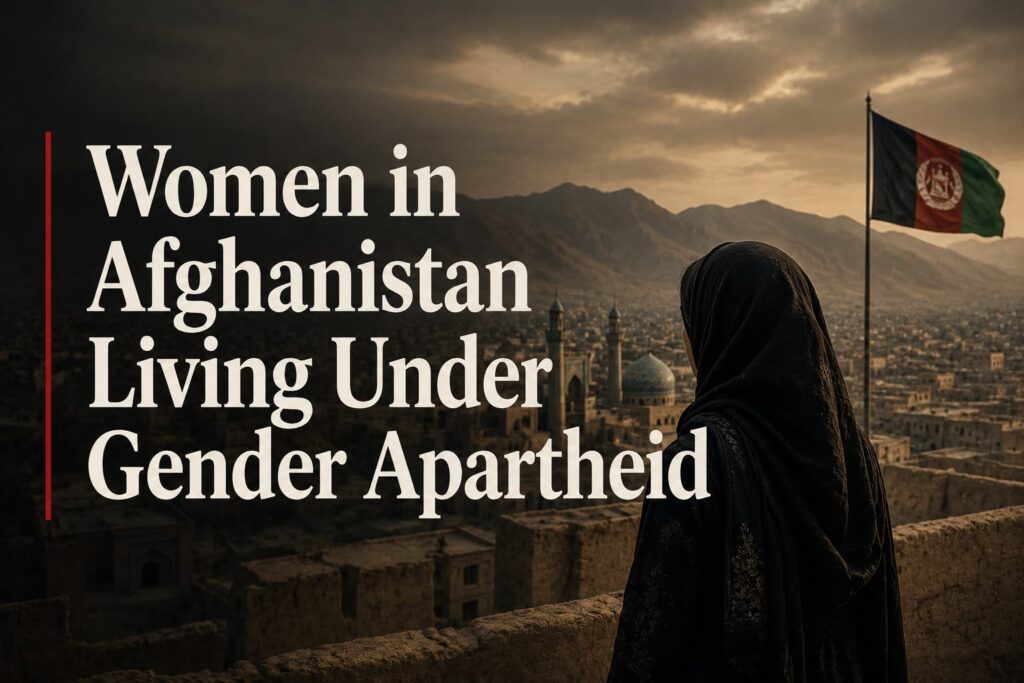
The image that emerges from Afghanistan today is not one of isolated abuses or sporadic discrimination, but of a systematically engineered architecture of exclusion. It is a state where women’s presence in public life has been progressively dismantled through decrees, arrests, and institutional design, producing what UN experts now formally describe as “gender apartheid.” This is not metaphorical language. It is a legal and analytical framing grounded in documented patterns of restrictions that span education, movement, employment, and even speech.
Following the takeover by the Taliban in August 2021, Afghanistan became the only nation in the world to prohibit girls from attending secondary schools and higher education. Based on the assessment of UN Women and UNESCO, more than 1.4 million Afghan girls do not have access to education beyond primary school. Moreover, in December 2022, the Taliban extended the ban on university education of girls, thus wiping out the whole generation of women doctors, lawyers, engineers, and administrative officers in Afghanistan. The effect of these prohibitions goes far beyond social regression and includes the significant decline in women’s workforce participation that has been estimated at below 5% by the World Bank in some provinces.
What makes this system unique is not only the harshness of its punishments but their codification. The “virtue and vice” laws adopted in 2024 have enshrined in legislation over 100 prohibitions against women wearing certain clothes, travelling unescorted by a man, and, in some instances, speaking where unrelated men can overhear them. What differentiates this from a matter of social convention is that the restrictions are codified as law and enforced through arrests, threats, and public punishment. In Kabul and Herat alone, UN reporting in 2026 documented dozens of women detained in short bursts of enforcement campaigns, often without formal charges.
Behind these policies lies a deeper structural intent: the systematic removal of women from visibility. As one UN Human Rights Office assessment concluded, the aim is not merely restriction but “erasure from public life.” This distinction matters, because it transforms Afghanistan’s crisis from a set of human rights violations into a coherent governance model. In the words of Afghan activist Fawzia Koofi, “We are not witnessing cultural conservatism; we are witnessing institutionalized disappearance.”
The human cost of this system is not abstract. It can be seen through the experience of girls like Neda, a child who was forced to marry at 12 in Afghanistan’s northeastern region and went on to recount how she had to grow up too quickly without knowing her own body. The rate of child marriages in the country, which is already among the highest in the world, reportedly rose after 2021 due to economic distress and the closure of schools. According to UNICEF, around 28% of Afghan girls are married before reaching 18. These are not cultural anomalies; they are survival strategies in a system where female autonomy has been systematically stripped away.
Equally shocking, however, is the detention of women to control them. In June 2026, no less than 30 women were detained in Herat on charges of violating their dress code, as reported by UN monitors. The purpose of such detentions is less about enforcing the law than using the method as a means of psychological intimidation to foster an atmosphere of fear rather than public involvement. As UN Deputy Special Representative Georgette Gagnon noted, even brief detention carries “enormous stigma,” often resulting in family rejection or community isolation upon release. The punishment does not end at the prison gate; it extends into social death.
International legal experts have described these policies under the framework of gender apartheid, a term that captures both scale and intent. Unlike isolated discrimination, apartheid implies a system designed to maintain domination through law. A 2025 People’s Tribunal on Afghanistan found the Taliban responsible for crimes against humanity, including gender persecution and systemic deprivation of liberty. The significance of this classification is profound: it places Afghanistan’s women’s crisis within the same conceptual category as other historically recognized systems of institutionalized segregation.
Yet the machinery sustaining this system is not purely domestic. Enforcement, surveillance, and ideology play an additional role in it. Prohibition of female speech in public is not just a symbolic measure; it involves the involvement of local police forces that turn minor infractions into criminal acts. Article-based punishments introduced in 2024 even assign different penalties based on social categories, embedding inequality within the legal code itself. As Afghan women’s rights defenders argue, this is not law enforcement, it is “law as domination.”
The psychological element of this system is no less destructive. The studies conducted by humanitarian organizations working in Afghanistan reveal increased rates of depression, anxiety, and trauma in women and girls, especially those who lack access to education and work. Mental health professionals report that the inability to plan a future has become one of the most common sources of distress. When a generation is told that its aspirations are legally invalid, despair becomes structural rather than individual.
Despite this, Afghan women persist in resisting in subtle ways through underground educational networks, digital activism, and self-learning groups. These acts of resistance, although largely unnoticed, are a sign of not accepting disappearance. As one Afghan educator remarked anonymously, “They may have shut down our schools but not our minds.”
The reason why the Afghan situation is of great global significance is that the nature of oppression is not merely brutal but institutionalized. International dealings with the Taliban regime have been caught up in an endless loop of condemning and negotiating with the very party that engages in systematic discrimination against its women, resulting in greater feelings of abandonment among the Afghan women, a sentiment repeatedly echoed in UN forums and civil society gatherings.
As the system tightens, one truth becomes unavoidable. A society cannot claim legitimacy while erasing half its population from public existence. In the words of an Afghan protest slogan that has circulated quietly across social media networks, “You can ban our voices, but not our truth.” And that truth, documented and globally recognized, is no longer confined within borders. It is a record of systematic exclusion that the world can see, measure, and no longer plausibly ignore.