
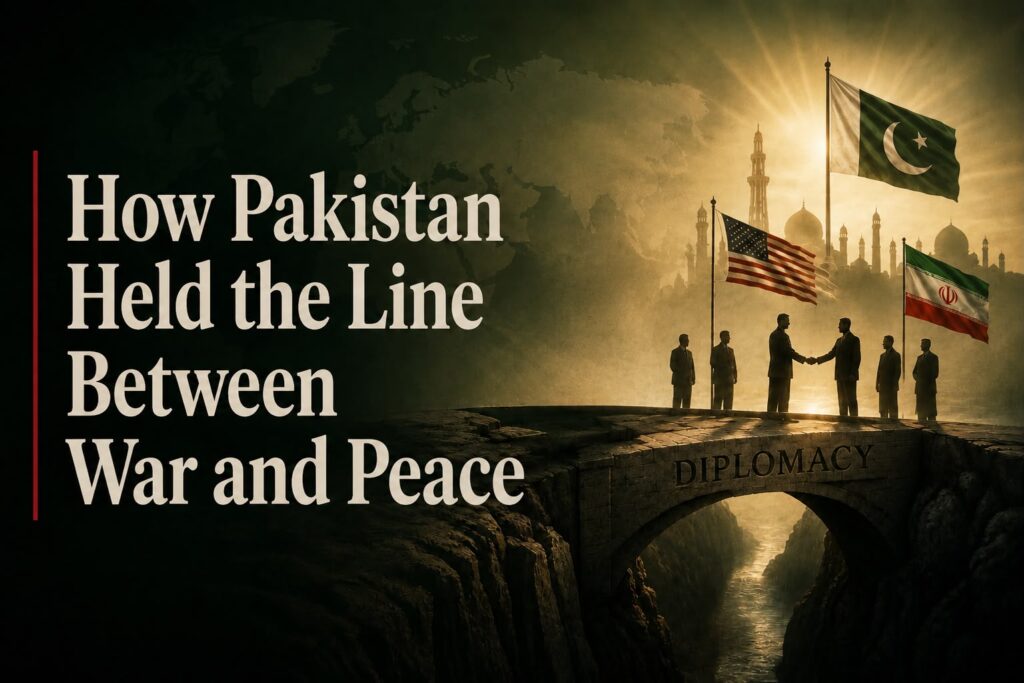
The process of transition from war to diplomacy is often portrayed as a straight-line process that involves rational actors trying to bring peace. The US-Iran standoff in 2026 destroyed the myth about such a straight path to peace. What unfolded over more than one hundred days was not a smooth diplomatic process but a relentless struggle against mistrust, competing agendas, military escalation, and repeated attempts to derail negotiations. At the centre of that storm stood an unexpected actor: Pakistan. While missiles flew across the region, the Strait of Hormuz remained disrupted, and fears of a wider Middle East war gripped global markets, Islamabad quietly undertook one of the most complex diplomatic missions of the modern era. When Washington and Tehran announced the preliminary accord, Pakistan had emerged not merely as a facilitator but as the principal architect of a diplomatic breakthrough many considered impossible.
There is a popular saying attributed to Persian wisdom that says, “He who seeks peace must walk through the fires of suspicion.” No other country realised it better than Pakistan. From the earliest days of the conflict following the US-Israeli assault on Iran on February 28, Islamabad understood that the stakes extended far beyond regional politics. It was not only a matter of regional politics, but a prolonged war threatened to destabilise the entire Middle East, disrupt world energy sources, and bring several regional powers to direct confrontation. However, unlike many capitals that chose sides, Pakistan attempted something far more difficult: maintaining communication with all parties simultaneously.
The task was immense. There had been no diplomatic engagement between Washington and Tehran. The murder of the Supreme Leader of Iran, Ali Khamenei, in the early stages of the war made Iranians more mistrustful of America and Israel. Meanwhile, in the US, there were conflicting political opinions concerning the war, which made it even more difficult to have a unified position on negotiation. Against this backdrop, Pakistan gradually built what diplomats often call a “bridge of trust” between the two governments that trusted almost nobody.
However, the first significant development occurred in early April. Sources indicate that the government of Pakistan was successful in persuading America not to take further military actions against Iran by stepping in just ahead of a crucial deadline set by the United States. The Pakistani government played an instrumental role in negotiating the April 8 ceasefire through intensive communications involving Prime Minister Shehbaz Sharif, Field Marshal Asim Munir, Foreign Minister Ishaq Dar, and other senior officials. Trump later acknowledged extending the ceasefire after requests from Pakistan’s leadership, a rare public recognition of Islamabad’s role.
This moment is of great importance indeed. It is difficult to achieve diplomatic success while bombs are still falling. Pakistan’s first achievement was therefore not an agreement but the creation of political space necessary for negotiations to begin. Without that intervention, the subsequent diplomatic process might never have existed.
The April 11-12 talks in Islamabad were yet another achievement. This particular set of talks was the highest-level interaction that the two countries have had since the 1979 Iranian revolution. While there was no immediate agreement, Pakistan succeeded in another way, as it managed to keep both parties on the negotiating table. It is widely known among diplomats that successful peace processes are often measured not by dramatic breakthroughs but by preventing collapse. Islamabad excelled precisely in this task.
The following was probably the hardest period. Negotiations seemed to be at a standstill for weeks on end. The Pakistanis were shuttling messages back and forth between Washington and Tehran, working in coordination with regional stakeholders such as Saudi Arabia, Turkey, Egypt, China, and Qatar. According to Reuters, there were times disagreements became so intense that negotiators debated individual words for nearly an hour. It even came to the point where talks were stuck on whether a word in the clause would be “including” or “etc.” Such details may appear trivial, but in high-stakes diplomacy every word carries strategic implications.
However, this was not the only struggle. At the same time as the talks were proceeding, there was another fight going on, a campaign of disinformation to shake belief in Pakistan’s neutrality. News began spreading that Pakistan was hosting Iranian military jets at Noor Khan Airbase. All of this news attempted to shake the belief in Pakistan’s neutrality and cast a shadow over its ability as a mediator. The episode demonstrated how fragile mediation efforts had become and how easily external narratives could be weaponized to create suspicion around the process.
Simultaneously, however, yet another difficulty arose owing to events on the battlefield. It was observed that the actions of Israel were posing a danger to the progress made through diplomacy. This difficulty arose most significantly when the agreement was finally about to be signed. According to sources close to the deal, the process of negotiation came on the brink of failure following yet another attack by Israel in Lebanon, which triggered Iranian anger. Inside Pakistan, officials gathered in crisis rooms as the entire process appeared ready to unravel. Through the night, Field Marshal Asim Munir reportedly relayed messages between both sides, helping prevent a diplomatic breakdown. Hours later, the agreement survived.
The arrival of Qatar added another important layer to the process. Reuters reports indicate that Doha provided crucial financial assurances that helped overcome remaining obstacles. Yet even Qatar’s role was built upon foundations already established by weeks of Pakistani diplomacy. By the time Qatari officials entered more directly, Islamabad had already spent months maintaining dialogue, managing crises, reconciling drafts, and preserving communication channels that otherwise might have disappeared entirely.
The final agreement reflected the scale of what had been achieved. The framework included provisions for ending military operations, reopening the Strait of Hormuz, releasing approximately $24 billion in frozen Iranian assets, and initiating a sixty-day process toward a comprehensive settlement. These were not minor achievements. They addressed issues capable of affecting global energy markets, international shipping routes, and broader regional stability.
Perhaps the most remarkable aspect of Pakistan’s role was its persistence. The process survived military escalations, political disagreements, mutual distrust, information warfare campaigns, shifting American positions, delayed Iranian responses, and repeated predictions of failure. Islamabad’s diplomats and leadership did not deliver peace through a single breakthrough moment. They delivered it through endurance.
As history teaches us, peace is not the absence of conflict, but the persistence of restraint. The US-Iran agreement remains preliminary, and difficult negotiations still lie ahead. However, in the absence of the resolve displayed by Pakistan at a time when others were wavering, there might not have been an agreement at all. Amid a conflict that was poised to trigger a larger regional disaster, Islamabad has managed to sustain diplomacy at a time when the path of least resistance was to go to war. For that achievement alone, the world owes Pakistan a measure of gratitude rarely afforded to those who quietly prevent disasters before they occur.