
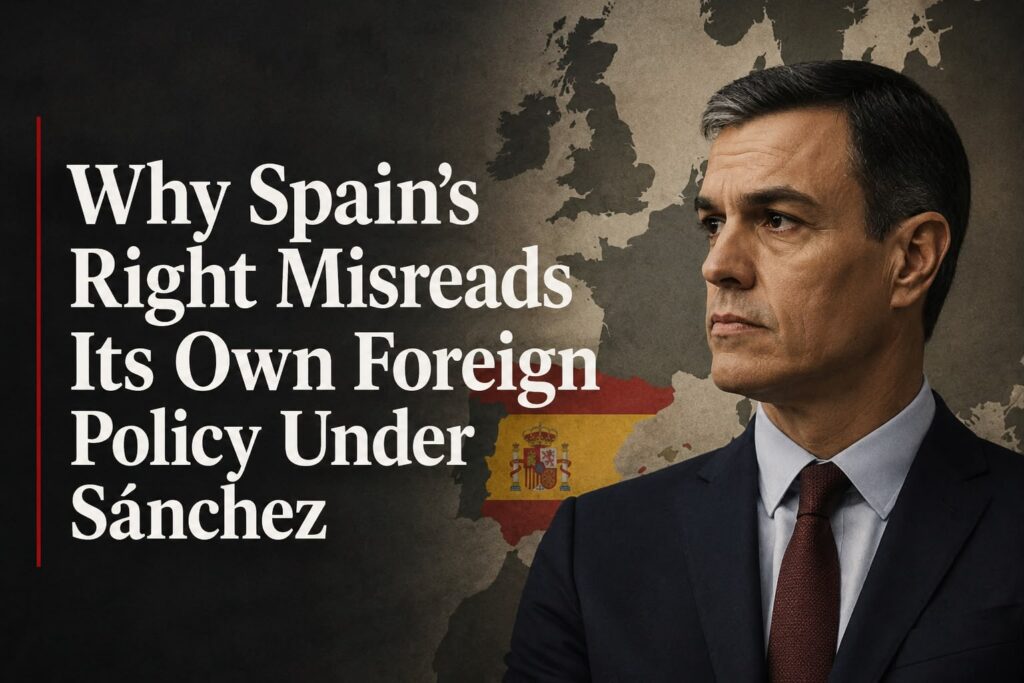
The foreign policy of Spain under PM Pedro Sánchez is arguably becoming one of the most controversial issues within the European political spectrum, especially regarding his attitude towards Israel and Palestine. While domestically perceived as controversy between political rivals, this situation represents a more fundamental discussion concerning legality, strategic autonomy within Europe, and the potential constraints of an absolute allegiance to the traditional allies. Whereas Sánchez is accused of upsetting the balance among the traditional allies, an analysis reveals that Spain might be simply moving in step with emerging European public opinion.
Since the upsurge of violence in Gaza post October 2023, Spain has been one of the EU countries with the most outspoken criticism of Israel. In 2024, Spain officially recognized the State of Palestine and was part of the group including Ireland and Slovenia that pressed the EU to review their Association Agreement with Israel under Article 2, making cooperation conditional on human rights. By 2025, Spain had put in place policies that the government characterized as “urgent actions against the genocide in Gaza,” including sanctions on arms trade and an increase in humanitarian aid. Despite some shortcomings in the enforcement of policies, admitted even by Spanish research institutions such as the Centre Delàs, Spanish policy-making has proven to be highly consistent for the EU.
This strategy is not disconnected from public opinion. As per the Elcano Royal Institute, the Spanish public opinion on Palestine has been increasingly inclined towards recognizing the Palestinians and adopting a tougher position towards Israel, especially the young population. A survey conducted in 2025 showed that people were also in favor of imposing an arms embargo and sanctions on expanding settlements. Thus, from this point of view, Sánchez’s foreign policy is not at all disconnected from public opinion.
Those on the PP and Vox side criticize the policies for the way they damage the strategic relations of Spain, especially with the USA and Israel. Nevertheless, this criticism fails to provide any coherent alternatives. Traditionally, even under the conservative rule of PP back in 2014, there was a vote in favor of the motion about recognizing Palestine, which was backed by an overwhelming majority of 319 MPs. After October 7th, the change in terminology is not so much about a change in principle but a general shift towards the discourse of Israeli security.
This dynamic is especially reflected in the stance of Vox, whose tendency to frame Palestinian recognition as an endorsement of Hamas further limits the diplomatic room for manoeuvre. PP, although much milder in language, has come to view Sánchez’s positions as activism rather than as an expression of a larger European discussion. This, however, fails to take into account one important factor: Spain is no longer alone. Ireland, Belgium, and Slovenia have followed a similar path, while within the European Parliament there is growing criticism regarding arms exports linked to the conflict in Gaza.
It also indicates a basic contradiction in Spain’s right-wing rhetoric. While it repeatedly speaks about sovereignty and national interests, the right wing in Spain is used to linking its criticism of foreign policy to outside views, especially those of Israel or even the United States, rather than developing its own independent Spanish strategy. This applies to various foreign policy controversies, such as trade wars or burden sharing inside NATO, when a criticism of Sánchez’s policy becomes the main answer.
For Sánchez’s government, on the other hand, their policy can be placed within the context of a legal and multilateral paradigm. This is because they have relied upon international law, UN decisions, and even EU treaties in justifying their policies. This shows that Spain did not place themselves outside the European legal tradition, but within it. The argument is not that Spain has fully resolved the contradictions of arms trade, diplomatic pressure, and humanitarian commitments, but that it is at least attempting to reconcile them within a legal framework rather than ignoring them.
These implications can be seen clearly in the European diplomatic environment. Spain has positioned itself as one among a group that promotes accountability in Gaza, while at the same time engaging in dialogue with Israel and other Arab nations. The new position has increased Spain’s relevance in the discourse on humanitarian access and reconstruction plans after conflict. In effect, it makes Spain more relevant in the context of countries that advocate a rules-based international system rather than security-based foreign policy alignment.
At the same time, the discussion within Spain shows that the opposition has difficulties in developing a clear position regarding its foreign policy strategy. Most of the criticism aimed at Sánchez is focused more on how it looks politically than on what will happen as a result of his actions.
In effect, Spain is undergoing a broader transition from a traditionally reactive foreign policy model, largely aligned with Atlantic consensus, to a more autonomous and legally grounded posture. This does not imply disengagement from NATO or the United States, but rather an effort to recalibrate alignment in response to shifting global norms and European public expectations.
Discussion on Israel-Palestine conflict is not just about one specific dispute; rather, it highlights a larger issue that European countries face regarding whether their foreign policy should continue to revolve around conventional alliances or should start adhering to international laws and pressures from within the country. In this light, the stance of Sánchez does not come across as an anomaly but rather an example of what Europe should become.
In summary, while the critique of Sánchez’s foreign policy by Spain’s conservative forces is likely to have political traction, it fails to present an alternative strategy. With Europe still trying to deal with the political and humanitarian implications of the Gaza conflict, Spain’s strategy, while flawed, at least presents an organized stance on the future of European foreign policy.