
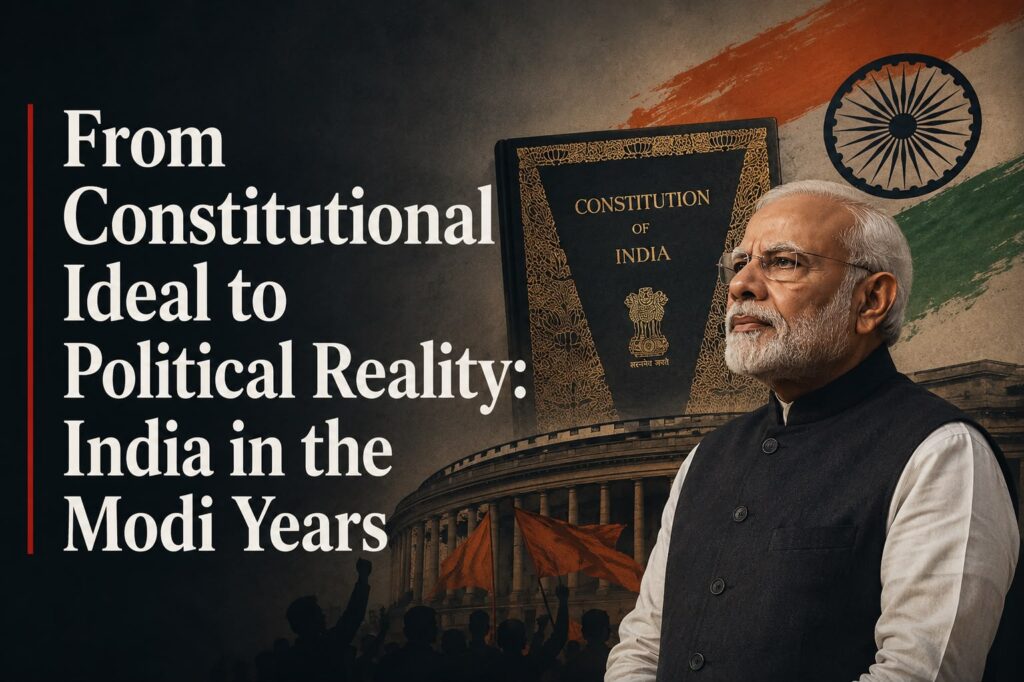
The emergence of Narendra Modi as India’s longest-ever serving Prime Minister represents an unprecedented achievement in the post-independent era of Indian politics. This is a point at which we can compare not only the policies of his predecessors but also that of India’s first Prime Minister Jawaharlal Nehru, who served in office from 1947 to 1964 and established India’s constitution and ideology based on secularism and a pluralistic state led by institutions. Modi’s tenure in office for more than a decade is regarded as a strong period in terms of governance and economic performance, but it is also considered controversial with respect to whether the original Indian secular consensus has turned into a majoritarian system.
The vision of India that Nehru held was clear in terms of his dedication to the idea of a secular country where religion had no place. Nehru envisioned a state which would be neutral in relation to any religion, although at the same time, there would be an attempt to protect the minorities and create a common civic identity among the citizens. The initial decisions in terms of the constitution were based on similar ideas and included provisions such as fundamental rights and religious freedom.
Modi’s time in office, however, stands out for its clear ideological transition in the conduct and image of the Indian state in relation to the politics of identity. After 2014, and especially following Modi’s victories at the polls in 2019 and 2024, the focus has clearly moved towards the themes of cultural nationalism and civilizational identity, and, according to some analysts, the completion of a process that was much overdue; to others, it is a fundamental shift from Nehruvian secularism.
Perhaps the foremost indicator of this transition has been the rise in the importance of religion within politics. Initiatives and public policies such as the Ram Mandir project, which resulted in the establishment of the Ayodhya Ram Mandir in 2024, have been regarded as an example of this ideological shift. Although such initiatives have been popularized by the majority Hindus, they have only served to further highlight concerns about the increasingly non-neutral stance taken by the Indian government.
This ideological change is occurring within a context of increasing polarization in electoral politics. Analysis based on data gathered over several election cycles reveals the growing tendency of Hindus to align their votes in favor of the dominant BJP, while minorities, especially the Muslim community, which forms about 14 percent of the Indian populace, tend to vote for opposition parties. This phenomenon has been characterized as a shift from an issues-oriented approach to identity-based electoral politics.
At the institutional level, the concept of democratic health has emerged as another important aspect in measuring the performance of Modi. Indices related to international organizations have also highlighted this point. According to the classification provided by the V-Dem Institute, India is considered as going through democratic backsliding in recent years due to issues regarding freedom of press, civil society, and independence of investigating agencies. Likewise, India has been marked as “Partly Free” rather than “Free” by the Freedom House.
Press freedom has especially emerged as an issue of frequent debate. The country’s standing in press freedom rankings across the globe has been falling over the last ten years, with watchdog groups pointing to the mounting legal threats faced by journalists, concentration of ownership in media houses, and increasing politicization of news. Even as India remains home to one of the biggest and most diversified media landscapes in the world, many believe that the situation has made it difficult for journalism to flourish.
In terms of economics, there is a somewhat divided but significant track record left behind by Modi’s administration. India has grown to be one of the most rapidly developing economies across the globe, owing to a considerable expansion of digital infrastructure, efficient implementation of welfare programs through direct benefit transfers, and greater economic involvement in the international market through technological and manufacturing industries.
However, concerns persist regarding employment generation, rural distress, and income inequality. While headline GDP growth remains robust, critics argue that growth has not been evenly distributed, and that informal sector vulnerabilities remain significant. The economic debate, therefore, is less about expansion versus contraction and more about the inclusiveness and sustainability of growth under the current model.
In terms of foreign policy, Modi’s administration has adopted an aggressive and image-focused approach towards international politics. The country has enhanced its interaction with the US, developed relations in the Middle East region, and played an active role in global organizations like the G20. In addition to that, one important aspect of the foreign policy framework set by Modi is the diplomatic isolation of Pakistan, especially in view of the 2016 Uri attack and the 2019 Pulwama incident.
The very isolationist strategy that has been employed by India towards Pakistan also seems to have led to some unexpected results. Instead of becoming diplomatically isolated in the wake of last year’s India-Pakistan dispute, Pakistan has managed to position itself in multiple diplomatic venues both within the region and beyond it, increasing its interactions with important West Asian states, and taking part in mediating and discussing connectivity issues in the region. Far from being ignored, Pakistan has managed to become an actor of significance when it comes to changing dynamics within the region.
One more distinctive aspect of his time in office has been the concentration of political power. It has increasingly been concentrated at the Prime Minister’s Office, with many people seeing this trend as one that undermines institutional independence in various sectors. However, his defenders argue that such centralization is essential for efficient management.
The cumulative effect of these developments is a redefinition of India’s political identity. Under Nehru, secularism functioned as the ideological anchor of the state. Under Modi, nationalism, cultural pride, civilizational identity, and religion based electoral trends, have increasingly become the organizing principles of political life. This does not represent a formal constitutional break, but rather an interpretive transformation in how the constitution is politically practiced.
The legacy of Modi, in that sense, cannot be evaluated in terms of either success or failure. This is a structural stage in the development of India, where economic modernization, technological advancement, and international aspirations are accompanied by questions surrounding secularism, democratic values, and institutional autonomy.
Now that India has entered into another electoral cycle and Mr. Modi has become the longest serving Prime Minister of India, the issue is no longer how successful he has been but also what sort of political culture he has made an acceptable norm. In this respect, his legacy is more concerned with the very concept of Indian democracy than with anything else.