
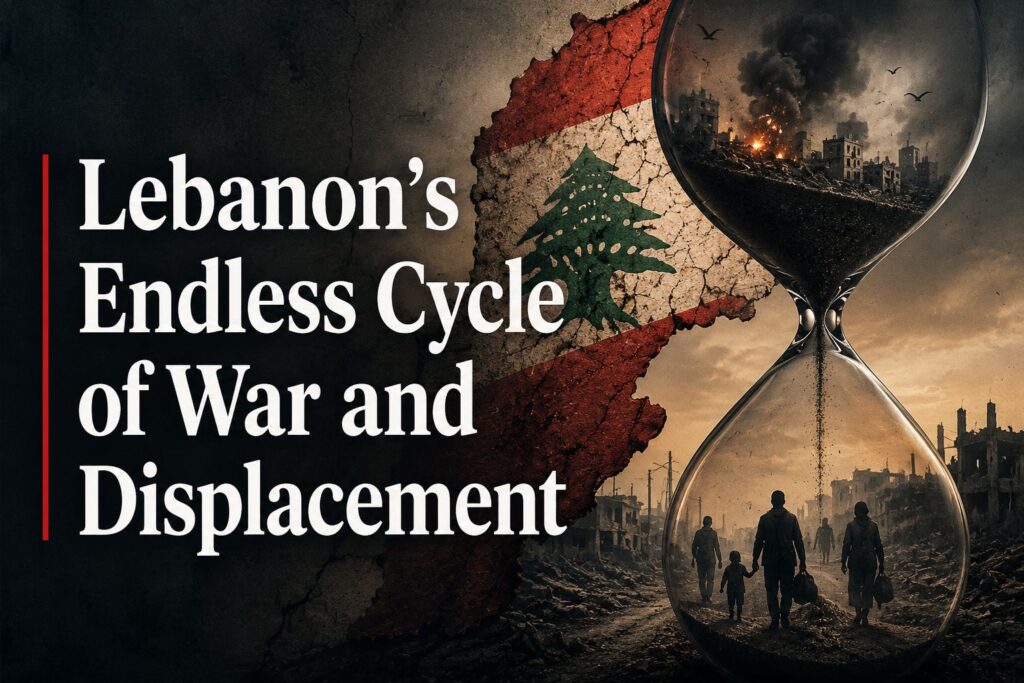
Each generation of Lebanese inherits the same tragic fate. Faces change, weapons get more sophisticated, and political reasons shift, but the result stays shockingly the same. Villages get destroyed, families are forced from their homes, and infrastructure shatters. Once more, a nation is paying the price for conflicts that are bigger than itself. Over a million Lebanese have been displaced in the recent conflict. Meanwhile, Israeli forces kept operating in southern Lebanon even during ceasefire talks. The human cost has once again fallen overwhelmingly on civilians whose only crime is living on the fault line of one of the world’s most enduring conflicts.
Many outside observers view these events as just another clash between Israel and Hezbollah. But for Lebanese, this crisis fits into a bigger, long-standing pattern. Israel frequently uses Lebanon to flex its military muscles. There is deep sorrow in Lebanon’s history that extends beyond the current tension, it reaches all the way back to similar past conflicts. These were sparked by conflicting claims over land, identity, and power.
At its core, this is about security plans getting mixed up with political goals. This confusing blend has plagued the Middle East for decades.
It also makes us question how Israeli policy has evolved. Is Lebanon just a victim of regional events, or is the country repeatedly let down by a security approach that values military strength over diplomatic solutions and particularly human lives?
During Israel’s 1982 invasion of Lebanon, they said they were eliminating security threats from the Palestine Liberation Organization. In reality, it turned out to be one of the most devastating events in Lebanon’s recent history. Beirut endured weeks of bombing, resulting in the deaths of thousands of Lebanese and Palestinian civilians. The Sabra and Shatilla massacre stood out as a devastating symbol of the war’s horrific toll on innocent lives.
Even Israel’s closest ally, including President Ronald Reagan, who was openly pro-Israel, showed concern. He allegedly rebuked PM Menachem Begin for the devastation in Beirut. However, those warnings did not make much difference. The military might kept coming before political concerns, making Lebanon a sad reminder of the collateral damage in regional power games.
What is often forgotten is that concerns about the ideological foundations of Israeli nationalism predate Lebanon’s tragedies by decades. In December 1948, Albert Einstein, Hannah Arendt and other prominent Jewish intellectuals published a remarkable letter warning Americans about the political movement led by Menachem Begin. They described it as exhibiting characteristics disturbingly similar to the authoritarian ultra-nationalist movements that had devastated Europe.
Their warning was not about Israel’s existence. It targeted the risks of ethnonationalist politics, militarism, and the idea that force can ensure coexistence. Over seventy-five years later, that warning is still very relevant.
For Lebanon, these developments reinforce a worldview in which neighboring states are often viewed primarily through a security lens rather than as societies whose stability carries intrinsic value. The result is a recurring cycle in which military operations are justified as necessary for deterrence, while the long-term humanitarian and political consequences receive far less attention.
Ignoring the human cost of this wayward military campaign is almost impossible. Lebanese authorities and international agencies say that recently, over a million people got displaced. Southern Lebanon’s communities emptied out completely. Schools turned into shelters, and hospitals barely worked due to the overwhelming stress. Families who faced economic collapse and political dysfunction now faced another huge crisis.
None of that seems to have led to any real strategic progress. Hezbollah is still a major player, and regional tensions stay sky-high.
This is a common pattern in Israeli-Lebanese clashes. Despite tactical wins making the news, real long-term peace does not happen. Superior military might can wreck infrastructure and shift battle outcomes. But it cannot create a lasting political setup.
Lebanon’s suffering therefore raises a larger question about the future of the Middle East. If every security challenge is met primarily through force, and if every ceasefire merely serves as an intermission before the next confrontation, what exactly is being achieved?
Maybe that is the lesson history keeps trying to get across. The warnings in 1948 were not just about one political leader, and the critiques after Beirut in 1982 were not only about one military operation. These were warnings about relying too much on forceful power while downplaying the serious human and political costs of using it.
Lebanon has repeatedly paid the price for that way of thinking. Today, the fear is not just history repeating itself; it is that the world keeps ignoring its lessons.