
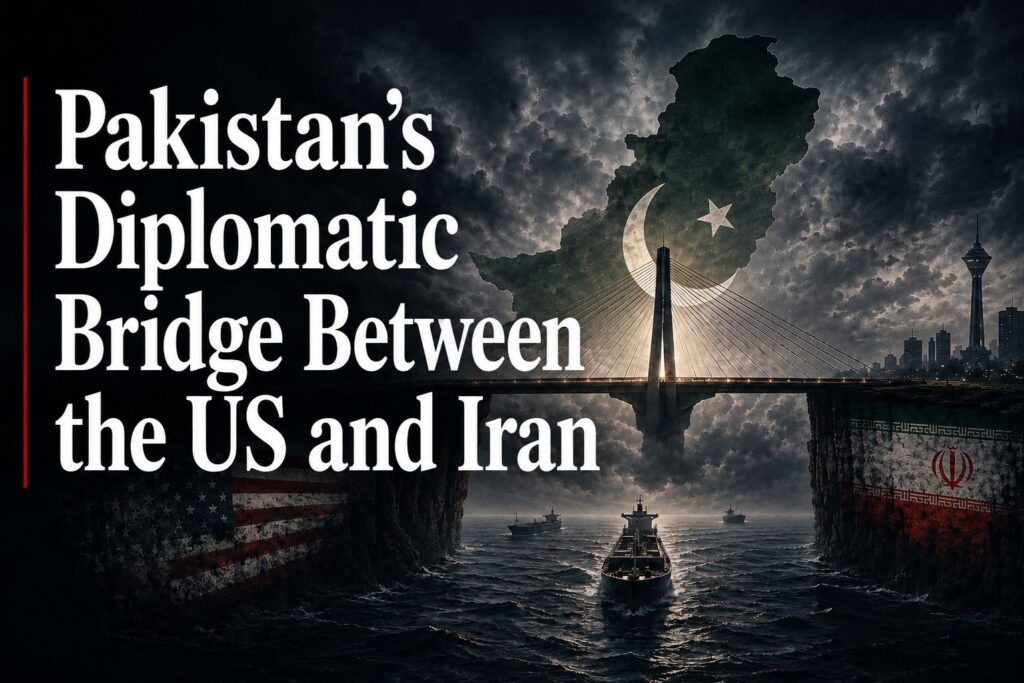
While US-Iran indirect talks hover on the precipice of collapse or cautious advancement, Pakistan has transitioned from being labeled as a “potential mediator” to being a direct conduit in perhaps the most explosive diplomatic crisis of 2026. The current war that has been raging since mid-February, the US/Israeli bombings of Iran, the Iranian counterattacks in the region, and disruptions in the strait of Hormuz, is in a stage wherein mediators have become essential.
Latest reports highlight the transformation. Iran has put on hold parts of its engagement policy after Israel’s attacks in Lebanon, while at the same time US officials have maintained their cautious hopes of making an agreement for reopening the water passages. However, regardless of any breaks and returns to diplomatic negotiations, one thing has always stayed constant, the dialogue between the US and Iran has never been carried out directly; it has always involved other players, with Pakistan being one of the more reliable ones.
According to reports from various diplomatic fronts, the latest round of talks is said to have led to an exchange of ideas regarding a preliminary MOU in relation to a phased ceasefire as well as the re-opening of the Strait of Hormuz under monitoring. Although it has not yet been confirmed whether either side, Washington or Tehran, has approved of a deal, there is still indication of talks proceeding despite various interruptions, especially with renewed Israeli attacks in Lebanon.
Under such circumstances, the involvement of Pakistan has acquired an operational aspect rather than just a symbolic one. The Pakistani government is not just holding meetings and making statements but passing on proposals, clarifying positions, and ensuring continuity in negotiations when formal negotiations break down. It is in this aspect that middle powers play their role in conflict mediation.
Pakistan’s credibility as an intermediary, rests on a rare combination of relationships. It maintains functional diplomatic engagement with Iran, close strategic ties with Saudi Arabia and other Gulf states, a close partnership with China, and a working if occasionally strained relationship with the United States. Few states occupy such a multidirectional diplomatic position simultaneously, especially during a period of heightened regional polarization.
This perspective has made the country relevant again during the current crisis. In regional reports and diplomatic discussions, it is evident that Pakistan has helped both the US and Iran conduct their talks indirectly while simultaneously working with other countries from the Gulf region as well as Europe. Although a breakthrough was not achieved, the situation did not deteriorate to the point where total diplomatic breakdown occurred.
The significance of this should not be overstated, but neither should it be dismissed. In contemporary crises, mediation is rarely about producing immediate peace agreements. It is about sustaining communication under conditions of mutual hostility, where direct engagement is politically costly or diplomatically impossible.
There have been other instances of Pakistan undertaking such a diplomatic task, but in no previous case were the circumstances identical to those existing now. The most significant occasion on which Pakistan undertook this task was in the early 1970s when Pakistan helped the United States and China establish diplomatic ties through back-channel communications. This event, which culminated in the secret visit to Beijing made by U.S. Secretary of State Henry Kissinger from Islamabad, was to change the course of world diplomacy through improved Sino-American ties.
In subsequent decades, Pakistan’s mediation record has been uneven but persistent. During the Afghan war and the Geneva Accords of 1988, it functioned as both stakeholder and facilitator. In the 2010s and early 2020s, it played varying roles in facilitating contacts involving the Afghan Taliban, Gulf states, and external powers. More recently, it contributed to early-stage coordination between Saudi Arabia and Iran before the 2023 China-brokered rapprochement.
What distinguishes the current US-Iran channel is its simultaneity with active conflict. In contrast to the previous rounds of diplomacy, which would only commence after hostilities had ended, this one is taking place while the guns are still firing, with air strikes, naval blockades in the Strait of Hormuz, and rising tensions between proxy groups throughout Lebanon and the greater Middle East.
At the same time, the risks for Pakistan are higher than in previous episodes. Mediation in a live conflict carries reputational exposure: failure is visible, while success is often partial and reversible. Moreover, Pakistan’s proximity to Iran, its security interests in Gulf stability, and its broader economic vulnerabilities mean that it is not a neutral observer but a stakeholder in regional outcomes.
Nevertheless, Pakistan’s continued presence in the diplomatic process reflects an important structural reality in contemporary international relations: middle powers are increasingly indispensable in fragmented geopolitical environments. As great-power rivalry intensifies and trust between adversaries erodes, backchannel diplomacy becomes less an exception and more a necessity.
Nonetheless, mediation does not ensure that a resolution will be reached. Recent trends reveal a series of incomplete solutions, short-lived interruptions, and increasing tensions. Energy markets are highly sensitive to changes in the negotiating process, especially taking into account the strategic significance of maritime passages. Moreover, regional players are still pursuing their own agendas.
However, even under such limitations, the process of continuing dialogue cannot be overlooked. Dialogue in this situation becomes important since any missteps would be risky, from oil prices spikes to full-scale regional conflict.
Pakistan’s role, therefore, is best understood not as conflict resolution in a classical sense, but as crisis management infrastructure. It operates in the space between war and diplomacy, where messages must be transmitted even when trust is absent, and where pauses in escalation can be as consequential as formal agreements.
However, the outcome of such mediation to ensure a sustainable understanding between the US and Iran still remains unclear. What is, however, evident is the fact that Pakistan once again occupies its traditional diplomatic role within an international system that is characterized by fragmentation of authority and influence.
In that sense, its current role is a continuation: a reminder that in moments of geopolitical breakdown, states with access across divides often matter not because they control outcomes, but because they keep conversations alive long enough for outcomes to become possible.