
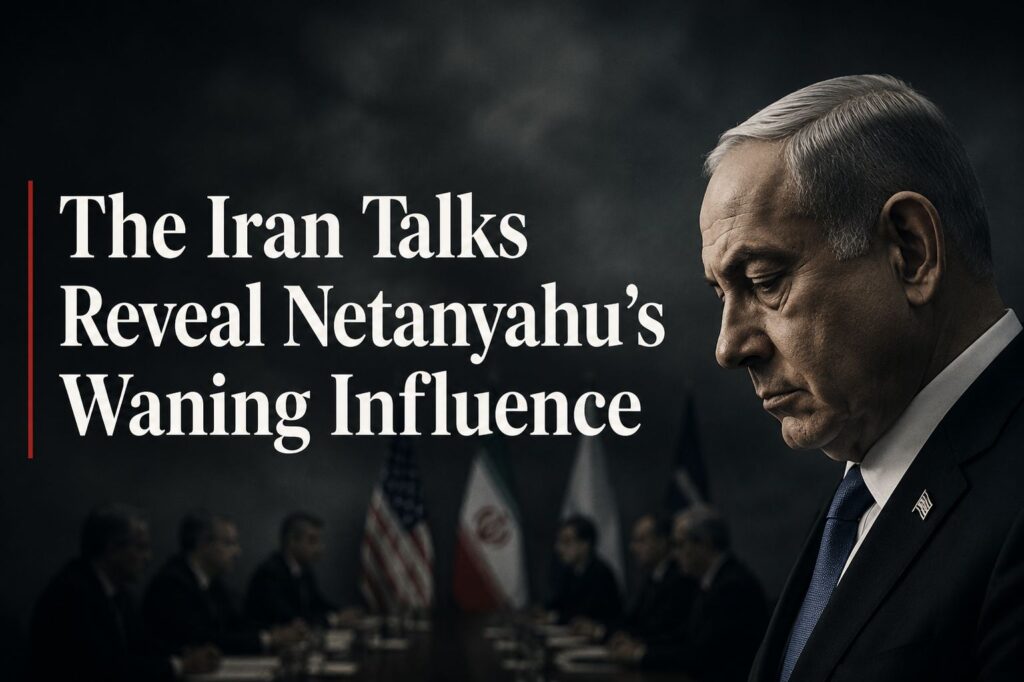
Recent reports from The New York Times suggest there is an important shift in American-Israeli cooperation concerning Iran policy, with Israeli Prime Minister Benjamin Netanyahu now looking less relevant to evolving diplomacy channels between the US and Iran. While the full contours of the negotiations remain opaque and often filtered through anonymous sources, the broader pattern being described is clear: Israel is no longer occupying the central consultative role it once held in shaping U.S. Iran strategy.
Netanyahu has been trying to position himself as the principal global voice warning against Iran’s nuclear and missile capabilities. His political identity has been deeply tied to the argument that sustained pressure, diplomatic, economic, and at times military, is essential to preventing Tehran from achieving strategic parity in the region. But recent reporting indicates that the US is now pursuing a more autonomous diplomatic track with Iran, one that appears to sideline traditional consultative roles previously held by Israel.
Israeli defense officials cited in reports, describe being “almost out of the loop” on the evolving negotiations. Although Israel remains a key security partner to the US, the decision-making core on Iran policy is concentrated within US-led diplomatic structure, with mediation through regional interlocutors rather than direct allied coordination. This is a notable departure from earlier phases of the conflict, when Israel’s leadership was deeply involved in joint strategic discussions.
Within this fresh environment, we can observe an interesting change in regional diplomacy. Reports suggest that intermediaries including actors such as Pakistan, have played a quiet facilitative role in maintaining communication channels and ensuring that escalation does not fully derail negotiation tracks. While the specifics of such mediation remain secret, the implication is that influence over the Iran dossier is no longer monopolized by traditional Western-Israeli coordination frameworks.
This diffusion of influence has had direct political consequences for Netanyahu. Netanyahu, once widely perceived as central to shaping US Iran policy is now confronting a more constrained reality in which Washington calibrates negotiations according to its own strategic and economic calculations, particularly concerns over regional stability, energy markets, and escalation control. The result is a diplomatic environment in which Israel’s preferences, especially those favoring maximalist outcomes such as full dismantlement of Iran’s nuclear infrastructure, are treated as one input among many, rather than the guiding framework.
Reported proposals have centered on temporary limitations or extended suspension of Iranian nuclear activity, coupled with phased discussions on sanctions relief. While such frameworks fall short of Israel’s long-standing demand for permanent structural rollback of Iran’s capabilities, they depict the US preference for managed containment rather than open-ended confrontation. For Netanyahu, this is a fundamental divergence in strategic worldview.
At the same time, Netanyahu’s political leverage is facing a subtle but potentially significant challenge. Perceptions are changing within influential constituencies traditionally supportive of Israel. This can be seen from recent commentaries emerging from US campus dialogue and part of the Israeli institutions’ dialogue, indicating that there is a growing realization by certain analysts that it is hard to justify Israel’s current trajectory and it is difficult to reconcile with long-standing moral and strategic assumptions. As one strand of discussion suggests, individuals across social and professional spaces, including within established Jewish organizations, are questioning whether unconditional political and public support for Israel remains tenable in light of its evolving military and diplomatic posture.
This sentiment does not represent a unified position, but it does signal a widening debate within communities that have historically formed part of Israel’s international advocacy base. Even among older members of the US Jewish establishment, some institutional leaders have privately acknowledged discomfort with the perception that Israel’s decision-making is becoming less responsive to external counsel, including from diaspora stakeholders who remain deeply invested in Israel’s security and legitimacy.
This does not imply that we will witness a deterioration in the relationship between the US and Israel. Cooperation on security will be vigorous, and the intelligence exchange system will continue to work effectively. Nevertheless, the difference between an operational partnership and strategic authorship has increased. Israel now appears as a concerned stakeholder reacting to outcomes shaped elsewhere.
What we can draw from this growing environment is that the Iran negotiations illustrate a transformation in Middle Eastern diplomacy. Influence is becoming more decentralized, alliances more conditional, and decision-making centralized within US strategic priorities rather than shared consensus frameworks. In such an environment, the task for Netanyahu goes beyond trying to shape events; it involves being responsive to the new dynamics wherein the dominant position that Israel has had in pushing the Iran agenda is no longer guaranteed.
Whether this is a temporary diplomatic adjustment or a long-term restructuring of regional power dynamics remains uncertain. What is evident, however, is that the Iran file is no longer defined by a single veto player. And in that context, one of its most vocal architects finds himself no longer at the center of the room, but at its edges.