
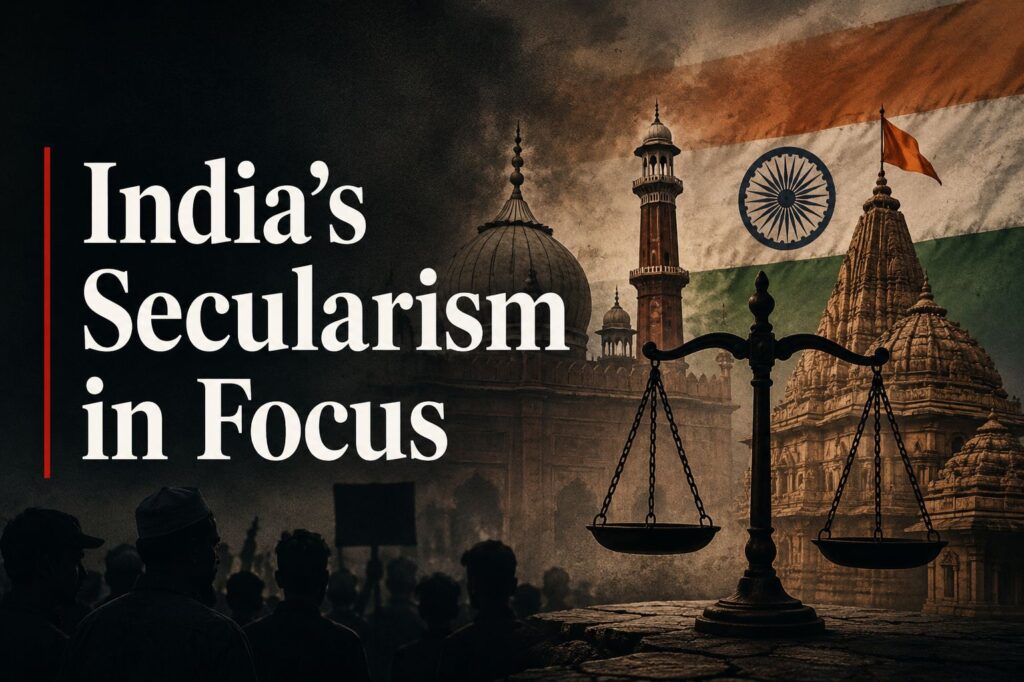
As Eid ul Adha approaches, Indian Secular claims will be tested once again as will endurance of its Muslim population. The intersection of recent political, judicial, cultural, and social developments across India has reignited an enduring question about the direction of constitutional secularism in the world’s largest democracy. A series of reports from different states in recent weeks, from religious symbolism in state ceremonies to regulatory disputes over cattle trade, mob violence, contested heritage claims, and cultural debates in Bollywood, together present a bleak state of affairs related to identity, law, and space for minorities in today’s India.
In eastern India, judicial and administrative decisions related to cattle slaughter ahead of Eid-ul-Adha have added fuel to the fire. Calcutta High Court observation noting that cow sacrifice is not a religious requirement in Islam coupled with regulatory measures affecting cattle markets in parts of West Bengal. These developments, combined with enforcement of older livestock laws, causing economic consequences for communities dependent on seasonal cattle trade. While such measures are framed in legal or environmental terms, they often acquire communal implications during sensitive religious periods.
Similar concerns have been raised in Assam, where appeals by local committees and statements from political leadership ahead of Eid have encouraged restraint in cattle slaughter. Authorities maintain these measures relate to law and order and animal welfare, while opposition voices argue that informal pressures around religious practice risk undermining the principle of equal freedom of faith during major religious festivals.
At the same time, reports of mob violence in different parts of India are raising concerns about the erosion of trust in institutional protection. In one such recently reported incident from Assam’s Nagaon district, three Muslim men were killed in a mob attack following allegations of burglary. The violence, which escalated before police intervention, has been cited in debates about the growing normalization of mob justice and the declining communal relations under the BJP.
On the other hand, Large-scale demolition and eviction campaigns in Assam portray the direction of new India. Reports suggest these drives affect Bengali-speaking Muslim populations disproportionately. Between 2021-2026, reports have cited the removal of thousands of families in anti-encroachment actions. While state authorities defend it as actions to target illegal settlements, but facts point to the demographic patterns of these operations as raising questions about fairness and proportionality.
In the vision of New India, these incidents are not limited to Muslims. Christian communities are also smarting under the communal wrath in India. Disruptions of religious gatherings and harassment linked to accusations of forced conversions are documented in different states. Human rights organizations argue that inconsistent legal responses in such cases contribute to perceptions of uneven protection under the law.
In Kerala, the full recital of “Vande Mataram” at a cabinet oath-taking ceremony triggered a political confrontation between the CPI(M) and the BJP, with competing interpretations over the use of cultural and religious symbolism in official state functions. While some described it as a cultural expression aligned with national heritage, others viewed it as indicative of the growing visibility of culturally charged symbols in institutional settings.
The rift over religious heritage sites is also widening. Verdicts from courts and administrative actions on contested monuments in central India, including historical mosques and temples, have ignited communal violence. These disputes indicate a national pattern, travelling down from state to masses, in which historical interpretation, religious identity, and contemporary politics converge in public discourse.
Besides state institutions and policy, India’s cultural side has also become an important site for shaping public understanding of history and identity. In recent years, Bollywood has changed its course, shifting from pure cinema to controversial historical events, touching on fault lines of identity. Recently released movies, based on historical characters appear to be an effort aimed at rewriting Indian history. While creators argue that cinema reflects artistic freedom, but mass cultural products can significantly influence collective memory. Consequently, cinema has become the cause of public conversation about how historical events are remembered, interpreted, and linked to present-day political identities.
India’s constitutional vision was based on the idea of equality of citizens regardless of religion, language, and ethnicity. India’s founding leaders clearly expressed what they desired for India. Jawaharlal Nehru, for example, observed that India’s strength lay in its pluralism, while Dr. B.R. Ambedkar emphasized that constitutional morality must guide public life even when social majorities pull in different directions. India’s model of secularism was designed not as strict separation, but as principled engagement with all faiths. The Constitution itself guarantees freedom of religion and equal protection under law.
However, the trajectory being followed by India under BJP is leading it far from the dream of its founding fathers. Politicization of religious symbolism, identity debates, and cultural narratives is impeding the practical application of secular principles.
Taken together, recent developments, from ceremonial symbolism and regulatory actions to incidents of violence, heritage disputes, and cultural debates, highlight the clouds accumulating over secularism in India. As religious festivals like Eid approach, these tensions become more visible, placing renewed attention on the balance between constitutional ideals and lived realities.
What remains evident is that secularism in India is not a settled doctrine but an evolving framework shaped by courts, governments, cultural institutions, and society at large. The challenge for India’s democratic system lies not only in preserving constitutional commitments in principle, but in ensuring their consistent and equitable application across its diverse social and political landscape.