
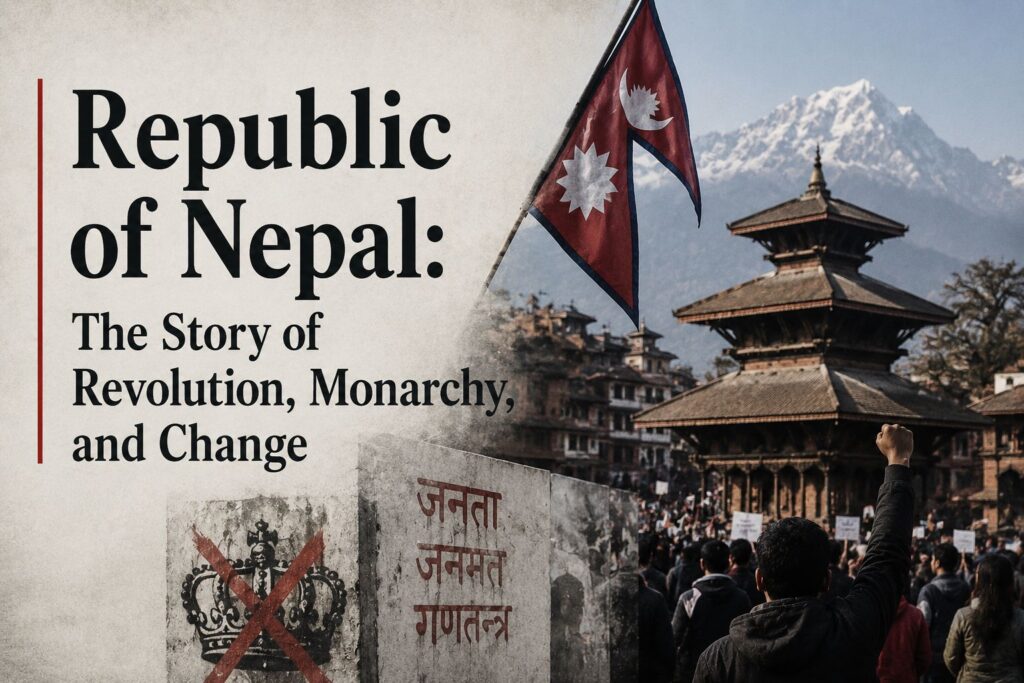
Nepal has been unique among all the nations of the modern era in many ways, as an exception that remained firmly anchored between tradition and transformation in the Himalayas. The nation, surrounded by India and China and had the distinction of being the world’s sole Hindu kingdom, governed through a monarchy which possessed both the power of political rule as well as a claim of religious sanctity.
However, amidst the image of mountains and spirituality, Nepal was going through a tremendous social and political revolution. Within the span of a single generation, it experienced mass revolts, the Maoist rebellion, the civil war, the collapse of the monarchy, and the end of a 240-years old monarchy, leaving it as a federation of republican democracy today.
The story of Nepal emerges as one of the most fascinating examples of political transformation within South Asia.
Historical Foundation: The Hindu Kingdom and Monarchical State
Today’s Nepal traces its origins back to the 18th century. When King Prithvi Narayan Shah united the fractured territories under a single throne, laying the foundation of historic Shah Dynasty.
What is historically unique about Nepal is it the only country remained as Hindu Dynasty. The monarchy, therefore acted as center of political power as well as a symbol of religious identity.
Between 1960-1990, Nepalese politics was characterized by the Panchayat system which abolished all political parties existed significantly limited political participation of masses.
The 1990 Democratic Movement: First Opening of the System
The first big change came about through the People’s Movement of 1990 (Jana Andolan I). It was a countrywide movement held in Nepal by various political and civil society organizations demanding democratic reform. Consequently, the king had no choice but to accept the system of constitutional monarchy and multiparty democracy. The result was a new framework that comprised of parliamentary election, competitive political parties, constitutional monarchy, and enhancement of civil rights. However, despite all these democratic efforts, political instability was one problem that could not be resolved.
The Maoist Insurgency (1996–2006): Revolution from the Margins
An important turning point was witnessed in 1996 when Pushpa Kamal Dahal, known as “Prachanda,” led the Communist Party of Nepal (Maoist) against the government. It was an armed insurgency, based on Marxist-Leninist-Maoist principles, this rebel movement fought for:
• Anti-feudal revolution
• Class struggle
• Abolition of monarchy
• Restructuring of the state.
This conflict, which was termed “People’s War”, persisted for a decade and ended with thousands dead, displacement of communities, militarization of rural areas and state control being completely dismantled in several parts of Nepal.
In spite of being a controversial armed struggle, it changed Nepal’s political future by shaking the king’s authority and making a case for a republican system.
2006 People’s Movement: End of Monarchy
Jana Andolan II, another major turning point in Nepal’s political history, came in 2006. The concentration of absolute power by King Gyanendra sparked united resistance from all political parties, civil society, and Maoist groups. Mass protests across the country, ultimately stripped the crown of its absolute authority, paving the way for a historic peace accord that resulted in:
• An agreement to halt hostilities between the Maoists and the government
• Incorporation of rebel forces into the mainstream political system
• And drafting a new constitution
Nepal achieved another significant milestone in 2008, when the Constituent Assembly formally abolished the monarchy, bringing an end to 240 years of Dynastic rule and started a new era of federal republic.
Ideological Shift: From Hindu State to Secular Federalism
One of the most historically notable transition was ideological shift. From a Hindu monarchy to a secular republic, Nepal redefined its national identity.
Key reforms included in the constitutional framework:
• Secularism (ending state religion)
• Federalism (decentralized governance)
• Inclusion (representation of ethnic groups)
• Social justice (addressing historical inequality)
These constitutional reforms were important for historically marginalized groups, like Madhesis, ethnic groups, and regional populations who had long remained deprived of political representation.
However, implementing these ideals in practice has remained complex and uneven.
The Rise of the Gen Z Republic Movement
Recently, Nepal dominated global headlines for its revolutionary movement against the ruling elite. This uprising was driven not by armed insurgency, but by Gen Z, frustrated with corruption, political stagnation, unemployment, and the dominance of aging political elites.
Described as emerging “Gen Z political wave,” this movement manifested growing dissatisfaction among urban youth with conventional politics dominated for decades by the same leaders from the Nepali Congress, Communist factions, and former revolutionary groups
The frustration became especially visible during:
• Anti-corruption protests
• Social media-driven activism
• Youth-led demonstrations
• Independent political campaigns in urban areas
Unlike the Maoist revolution of the 1990s, this movement was less ideological and more governance-oriented, driven less by class warfare and more by demands for:
• Transparency
• Accountability
• Efficient public service delivery
• Employment opportunities
• Meritocracy
Although it is premature to consider it as a full-scale revolution, it manifests an important shift in Nepal’s socio-political trajectory. The country’s youth views the republic not as a completed achievement, but as an unfinished project requiring continuity in reforms and public service delivery
Nepal’s Political System Today
Nepal is a Federal Democratic Republic with a parliamentary system of government.
President
The President functions as the ceremonial head of state.
Prime Minister
Prime Minister is the executive head of the county, who leads the government.
Parliament
Nepal’s Parliament, called the Federal Parliament of Nepal, consists of two houses:
• House of Representatives (Pratinidhi Sabha) lower house
• National Assembly (Rastriya Sabha) upper house
Nepal is a union of seven provinces under its federal structure, based on principle of decentralization of power.
A Revolution Still Unfinished
From the world’s only Hindu dynasty to a federal republic, Nepal’s political shift is one of the most consequential political events in modern South Asian history. It depicts a journey propelled by monarchy, rebellion, ideological struggle, and democratic experimentation.
However, this transformation is not the end but a means to an end. It is an ongoing process of political negotiation between stability and change, identity and inclusion, tradition and modern governance.
Nepal, today, stands not as a finished republic, but as a society still defining what its republic should become.