
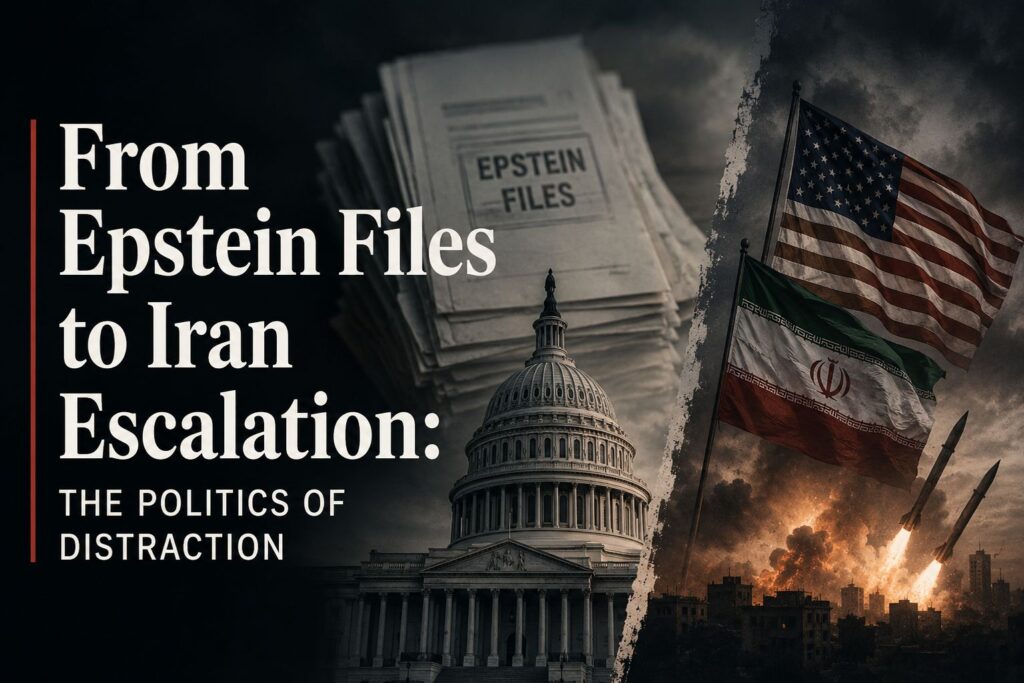
Politics in today’s world is not just defined by policy, but also by control over public perception. In the age of digital media, quick flow of information and viral narratives, the ability to stay in headlines can significantly influence political outcomes.
This dynamic has re-emerged in the United States following renewed controversy surrounding the Jeffrey Epstein files and the subsequent escalation of tensions with Iran involving the United States and Israel. For critics of Donald Trump, the timing appeared politically significant. As scrutiny surrounding Epstein-related documents intensified, media focus quickly shifted toward military escalation, oil market instability, and regional conflict.
This overlap has revived an old political debate: can foreign crises reshape domestic political pressure?
The Epstein Files: Scale and Political Sensitivity
The Jeffrey Epstein case is one of the most appalling and politically sensitive scandals in modern U.S political life. Epstein’s network of elite associations across politics, finance, and entertainment, has generated years of distrust and speculation.
The scale of recent document releases under the Epstein Files Transparency unveils shocking revelations. U.S. Department of Justice released Millions of pages of material in phases.
Trump’s name in these releases appears frequently. According to congressional summaries and media analysis of released documents:
Trump is mentioned hundreds to over 1,000 times in major document releases. Some later compilations and subpoenaed email sets show references exceeding 1,000–1,500 mentions in selected batches. Larger aggregated datasets have been reported as containing thousands of total references across documents. Notably, most mentions are contextual references, email discussions, or third-party documents.
For weeks, these revelations occupied American political discourse. From social media trends to podcasts, and political analysis, focus remained on elite accountability and the perception that powerful individuals often operate beyond meaningful scrutiny. But this discourse changed almost overnight once the confrontation with Iran began.
Iran Escalation and the Media Shift
As attention on Epstein files intensified, surprisingly, tensions with Iran started to grow. It dramatically shifted global attention toward military conflict, supply-chains risks, and regional volatility. Media coverage instantly moved from investigative and political reporting to military briefings, geopolitical analysis, energy market reaction, and national security debates.
Shipping concerns, inflation fears, and uncertainty surrounding regional escalation affected international markets already struggling with economic instability. The crisis therefore became more than a political media event. Simultaneously, the confrontation with Iran ensured that domestic scandals received significantly less public attention.
In practice, this meant that domestic political controversy was quickly displaced by foreign policy escalation.
The “Diversionary War” Theory
The Diversionary theory is not new in Political science. History is replete with such instances where leaders facing scandals, economic instability, or declining popularity have often been accused of starting external conflicts to consolidate internal unity.
Political scientists describe this phenomenon as the “rally-around-the-flag effect,” a situation when populations temporarily unite behind leadership during periods of external threat to national security. Because external threats simplify political messaging into questions of patriotism, security, and national survival. In such environments, public attention narrows rapidly.
This does not automatically mean wars are manufactured for distraction. States pursue military actions for multiple strategic reasons involving security calculations, alliances, deterrence, and regional interests. But history repeatedly shows that external conflict can produce domestic political advantages, whether planned or accidental.
For Trump’s critics, that possibility became central to the debate.
The Contradictions of Trump’s Foreign Policy
The Iran confrontation also highlighted contradictions within Trump’s broader political image. Trump, throughout his political career, presented himself as a leader skeptical of prolonged foreign wars, criticizing previous American administrations for military interventionism. But his recent foreign policy posture has embraced aggressive rhetoric, coercive diplomacy, and military escalation. This contradiction has further intensified suspicion over the factors behind his Iran campaign. Whether foreign policy decisions are influenced not only by strategic calculations, but also driven by domestic political environment. Why a president, who calls himself a peace-maker, had to launch a miscalculated attack on Iran? As long as these questions remain unsolved, theories will keep following him.
Scandal and War in the Attention Economy
The overlap between Epstein files scrutiny and the Iran escalation, whether coincidental or intentional, depict a dark reality of modern governance.
The Epstein files represent slow-moving institutional scandal, centered on accountability and elite networks. The Iran crisis represents fast-moving geopolitical escalation, centered on urgency, security, and fear.
In the modern attention economy, these two forces compete directly. And historically, when war enters the media cycle, scandal almost always fades from immediate public focus.
Ultimately, domestic scandals do not remain confined within national borders, they ripple outward, touching global fault lines, and shaking global economic stability. The consequence is a world where markets, alliances, and security environments can be shaken not only by wars themselves, but by the political survival instincts surrounding them. In that sense, the true cost of domestic political crisis is rarely paid by those at its center alone; it is often absorbed, indirectly and unpredictably, by the wider global order.