
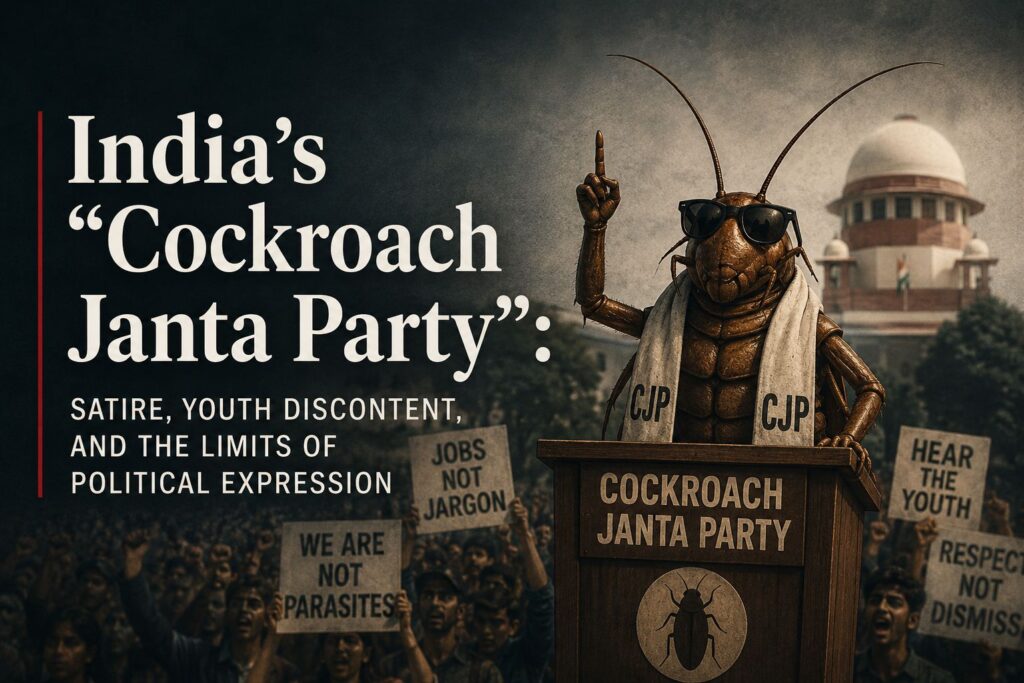
In the context of rapidly evolving digital environment, satire has become a form of mass political expression, resistance, and political movement. The development of India’s “Cockroach Janta Party” (CJP) reflects this evolution, where humor, symbolism, and youth’s frustration converge into a viral online movement.
The emergence of this digital political movement can be traced back to controversial remarks attributed to India’s Chief Justice, and has since developed into much larger question of Indian youth’s discontent, political communication, and the evolving boundaries of democratic expression.
From Controversy to Viral Identity
The movement originated from comments made during a court proceeding in which Chief Justice Surya Kant compared unemployed youth involved in journalism and activism to “cockroaches and parasites.” Before the clarification from the CJP, the statement had already spread widely across social media, triggering backlash and satire.
In no time, online users converted the controversy into an organized symbol known as “Cockroach Janta Party”. The name itself, a mockery of existing political branding, quickly gained traction across digital platforms.
However, the significance of this instance lies not in the controversy itself, but in the swift development of satire to evolved into an organized online identity.
A Symbol Born From Frustration
The cockroach, symbolizing adaptation to tough conditions of life, was adopted as the movement’s symbol. In this framing, it represents resilience of those youths who feel politically and economically marginalized.
The movement itself is not a formal political party. Rather, it serves as a virtual collective based on humor, irony, and political-expression. Its rhetoric stems from a generation that express financial deprivation and political frustration through memes and symbolic activism rather than conventional political means.
It is reflective of a broader trend in political culture, where identity is formed less by party membership and more by online narratives.
Youth Unemployment and Political Disconnection
The popularity of “Cockroach Janta Party” has revealed a number of underlying socio-economic issues, particularly among younger demographics.
India boasts a significant portion of young voters, but the rising rate of unemployment and underemployment among its youth, coupled with growing competition and economic and social pressure, has fostered feelings of political disconnect.
In this context, the CJP functions less as a political alternative and more as a form of digital expression of frustration against current ruling elite.
Institutional Politics and the Digital Gap
Perhaps, the most compelling feature of the movement is the gap between digital momentum and institutional politics in India.
While traditional political parties continue to dominate electoral structures and governance, online movements like CJP demonstrate that political sentiment is influenced by outside formal institutions.
Although there is little evidence that such digital movements translate into sustained political organization or electoral power, they illustrate a growing divide between online political expression and offline political participation in India.
Political Reactions and Narrative Contestation
The phenomenon has drawn mixed reactions from various political figures. Opposition voices have cited it as an indicator of youth frustration, while supporters of the ruling party have dismissed it as a social media trend lacking real political grounding.
This divergence is indicative of a pattern in contemporary democratic politics, where online narratives quickly become part of political discourse, with different interpretations based on ideological position.
Rather than representing a clear political challenge, the CJP illustrates how digital culture can become a battleground for competing interpretations of public sentiment.
Conclusion
The “Cockroach Janta Party” is not a traditional political entity, but a reflection of a deeper transformation in political expression in India. It highlights the growing role of digital platforms in shaping political identity, particularly among younger citizens navigating economic and institutional uncertainty.
The challenge for the traditional political parties is not the movement itself, but what it represents, a widening gap between Indian political culture and Youth’s expectations.