
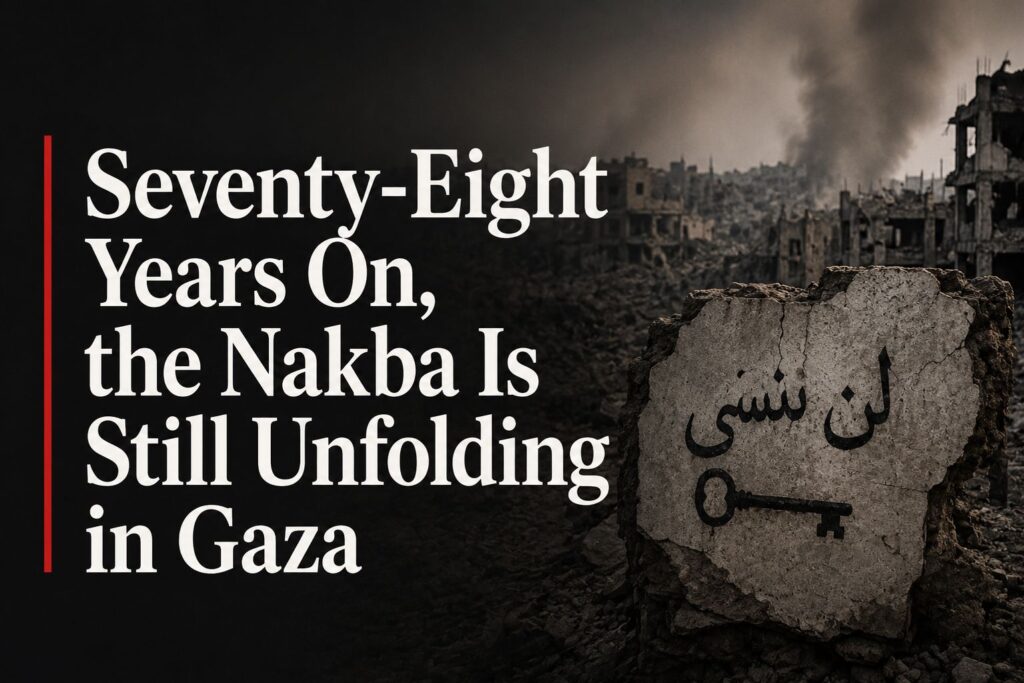
The Nakba was never only about 1948. It was about displacement becoming permanent, exile becoming inherited and Palestinian loss becoming normalized. Seventy-eight years later, as Gaza is reduced to rubble and millions face repeated displacement, Palestinians are asking a question the world can no longer avoid: if the destruction of a people’s homes, communities and future continues generation after generation, did the Nakba ever truly end?
The current moment is historically alarming because the patterns of Nakba resemble the realities of Gaza today. Entire neighborhoods have been razed to ruins. Families have been displaced repeatedly. The territory has become militarized buffer zones. Refugee camps built to sheltered survivors of 1948 now lie in ruins. For Palestinians, the patterns are not new. The descendants of 1948 refugees are once again confronted with bombardment, dispossession and uncertainty about whether they will ever return.
More than 90 percent of Gaza’s population has faced displacement since the war began. Cities in the north have been ravaged. Israel’s PM Benjamin Netanyahu’s claim that Israel now controls around 60 percent of Gaza, intensified fears of permanent fragmentation and forever occupation.
That perception elucidates why the phrase “ongoing Nakba” has become central to the discourse of human rights activists. The term reflects more than emotion or symbolism. It describes a belief that Palestinian dispossession evolved through different stages: the expulsions of 1948, the occupation of 1967, settlement expansion in the West Bank, the blockade of Gaza and now the large-scale devastation of Palestinian urban life in Gaza.
This year’s anniversary is significant because we are witnessing a change in global attitudes. For years, discussion of the Nakba remained politically marginal in Western capitals, often dismissed as hostile to Israel’s legitimacy. That barrier is eroding. International organizations, historians, human rights groups and even sections of Western political establishments willing to confront the historical realities of Palestinian displacement.
This shift is driven partly by the visibility of Gaza itself. Because it is not 1948, the world can now see the plight in real time, bombardment of hospitals, displaced civilians, ruins of refugee camps and children carrying the keys and memories of homes they may never see again. The continuity between past and present has become harder to deny.
Seventy-eight years later, Gaza forces the world to confront an uncomfortable truth that the Nakba was never a single event. It was the beginning of a process, one Palestinians are still living through today.
The Nakba persists because deeper issues extends beyond recognition. Palestinian are still stateless, living in constant fear, hunger and confronted with territorial dispossession. Military operations may end, ceasefires may emerge and reconstruction plans may be drafted, but none of these addresses the underlying reality that millions of Palestinians still live without sovereignty, security or permanence.
That is why commemorating the Nakba today is not merely about remembering 1948. It is about understanding how unresolved historical injustices reproduce themselves across generations.