
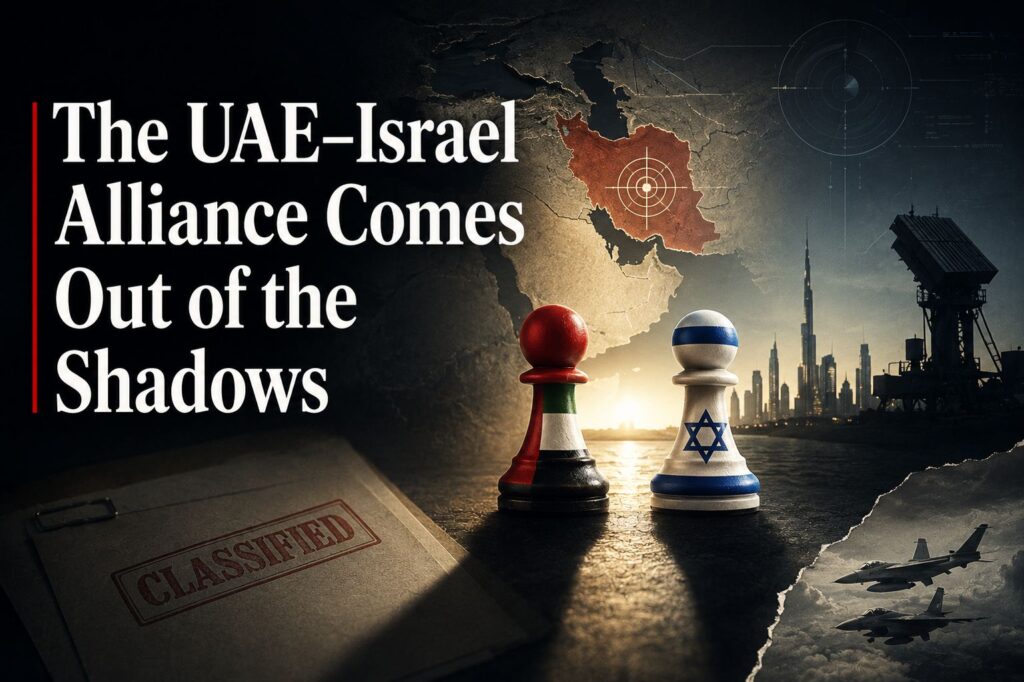
The Iran war has stripped away one of the Middle East’s last remaining illusions: that the Abraham Accords were primarily about peace.
The normalization efforts between Israel and several Arab states were presented as economic cooperation and regional stability. But the recent disclosures surrounding the UAE and Israel are far more consequential. A hard security alliance has quietly emerged beneath the language of diplomacy, not around reconciliation, but around confrontation with Iran.
Over the past week, a series of reports have exposed the extent of covert wartime coordination between Israel and the United Arab Emirates. According to these reports, Mossad chief David Barnea secretly visited the UAE multiple times during the conflict to coordinate military and intelligence activities against Iran. Reports further revealed that Israeli Prime Minister Benjamin Netanyahu held a clandestine meeting with UAE President Mohamed bin Zayed Al Nahyan in Al Ain in March, at the height of the war. Then came the public confirmation from US ambassador Mike Huckabee that Israel had deployed Iron Dome and military personnel to Emirati territory during Iranian attacks. The revelations are striking not because they are entirely surprising, but because they are no longer hidden.
Later, the UAE’s denial of Netanyahu’s secret wartime visit was itself revealing. Abu Dhabi appears to understand the difference between quiet coordination with Israel and Public exposure of bromance. For Benjamin Netanyahu, however, disclosure of these developments served a domestic purpose. Projecting Israel as the center of a growing anti-Iran regional alliance will strengthen his political standing.
Taken together, these developments confirm what many in the region long suspected that the Abraham Accords have evolved far beyond normalization. The UAE and Israel are no longer covert diplomatic partners, they are operating as strategic allies in a shared security framework directed against Iran.
More troubling are reports that the UAE itself participated in military strikes on Iranian territory. According to the Wall Street Journal, UAE operations included strikes on Iran’s Lavan Island refinery, with at least one operation allegedly coordinated alongside Israeli attacks on South Pars facilities. Abu Dhabi has not publicly acknowledged these claims, but neither has it fully dispelled them.
This is a historic transformation in the region. Because, for decades, Arab governments maintained quiet channels with Israel while publicly distancing themselves from military cooperation due to the Palestinian issue. That restraint appears to be disappearing. The Gaza war and the confrontation with Iran have accelerated the emergence of an overtly operational UAE-Israel axis. While the UAE wants ambiguity, Israel is desperate to make it visible
From the UAE perspective, the logic is very clear. Israel offers advanced intelligence, missile defense systems and a smooth route to Washington. Abu Dhabi, meanwhile, offers strategic geography, financial reach and growing regional influence. Both states share hostility toward Iran and political Islam. They have just landed on common ground.
But the exposure of this alliance invites severe implications. By integrating itself into Israel’s security framework, the UAE may also be importing Israel’s conflicts. Tehran is unlikely to distinguish between Israeli and Gulf targets if Gulf territory, intelligence networks or military systems are perceived as facilitating operations against Iran. We have already witnessed the manifestation in latest X post from Iranian FM Abbas Araghchi where he directly warned that collusion with Israel is unforgivable. It is one of the reasons for UAE’s swift denial of Netanyahu’s visit.
The most disturbing aspect of this alliance is, however, the disconnect between UAE leadership and public sentiment. Across the Arab world, normalization was defended as pragmatic forward-looking diplomacy that could moderate Israel’s behavior and stabilize the region. Instead, many now see the opposite occurring, normalization evolving into strategic alignment during one of the bloodiest and most polarizing periods in modern Middle Eastern history.
The consequences of UAE’s strategic choices are already visible. Israel’s apparent irritation at the UAE’s refusal to publicly acknowledge Netanyahu’s visit revealed, what this alliance holds for the UAE. Abu Dhabi entered the anti-Iran alignment believing it could manage the risks through strategic ambiguity, but Israel’s willingness to expose covert coordination for domestic political gains showed how little control the UAE retain. The UAE having invested fully in this alignment, may discover that entering such alliances is easier than recalibrating them later. Perhaps, it is already sensing the heat.