
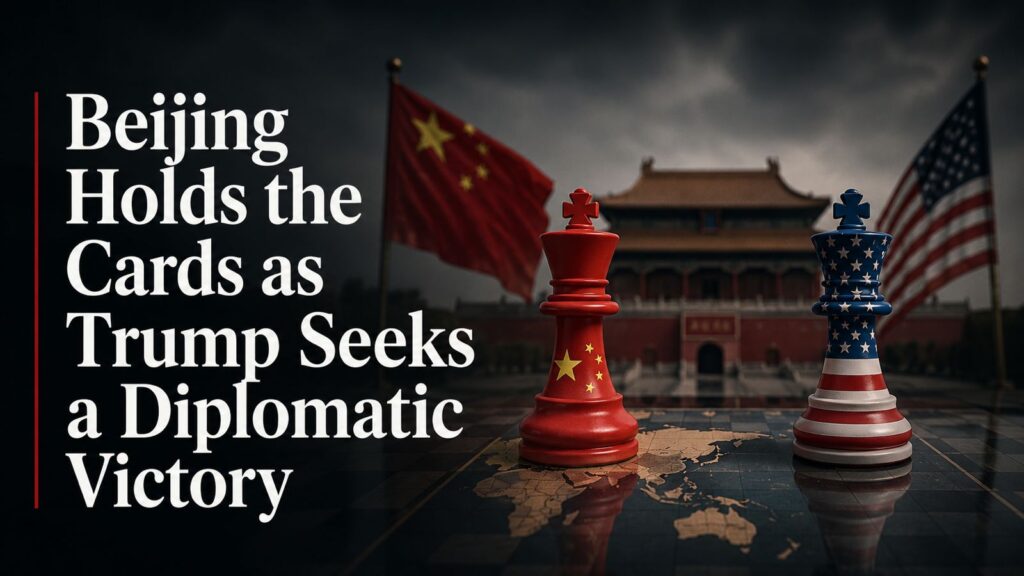
When Donald Trump lands in Beijing, the spectacles will be familiar. The firm handshakes, red carpet, and statements about constructive dialogue. But beyond the diplomatic ceremony, there is little reason to expect a breakthrough. The relationship between Washington and Beijing has moved far beyond the stage where a summit alone can fix it. If this meeting reveals anything, it will be how differently the two countries now see power, strategy, and the future of the global order. Trump approaches diplomacy like a negotiation that must deliver immediate gains, while China plays a much longer game, measured less in election cycles than in decades.
This sit-down will just be about holding the line. The last trade truce was a reality check for everyone, it proved that while Washington and Beijing both possess capacity to inflict economic pain, but both end up bleeding. The economic pain goes both ways, so nobody is actually winning here.
For the US, especially with Trump at the helm, it is all about immediacy. Foreign policy is not some deep, 50-year plan, it is driven by domestic political ambitions. He wants dramatic, attention-grabbing breakthroughs, he can vaunt about. Spike in soybean orders, some aircraft deals, or quick tariffs adjustments, may generate short-term headlines, but do not expect long-term diplomatic results. You cannot build a stable, long-term foundation with a country like China when you are only looking as far ahead as the next news cycle.
China is playing its cards wisely. It has been hit with every possible external pressure, tariffs and tech bans. But it has maintained a consistent emphasis on economic resilience, supply chains diversification, and subtle geopolitical insulation. For China, this meeting will not be an extra-ordinary diplomatic breakthrough. It is just another chance to subtly advance its national interests.
The difference in how both sides handle diplomatic meetings is interesting to observe. The US treats every summit as decisive inflection moment. China, see it as just one more innings in a game that never ends. This mismatch is exactly why US presidents usually walk away disappointed, they seek transformative deals, that China never intended to give. Because the systems and goals are so fundamentally different, even the ‘big’ agreements usually just dissipate into symbolic gestures or half-hearted follow-throughs.
The divergence over Taiwan remains a volatile issue, with potential for Beijing to urge a shift in U.S policy language at the upcoming summit. While China views Taiwan as a non-negotiable sovereignty issue, the U.S relies on strategic ambiguity to maintain regional deterrence, making any perceived change highly consequential for credibility across Asia.
Adding further complexity is the broader geopolitical backdrop. From the Middle East conflict to tensions in global energy markets, the stakes are just higher. What China is doing is worth heeding: it is not sending in the tanks. Instead, it is playing the indispensable card. By engaging multiple stakeholders from the Gulf states to European partners all at once, basically, China is proving to be the adult in the room.
The United States, on the other hand, is stretched between multiple theaters of engagement. While Washington has unmatched military influence and deep-pockets, its foreign policy is often entangled with its electoral cycles, legal constraints, and rapidly changing domestic priorities.
The bottom line is, do not expect transformative agreements from this upcoming Xi-Trump meeting. The only real win here is, basically, showing that despite intensifying rivalry they still recognize the importance of communication. Bigger picture, however, remains the same. China is still playing the long game, being patient, sticking to their guns, and trying to outlast everyone. Meanwhile, the U.S is still bouncing back and forth between playing nice and picking a fight. This summit is not, therefore, some historic turning point. It is just another reminder that global power is less about decisive moments and more about sustained endurance.