
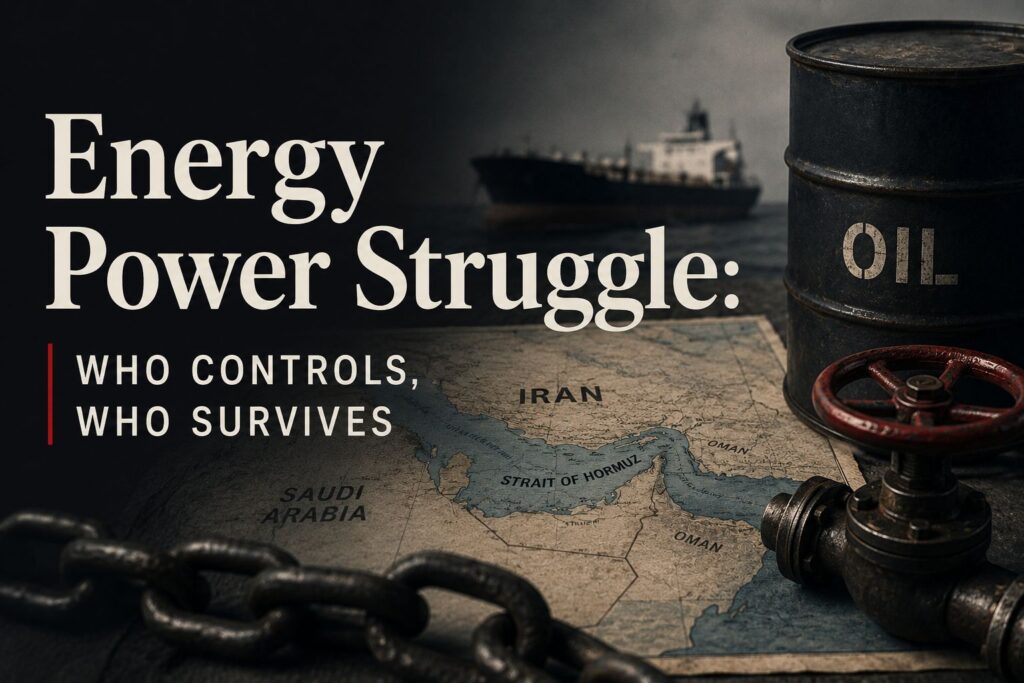
The global energy shock unleashed by U.S–Israel war against Iran is way more than just a temporary supply disruption and price spike. We are looking at a massive shift in who actually runs the world’s energy. This is not just about the current crisis; it’s a total redrawing of the global power map. The old ways of measuring a country’s influence are disappearing. Moving forward, power will come down to three factors: who controls the shipping lanes and pipelines, who wins the race for new energy tech, and which nations are actually strong enough to survive a major supply cut.
In this context the, Strait of Hormuz has proved to be the biggest bottleneck for the world. Because a fifth of the world’s total oil and a massive amount of gas have to squeeze through this one narrow gap. the ongoing closure of Strait has shown that the world is depending on such a fragile, single point of failure.
Asia is feeling the pain more than anywhere else. Since they rely so heavily on energy from the Gulf, their oil imports dropped by nearly 30% this April compared to last year. This has tanked growth forecasts and sent prices through the roof. To keep things from spiraling, governments across South Asia are spending a fortune on fuel subsidies. It helps for now, but it’s really just a band-aid on a much deep wound: they’re still stuck depending on a supply line that can be cut off at any moment.
Similarly, Europe is also experiencing a resurgence of severe economic pressure. Just as the region started to find its footing after the 2022 energy crisis, this new wave of supply chaos and skyrocketing costs profoundly impacted Eurozone. For big industrial players, especially in Germany, these rising costs are not a transient disruption; they are a legitimate threat to their ability to stay competitive in global markets. At the same time, households are seeing their monthly bills spike, turning it into a political nightmare. It has actually forced a massive U-turn on nuclear power, not because of some sudden shift in philosophy, but because of pure necessity. When the global market is this volatile, having a steady, reliable source of baseload energy isn’t just a goal anymore. It’s a requirement for national security.
What we are witnessing, then, is not just a temporary setback; it’s a total redrawing of the global power map based on who can actually control and protect their energy. UAE leaving OPEC is a notable signal that the old days of countries working together on oil prices are over, replaced by a “every nation for itself” mentality. At the same time, the chaos in the oil markets is forcing everyone to sprint toward renewables. Even in developing countries solar panels installations are accelerating at an unprecedented pace. This is a shift that ironically plays right into China’s hands since they own the supply chains for that tech. Ultimately, the new measure of a world power is pure resilience. Countries like the U.S. can use their own domestic production to tune out the noise, while everyone else is left scrambling and vulnerable to whoever holds the keys to the next shipment.
This is not just a temporary shift; we are watching the entire global energy system fall apart and rebuild itself in real-time. The old model of relying on a few big oil producers and crossing fingers that shipping lanes stay open is officially dead. It’s being replaced by something much more scattered and, frankly, pretty chaotic. Countries are realizing that being ‘efficient’ doesn’t mean much if you are at the mercy of global politics.
This goes way deeper than economic implications. The world is at a point where energy is being used as an instrument of statecraft. It is driving geopolitical alignments. We need to stop looking at this as a temporary mess and start seeing it for what it is. The mask is off, and it is clear the previous system was incredibly fragile. Moving forward, the real ‘superpowers’ would not just be the ones sitting on a pile of natural resources. The real winners will be the ones who can pivot fast, invent new solutions, and absorb shock without country’s economic system falling apart.
The struggle over energy is, at its core, a struggle over the future of global power. Those who can navigate this transition effectively will shape the contours of the international system in the decades to come. Those who cannot will remain at the mercy of forces they do not control.