
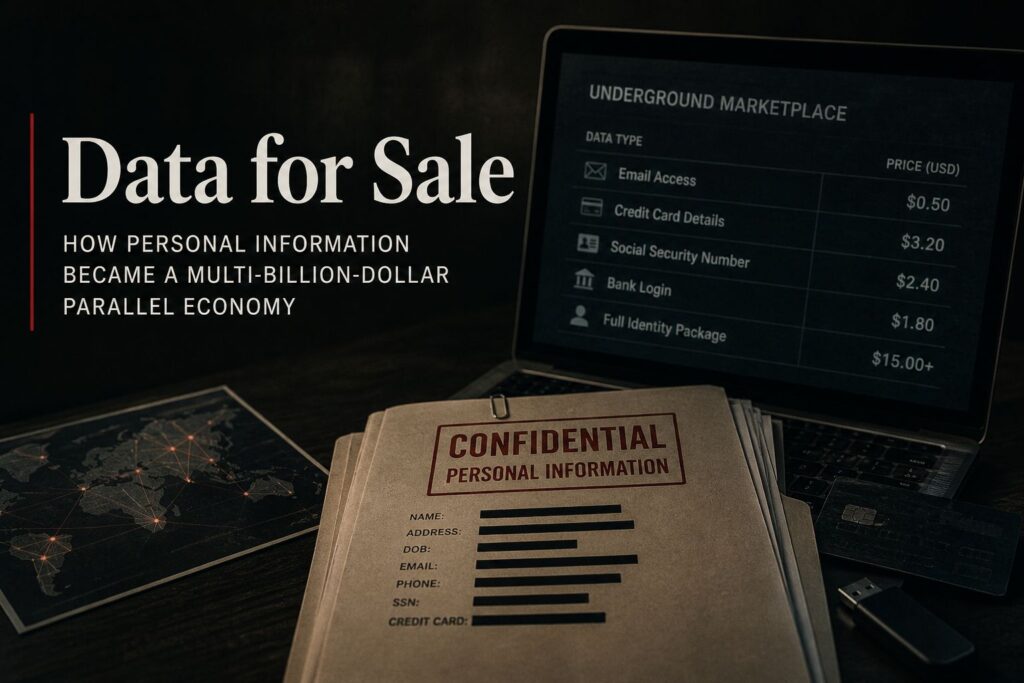
Nearly a million complaints in a single year. Around $21 Billion stolen from victims in 2025 alone. These figures are not abstract data breaches, but financial transactions in an underground marketplace where data is bought, sold, and monetized. Every phishing email, breached database, or hacked account carries a dark reality: the personal data has become the primary currency of a global illicit economy. The evidence, from law enforcement reports and cybersecurity research, proves this trend.
The Supply Chain and Scale of Data Breaches
Supply is the backbone of every market. In the case of illicit data trade, supply is managed through an industrial scale of breaches.
The Global Data Breach Report 2025 documents 3,332 breaches in the United States alone, with 5.5 billion accounts compromised globally in a single year. The time factor is also critical; the average breach detection time is 241 days, meaning stolen data remains in use for months before any legal response. Data is stolen, stored, and prepared for resale long before victims are even aware. That is how this lag fulfills the need of supply chains.
The Economics Behind Stolen Data
The financial dimension makes the blurry picture even clearer. It is not an ordinary cybercrime, but a rapidly growing economic system, built on stolen personal data.
According to the FBI’s Internet Crime Report 2025, crimes related to cyber breaches generated more than $20.8-21$ billion in reported cases. Notably, over $17.7 billion of losses are related to crimes directly driven by the infringement of personal data, including identity theft and phishing. This trajectory is alarming because, just five years ago, these losses were $4.2 billion.
These figures are only a fraction of a much larger underground economy, as cybercrime is significantly underreported, suggesting that the real economic footprint is far larger. We can term it a parallel economy run by shadow activities, where personal data is the raw material.
Demand: Why Personal Data Drives Cybercrime
The success of this market stands upon demand. Personal data makes a space for low-risk, high-reward criminal activity.
The Logic is simple:
- Credentials enable unauthorized access.
- Access allows financial exploitation.
- Exploitation leads to profit.
This explains why attackers choose stolen data rather than sophisticated hacking. It is easier, faster, and more fruitful.
Structural Enablers
Legitimate systems often become indirect facilitators of data breaches. The modern corporate system collects personal information, including emails, phone numbers, and financial records, often far beyond immediate operational needs. What comes next is the potential breaches of this aggregated data. Leakage of billions of records annually is directly linked to the accumulation of personal information by corporations.
In effect, corporations, not intentionally but structurally, become upstream suppliers for an underground data economy.
Establishment of a Parallel Economy
When the sequence is examined, it leads to the formation of a coherent system:
- Supply: Data breaches in billions annually
- Marketplace: Underground but global.
- Economics: Billions in annual losses globally.
- Demand: Driven by low-risk, high-reward frauds.
- Enablers: Accumulation of data in corporations.
Although it is a fragmented network of cybercriminals, when we look at the combined losses, it establishes a parallel economy.
In conclusion, the uncomfortable reality is that presence in digital space entails exposure to this system. The market will not diminish, but expand, until data collection practices are reformed. Because, in this global village, the most valuable commodity is not extracted from the ground, it is extracted from people.