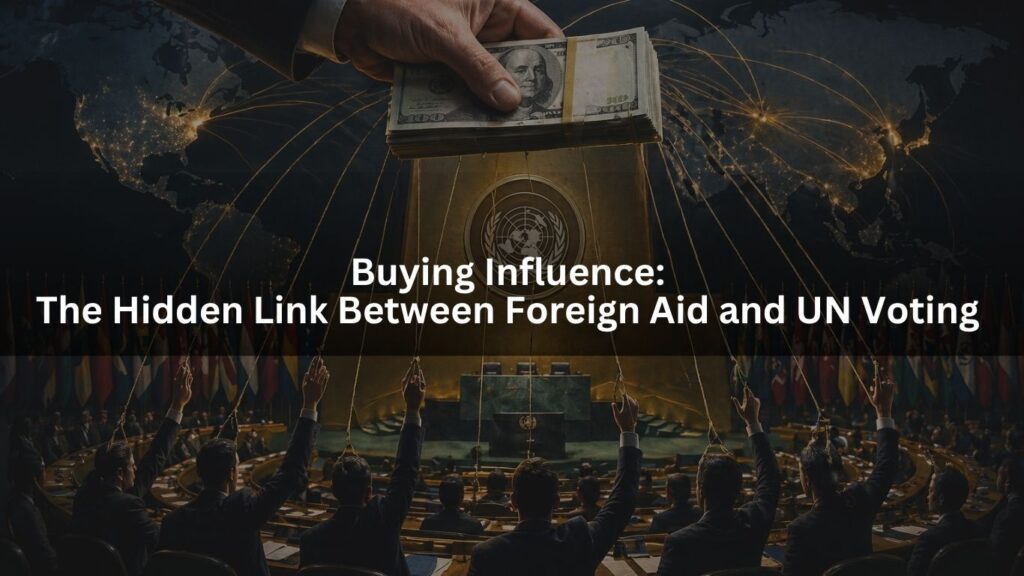
When money speaks, principles fall silent.
In theory, the United Nations formal halls allow one vote to each country, a reflection of sovereign judgement. In practice, empirical research suggests something more transactional. Behind the closed doors the flow of billions may be the deciding factor long before the ballots are cast.
A cross-dataset analysis of UN General Assembly voting history and reading of global aid flows unveils a pattern that is difficult to ignore. Countries receiving higher discretionary and politically motivated aid, tend to align with the donor’s preferences.
The Statistical Overview
The most cited empirical and influential analytical studies by Alberto Alesina and David Dollar (2000) challenged the narrative of altruistic aid. By juxtaposing aid allocation with UN voting similarity indicators, they found that the aid allocation is influenced by political and strategic considerations, particularly alignment with the US and G7. Countries that received significantly higher aid flows, voted more frequently with the US and G7.
Building on this finding, Ilyana Kuziemko and Eric Werker (2006), analyzed the behavior of countries serving as temporary members of the UN Security Council. Their research revealed that during this temporary serving period, aid inflows from the US and multilateral institutions increased by up to 59% in some cases. The crucial part is, this aid spike came during the periods when these countries’ votes were most strategically important. What it implies is that the aid was not developmental but transactional.
More recent work by Axel Dreher and colleagues adds more detail. By analyzing disaggregated aid data, they found that certain types of aid, where funds channeled through multilateral financial institutions, earmarked by certain donors to influence voting patterns.
Mechanisms Of Influence: Reward, Anticipation, and Leverage
The logic of reward comes first. Countries that align their vote with the donor country are rewarded with increased financial support. Commonly, in the form of general budget support or unconditional financial grants that offer maximum fiscal discretion in spending.
Then comes anticipation. Countries dependent on external financial support may adjust their diplomatic position to secure future aid. It is a preemptive act of aligning with donor preferences.
The US State Department has historically determined important votes in the UNGA and designed aid allocation decisions according to voting behavior. This formal identification transforms aid into a strategically potent instrument of foreign policy.
There is another layer to this dynamic. Multilateral institutions, while operate under mandates of neutrality, their governance structures create backdoor channels for influence.
A Subtle Economy of Power
The analysis of research data does not a simplistic view of direct vote-buying. It exposes a more sophisticated structure where economy of influence, aid diplomacy, and strategic interests intersect. Aid flows do not directly dictate vote alignments, but they drive incentives, expectations, and margins of decision-making.
This is a question mark on the integrity of multilateral governance. Influence on voting behavior, directly or indirectly, by financial dependency, is against the principle of sovereign equality. The UN may remain democratic in theory, but the reality suggests that the playing field is far from level.