
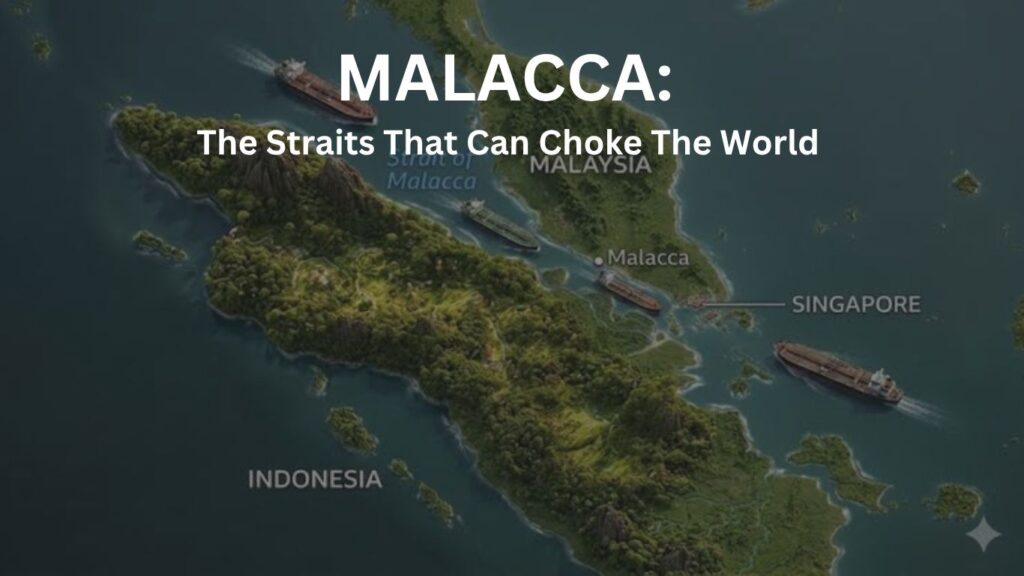
A world led by erratic leadership and marked by rising geopolitical volatility is now discovering that even oceans have chokepoints. The Strait of Malacca is one of the clearest expressions of this reality. It is one of the most important maritime passages in the world, linking the Indian Ocean with the South China Sea. Despite its narrow geography, it carries a massive share of global trade and energy flows, making it a critical artery for the global economy.
In practical terms, the strait functions as the fastest and most efficient route between Middle Eastern energy exporters and the industrial economies of East Asia. In the first half of 2025 alone, more than 23 million barrels of oil per day passed through it, accounting for nearly a third of global maritime oil flows. Such concentration of critical supply routes in a single passage underscores both its importance and its vulnerability.
What has renewed attention on Malacca is the growing instability in the broader geopolitical system, particularly tensions in the Middle East. Ongoing conflicts involving Iran, Israel, and the United States have already raised concerns about the security of the Strait of Hormuz. When one chokepoint faces disruption, attention naturally shifts to others, and Malacca emerges as a parallel vulnerability in the global supply chain architecture.
Within this backdrop, even peripheral policy discussions, such as Indonesia’s consideration of transit tolls on shipping reflect a subtle but significant shift. What were once considered neutral international waterways are gradually being reinterpreted through the lens of strategic leverage, economic pressure, and geopolitical bargaining.
For China, this evolving landscape touches a long-standing structural concern. A significant portion of its energy imports transits through Malacca, a dependency widely described in Chinese strategic thinking as the “Malacca Dilemma.” It reflects a fundamental vulnerability: that external powers, through presence or influence in surrounding waters, could potentially disrupt a critical economic lifeline.
The United States, through its Indo-Pacific posture and extensive network of alliances across Southeast Asia, remains a dominant external actor shaping the strategic environment around the strait. While Malacca itself is not under any single jurisdiction, the surrounding maritime architecture is increasingly influenced by US naval presence and partnership frameworks, which are often viewed in Beijing as part of a broader containment calculus.
From Washington’s perspective, however, influence over key sea lanes forms part of a wider effort to preserve a rules-based maritime order and maintain leverage in an era of intensifying great-power competition. In practice, this translates into sustained strategic visibility across the Indo-Pacific’s most critical shipping corridors.
It is within this tightening geopolitical space that Southeast Asia finds itself navigating an increasingly delicate balance. Malaysia and its neighbours have historically maintained a careful posture of neutrality, rooted in ASEAN’s principle of non-alignment and freedom of navigation. This approach is not ideological, but structural, born from geography. Sitting at the centre of global trade flows, the region has little strategic depth to absorb external shocks.
Yet this neutrality is becoming harder to sustain. As major powers deepen their maritime presence and global tensions spill further into trade and energy networks, Southeast Asia is no longer simply a passive transit region. It is becoming a space where competing strategic interests overlap, quietly but persistently.
The broader reality is that global trade now rests on a small number of highly concentrated chokepoints. In such a mechanism, instability is no longer localised. A disruption in the Middle East can alter shipping dynamics in Southeast Asia; a shift in Indo-Pacific balance can reverberate through energy markets in Europe. The Strait of Malacca sits at the centre of this fragile interdependence.
In this evolving order, the Iran-US-Israel confrontation has exposed deeper structural weaknesses in global governance. The absence of coordinated leadership has allowed regional conflicts to spill into economic systems, turning strategic waterways into pressure points of global consequence.
Ultimately, Malacca is not merely a shipping route. It is a mirror of the current international system, defined by interdependence, shaped by rivalry, and vulnerable to disruption. Consequently, Southeast Asia’s ability to preserve autonomy amid competing external pressures may prove as important as the flow of goods through the strait itself