
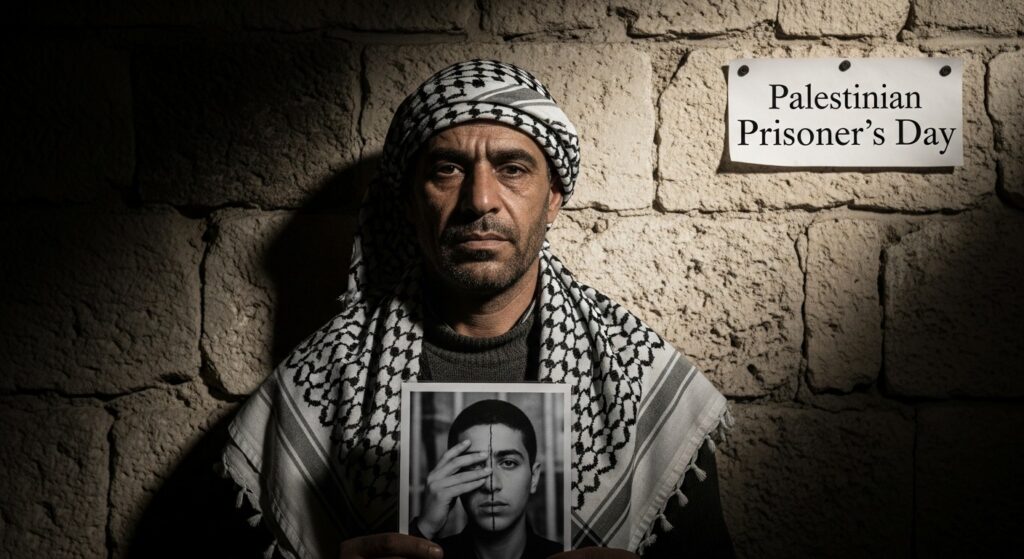
The calendar for many Palestinians is not differentiated by seasons but rather by moments of unyielding resistance and historical remembrance. April 17 happens to be one of the key events when the world remember Palestinians in prisons. On this day, cold figures take flesh and political differences turn in an audible collective call for justice. Though the event is a scheduled annual one, the situation of Palestinian prisoners is deteriorating every year which is reflected both in their number as well as in the ever changing legal environment which leaves the lives of Palestinians under occupation very uncertain.
The Spark of 1971
First of all, let us understand the importance of April 17. This date was chosen to commemorate Mahmoud Bakr Hejazi’s release, as a result of the first prisoner swap deal between the Palestinian guerrilla groups and the State of Israel, on that day in 1971. This act gave a new life to thousands of prisoners whose hope had been lost. Realizing the emotional and patriotic influence of this issue, the Palestinian National Council formally declared April 17 to be a day of national solidarity in 1974. Since then, it has become a center of attention and has been used widely to draw the world’s attention to the harsh and inhumane conditions that are still prevailing in the Israeli prisons for Palestinians.
A Crisis in Numbers
The current level of incarceration is incredibly high. According to Addameer, a rights organization, the number of Palestinians in Israeli detention as of April 2024 exceeds 9,600. But these figures are not just cold numbers; they represent an entire community. For instance, present female detainees number 84 and minors 342 among the prisoners. Probably, the most controversial aspect of this system is the practice of “administrative detention.”
On administrative detention, one can be held for 6 months on the basis of “secret evidence” that the detainee and his/her lawyer are not even allowed to see. Such detention can be renewed over and over again, the families of detainees being left in the complete dark as to the whereabouts of their loved ones. There are now 3,532 detainees who have not been charged or tried, making up more than one-third of the total inmate population.
Childhood Under Military Law
Detention of children is a very cruel aspect of the occupation. Israel is still the only country that sends children systematically to military courts. Since 2000, about 12,000 Palestinian children have been locked up in these jails. Rights groups say that kids are usually interrogated without their parents or lawyers there, and they are pressured, physically and mentally, to make written confessions in Hebrew, a language they hardly understand. Just this one act robs children of their school days and gives them traumas, which are very deep and eternal, that affect the social life of the youth of Palestine.
The Two-Tier Legal System
The differences in the judicial rights of persons and the economic situation are dramatically revealed in this “dual legal system” of the West Bank. It is striking that we see Israelis living in the same territory following primarily a different legal system known as Israeli civil law, while on the other hand Palestinians being prosecuted in military courts by soldiers in uniform.
The percentage of convictions is very high, almost invariable, with figures of 96% to 99% in these military courts. The situation is made worse by the approval of the death penalty law, which is clearly directed at Palestinians who have been convicted of attacking Israelis.
A Legacy of One Million
The historical context presents an even grimmer picture. Since 1967, Israeli authorities have arrested close to one million Palestinians. By the numbers, this indicates that nearly 1 out of 5 Palestinians overall, and almost 2 out of 5 Palestinian men, have been imprisoned at some time by Israel.
For Palestinians, these statistics carry the implication that incarceration is not the result of a crime prevention strategy but rather a political instrument intended to divide and control the community. When on April 17, families will unite to call on the authorities for the release of the 119 prisoners who are serving life sentences and to break the silence about the thousands of others who are behind bars, Palestinian Prisoner’s Day continues to be a witness to a conflict that involves not only the physical confines of a prison cell but also the geographical boundaries of a nation.