
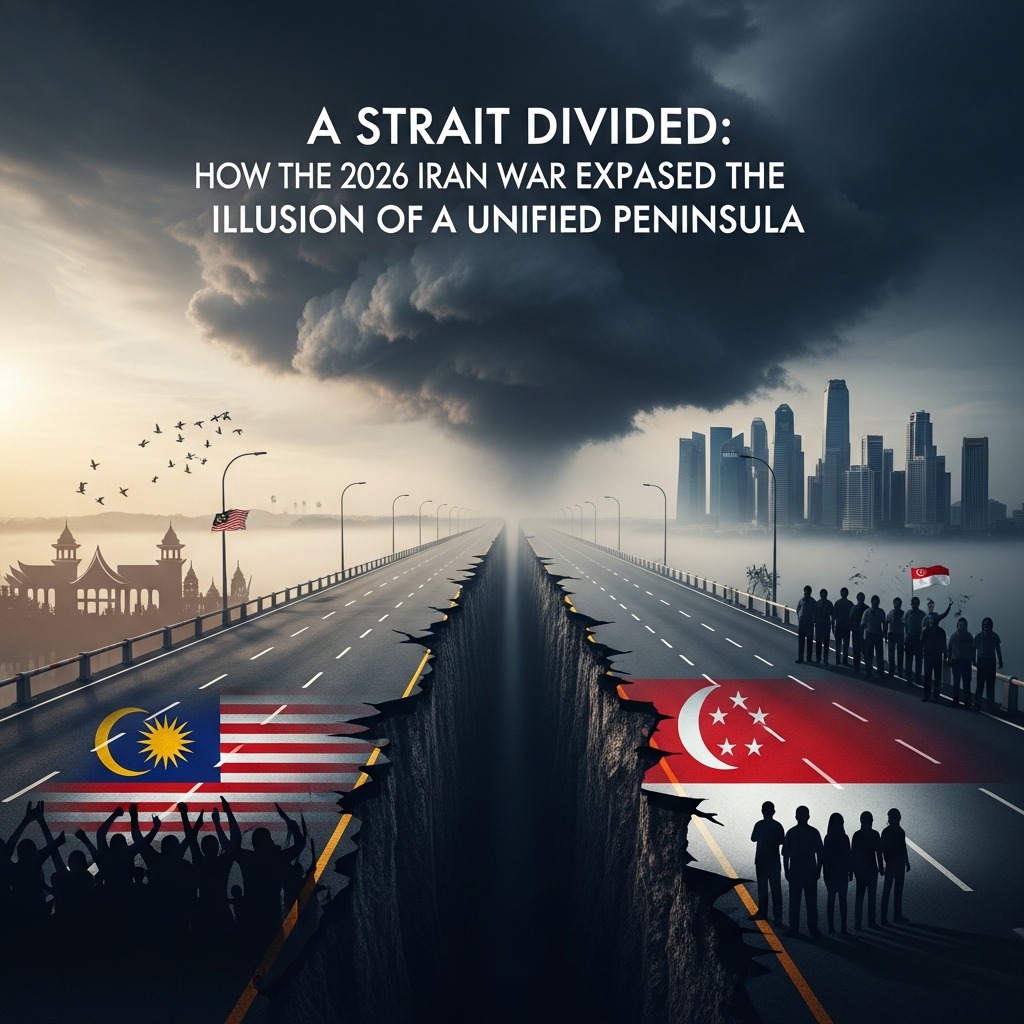
The geopolitical ramifications of the war in Iran have not only led to a blockade of the Strait of Hormuz. Far from the scene, the war has also between Malaysia and Singapore tearing off the diplomatic band-aid and revealing a dangerously widening ideological chasm. If anyone still held on to the idea that the bilateral relations of these two neighbors were based on common regional interests, the happenings of 2026 have forcefully refuted that.
The ongoing drama at the Johor Causeway is nothing but a confrontation between populist outrage staged for the audience and deeply suspicious technocratic realism. Neither side looks particularly good in the fallout.
In Putrajaya, the reaction to the Iranian conflict has been nothing short of diplomatic theater, engineered entirely for a domestic audience. Malaysia’s top leaders, struggling to hold together a weak political coalition and appealing to a very conservative electorate, have not hesitated to exploit the Middle East conflict for their own purposes in demonstrating their Islamic credentials. In taking a strongly vocal, one hundred percent pro-Tehran position and looking at the war only as a global Islamic solidarity issue Malaysia is indeed playing a very dangerous game.
One could hardly name a more disastrous example of diplomacy via megaphone. Putrajaya is actively stoking domestic religious fervor to distract from economic stagnation at home. In doing so, Malaysia’s political elites are signaling to the world that their foreign policy is no longer guided by non-alignment or regional stability, but by the desperate need to pander to ethno-nationalist voting blocs.
Singapore, conversely, is treating the Iran war with its trademark blend of sterile pragmatism and low-grade paranoia. For the island-state, foreign policy is not a matter of morality; it is a spreadsheet where the only acceptable outcome is the uninterrupted flow of global maritime trade and the preservation of domestic order. Singapore’s leadership views Malaysia’s ideological grandstanding with quiet, seething contempt. To the government in the city-state, Putrajaya is acting as a regional arsonist, lighting ideological fires right on Singapore’s doorstep.
Yet, Singapore’s hyper-defensive posture deserves its own critique. The fortress mentality currently gripping the nation highlights the inherent fragility of its algorithmic statecraft. Singapore’s relentless crackdown on any domestic expression of solidarity or dissent regarding the Iranian war reveals a government terrified of its own citizens’ organic political sentiments. By treating genuine ideological and religious sympathies merely as “imported security threats” to be neutralized by the Internal Security Act, Singapore reduces its populace to economic units devoid of political agency.
Friction between the two countries is so intense it can be sensed physically. For Malaysia, looking to the south, it is like seeing a Western proxy who does not even bother to apologize of their actions, a trading post without a soul that values commerce over human life and religious brotherhood. To the north, Singapore sees a neighbor, who is a volatile populist that is so bent on cheap domestic applause that it is even willing to sacrifice the region’s peace.
Besides the deterioration of the states’ relationship, the greatest tragedy is the concept of ASEAN centrality becoming mere words without substance. The Association of Southeast Asian Nations that was expected to play the role of a neutral mediator has disappeared into the shadows like a background figure, and its non-interference policy, which is also its most sacred and oldest one, has rendered it incapable of action. When two founding members are practically hurling abuses at each other over the foreign war, it is clear that regional integration is nothing more than a matter of economic convenience rather than a geopolitical reality.
The war in Iran did not create the fundamental differences between Malaysia and Singapore; it simply acted as a ruthless mirror. It has shown Malaysia to be a state held hostage by the gallery it plays to, and Singapore as a nation trapped in its own gilded cage of security paranoia. They may be separated by barely a mile of water, but in the brutal light of 2026, they are operating in entirely different worlds.