
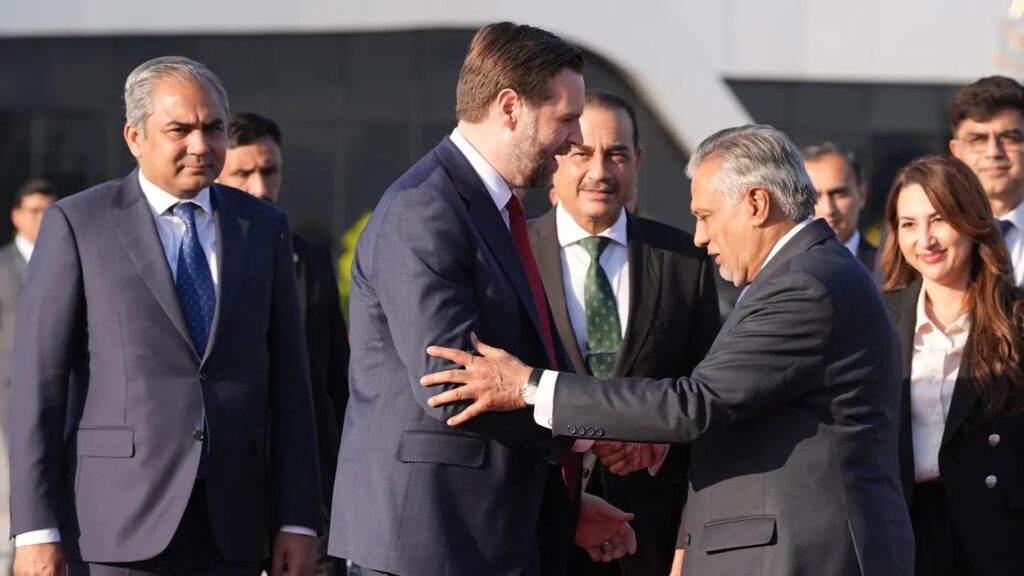
There is a specific kind of silence that settles over a city at 7:00 a.m. on a Sunday, a stillness usually reserved for rest. Ноt this morning. With Air Force Two’s engines bursting to life at Nur Khan Airbase, the noise echoed the exhaustion of a 21 hours marathon that had unfolded behind the high-security walls of the Serena Hotel.
JD Vance was leaving. He was leaving without a signed treaty, without a historic handshake, and with the heavy admission that “the bad news is we have not reached an agreement.” But as the Vice President’s plane climbed into the hazy Islamabad sky, the atmosphere left behind wasn’t one of failure. It was one of exhausted, quiet pride. For the first time in a generation, the world’s two most bitter rivals had sat in the same room, and it was Pakistan that had held that room together.
Diplomacy at that level is more a test of endurance than anything else. For 21 hours, the air inside the Serena was heavy with the smell of coffee and the stress of decades of hostility. At one side of the table sat Vance, with Jared Kushner and Steve Witkoff, the experienced negotiation team, on each side. Mohammad Bagher Qalibaf, Parliament Speaker and leader of an Iranian delegation, appeared to be on a completely different time zone from the others.
While the Americans were in a hurry for a quick boardroom deal, the Iranians, on the other hand, were moving at a leisurely pace typical of a culture that negotiates in centuries rather than hours. They kept on exchanging technical papers until the ink was almost running out. They quarreled about the Strait of Hormuz, sanctions, and also the ghosts of the 1979 Revolution. The only issue that they failed to overcome? The nuclear issue.
While the negotiators were struggling over the issues that mattered, another drama was being played out on the screens. Vance was in constant touch with the “War Room” in WashingtonRubio, Hegseth, and the President himself. Around midnight, Trump’s voice came through Truth Social, a harsh and straightforward reminder of the stakes: “Whether we make a deal or not makes no difference to me.” It was a typical “good cop, bad cop” scenario being performed on a global scale, the threat of a naval blockade was hanging over every cup of tea.
Still, amidst all the squabbling and exhaustion, the host turned out to be the most human aspect of the summit. Pakistan went beyond just offering a place to hold the event; they were the connecting factor. This wasn’t an element that was thrown in at the last minute. Conferences such as this one are the result of several months of discreet, “One Page” diplomacy conducted by Prime Minister Shehbaz Sharif and Chief of the Army Staff, Field Marshal Asim Munir. Their work was so relentless that it is difficult to recall even a moment when they stepped away from it.
Sharif handled the diplomatic subtleties and Munir made sure that the environment was calm, secure, and stable to the point that both sides, Americans and Iranians, could sufficiently lower their guards to be true to each other. It is not often that a single, united Pakistan can be witnessed as a neutral location where direct communications once deemed unfeasible actually took place.
Before he left, Vance stopped to make sure his gratitude was on the record. He didn’t just thank the government; he recognized the “tireless work” of Sharif and Munir in “bridging the gap.” He called Pakistan a “vital partner.” It was a public validation that Islamabad has been craving, a shift from being viewed as a “problem to be managed” to a “solution to be sought.”
Foreign Minister Ishaq Dar, hollow-eyed but resolute after the nearly day-long session, reaffirmed that Pakistan’s doors remain open. Tehran’s state media may have been blunt about the “excessive” U.S. demands, and Washington may be looking at its next military options, but the fact remains: the conversation happened.
The 21 hours in Islamabad didn’t end the war, but they ended the silence. And in the world of high-stakes diplomacy, the bridge is often just as important as the destination. For one long, historic night, Pakistan was that bridge.