
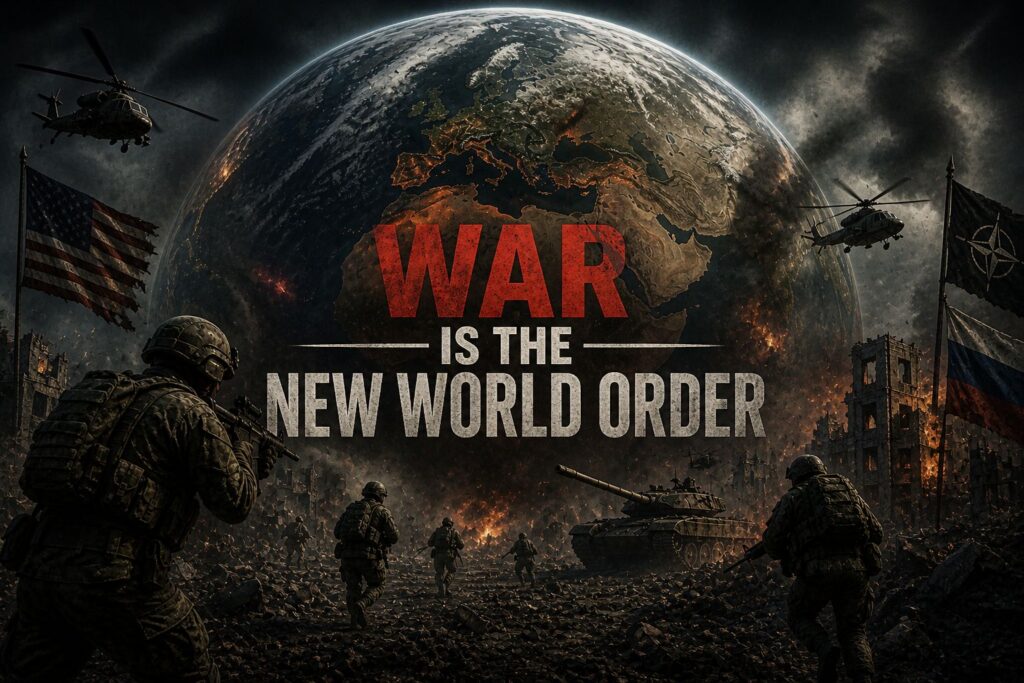
War is no longer a disruption of order, it is fast becoming the order itself. For decades after World War II, the dominant notion in international relations was that global institutions, economic interdependence, and nuclear deterrence had made large-scale regional and global conflict unlikely. But the assumption of a peaceful world is now breaking down.
Recent assessments by the Council on Foreign Relations, particularly its preventive priorities survey, paint a dark picture: the number of armed conflicts has reached its highest level since the end of World War II. More troubling is the nature of these conflicts. Unlike the post-cold war era, where civil wars dominated, today’s interstate conflicts and direct confrontations between nations are making a dangerous return. This is a qualitative shift toward a more unstable global system.
The war in Ukraine is perhaps the manifestation of this global shift. It has evolved from a territorial invasion into a prolonged geopolitical contest drawing in NATO, Russia, and the wider West. Triggered by a wave of military expansion across Europe, defense budgets are rising, alliances are tightening, and the idea of peace as the default condition is steadily eroding.
At the same time, the Middle East continues to shake the world with the spillover effects of its regional conflict. It demonstrates how quickly conflicts can expand beyond their original scope. All the peace efforts around the US-Iran confrontation underscore a critical reality that modern wars are not easily contained. Despite the tactical superiority of one side, strategic outcomes remain elusive. Regimes endure, non-state actors multiply, and conflicts bleed across borders, drawing in new parties to conflict.
History offers the same pattern. Before the outbreak of World War II, the international system was marked by a series of smaller conflicts that, in retrospect, formed the foothills of a global war. The battle of Khalkhin Gol was a limited clash between the Soviet Union and Imperial Japan, still it foreshadowed the scale and alliances that would soon define a World War. Modern World Conflicts, from Ukraine to the South China Sea to the Middle East, may be playing the role of early chapter of a larger and more dangerous story.
The hardening of global alignments is a major factor behind the growing volatility. The World is fast-moving from mere competition to structural adversaries. Military exercises are expanding, advanced weaponry is proliferating, and diplomacy has conceded to the logic of power.
To argue that war is a most likely trend is not to suggest inevitability, but to recognize a dangerous trajectory. The frequency of conflicts, their expanding reach, and willingness of major global actors to engage directly or indirectly, point toward the War as a new normal. Peace, once assumed to be the standard of global order, now appears progressively contingent.
The real danger, however, lies not in a sudden outbreak of global war, but in habituation to constant conflict. History does not announce its turning points. The world-altering catastrophes often sneak up on us through a series of crises that seem under control, until they spiral out of control.
The risk today is not that the world will wake up to find itself at war one random morning, It is that it may already be walking into a war step by step, mistaking escalation for routine, until the day when retreat is no longer possible.