
By Ahan S. Prakash
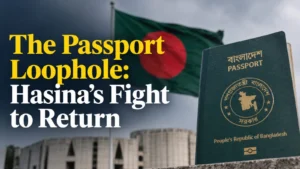
Exiled leaders rarely fade into obscurity, you do not see many simply giving up and disappearing. But it is even rarer to find someone trying to claw their way back through the grind of consular paperwork. That is exactly what Sheikh Hasina is doing right now. Her iron fisted fifteen year reign over Bangladesh ended in chaos after students sparked a dramatic uprising in 2024. These days, she is holed up in New Delhi, far from Dhaka’s fury, directing a team of London lawyers to petition the Bangladesh High Commission for a new passport and a renewed National Identity Card. Hasina’s legal team insists that, despite all of Dhaka’s loud claims about canceling her travel documents, her basic rights as a citizen are still intact, both under Bangladeshi law and international standards.
For the new government led by Prime Minister Tarique Rahman, Hasina’s move is a headache they did not want. It is a legal trick that throws them off balance, right as they are trying to consolidate power and put the past behind them. Hasina claims, quite publicly, that she will return this December, face her adversaries, and stand up to the music. But this is not just a criminal trial anymore. By seeking regular travel papers, she has turned it into a complicated game of legal statutes and tense diplomacy between Bangladesh and India.
Bangladeshi officials weren’t shy about their reactions. The State Minister for Foreign Affairs, Humaiun Kobir, went straight for the jugular, brushing off Hasina’s move as absurd. He laughed at the idea she could just stroll back as a normal citizen, declaring she would only be allowed back in handcuffs, delivered through the official channels of extradition, not wandering through customs as if nothing happened.
By seeking regular travel papers, Hasina has turned a criminal trial into a complicated game of legal statutes and tense bilateral diplomacy.
The Home Minister, Salahuddin Ahmed, took a cooler approach. He confirmed the government’s lawyers are combing through the 1973 Bangladesh Passport Order and core citizenship laws. Their goal is pretty clear: build a legal case so solid, it will stand up to any international scrutiny and stop Hasina from slipping through the cracks. The real fight sits deep inside Bangladeshi law’s ambiguities. Article 6 of the Passport Order lets authorities deny passports to anyone convicted of an offense involving moral turpitude and sentenced to at least two years in prison within the last five years. Hasina’s situation is bizarre, though. The International Crimes Tribunal sentenced her to death in absentia back in November 2025, tying her directly to atrocities during the 2024 uprising.
But the statute specifically talks about prison sentences, not death sentences. That is a weird loophole Hasina’s lawyers can pounce on. Maybe a death sentence is not technically covered by the law as written. Plus, while the executive can block passport applications on grounds like national security, a huge court decision from 2023 says they cannot just withhold documents because someone faces criminal charges or because the case is politically charged. And, by law, getting convicted does not strip you of Bangladeshi citizenship, nor does a pending extradition stop you from applying for basic consular services.
Bangladesh and India have a strong extradition treaty, tweaked in 2013 so that serious offenses like murder cannot hide behind political offense exceptions. Dhaka already lodged a high priority extradition request with New Delhi, demanding Hasina’s return. The Tribunal’s chief prosecutor, Md Aminul Islam, dismissed her legal filings as a desperate stunt, highlighting that Hasina has not made any real effort to surrender to the court. They have confiscated her assets, and those of her former home minister, making it clear there is no room for mercy.
If you want to strip a former leader of her rights, you better have your legal argument airtight, and statutory loopholes continue to test the government.
On the Indian side, this whole drama puts them in a tight spot. India’s decision to host Hasina after her helicopter escape in 2024 strained their relationship with Bangladesh’s new administration. If Bangladesh outright denies her passport, India ends up with a convicted fugitive sentenced to death, awkward, stuck between old alliances and wanting to rekindle ties with a key neighbor. If Bangladesh must issue her documents because of legal technicalities, Hasina might try to return as a regular traveler, sidestepping extradition entirely and throwing another wrench into the works.
Hasina’s lawyers know a passport does not mean automatic freedom. As soon as she steps foot in Bangladesh, law enforcement will swoop in. The old Awami League would rally, and she would be ushered straight to the tribunal. But by forcing Bangladesh to publicly wrestle with its own legal code, Hasina’s sending a message, having executive power is not enough. If you want to strip a former leader of her rights, you better have your legal argument airtight, and so far, the government has not managed to tie the knot tight enough.
About the Author
Ahan S. Prakash is a Geopolitical analyst and columnist covering South Asian affairs, strategic security, and international relations.