
By Daniel Frost
West Asia’s whole geopolitical landscape is shifting, and it’s not the gradual change people might expect. There’s a real transformation underway, not just diplomatic visits or standard trade deals. What’s happening is pretty dramatic: Israel and the United Arab Emirates, an unlikely pair, are forming a hardened security bloc. It started with the 2020 Abraham Accords, which seemed mostly symbolic at first, but now Israel and the UAE are deep into a functional, operational defense alliance. In the middle of ongoing confrontations with Iran, the nonstop tension in Gaza, and new flashpoints across the Red Sea, this partnership is changing the region’s balance of power.
You can see the depth of this relationship in their actions, not just in policy statements. Quiet visits between top officials, secretive intelligence sharing, and Israeli Iron Dome systems deployed right on Gulf territory are big departures from how Arab states have typically handled their security. For the first time, a major Gulf country, Abu Dhabi, is letting Israeli defense tech become part of its national security. It’s not just a business hub anymore. Abu Dhabi has staked its security on Tel Aviv, and that means it’s picking up some very immediate risks and exposing itself to any fallout from wider regional conflict.
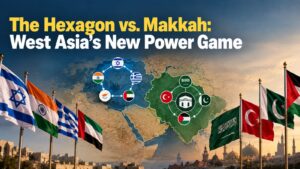
This partnership isn’t just about two countries. It’s the foundation of what Prime Minister Netanyahu calls the “hexagon of alliances,” a larger idea aiming to create a new regional security system. Picture Israel linked to India, Greece, Cyprus, and key Arab and African partners. The goal? Build a solid counterweight to rival coalitions, both Shia led and emerging Sunni blocs.
India is a linchpin here. For years, Israel, India, and the UAE have tightened their trilateral links through projects like I2U2 and the India Middle East Europe Economic Corridor. New Delhi’s security agreements with Tel Aviv have brought about more tech transfers and joint counterterrorism planning. India gains easier maritime routes, reliable energy, and cutting edge military tech. For Israel, planting an anchor in Asia helps ease its diplomatic vulnerabilities, letting its defense industry integrate into larger global supply chains.
West Asia is splitting into rival blocs fast, replacing shaky diplomatic talk with rigid military commitments and hardware on the ground.
But there’s a flip side, this new axis is pushing other regional powers closer together. Saudi Arabia, Pakistan, and Turkey have built an alternative: the Makkah Joint Defence Agreement. It’s not just symbolic, either. They’ve written clear plans for mutual defense, combined military exercises, and put together a permanent secretariat in Riyadh. Their pact reflects their drive to build their own security umbrella, free from the influence of the emerging Israeli Emirati Indian axis. With high level military meetings now happening, West Asia is splitting into rival blocs fast.
These lines aren’t just affecting the Middle East. They’re echoing into South Asia, especially for Pakistan, which is now squeezed between hostile alliances. For decades, Pakistan depended on Gulf countries for jobs, remittances, and economic support. Now its main economic partner, the UAE, is aligning tightly with India and Israel, Pakistan’s chief rivals. That’s led to financial withdrawals and tough diplomatic moments, making Islamabad’s foreign policy choices even harder.
Meanwhile, unity inside the Gulf is breaking down in multiple arenas. The UAE is following its own path, think naval strategies in the Horn of Africa, separate moves in Yemen and Sudan, and even pulling back from traditional energy groups. These actions push Abu Dhabi away from its old allies in Riyadh, adding strain to regional relations. By anchoring its military ambitions to Israel, the UAE has isolated itself from traditional Arab consensus, making the Gulf’s structural divisions worse.
The so called “hexagon vision” is a gamble. Supporters say it’s a smart, post American approach to containing radical threats, but it’s turning West Asia into a region of hard edged, militarized camps. Diplomatic dialogue is being tossed out in favor of security pacts, and that ensures any local conflict can explode into a regional crisis. Once nuclear powers and heavy militaries pick teams along these new lines, dreams of a stable, integrated Middle East start feeling distant. What’s left is a fragile balance built on confrontation and suspicion.
Once nuclear powers and heavy militaries pick teams along these new lines, even small tactical errors could spiral into broad coalition warfare.
At the core of this divide is a deep disagreement about how security should be organized from the Indian Ocean all the way to the Eastern Mediterranean. The Hexagon is building a corridor of tech, intelligence, and naval cooperation, but by shutting out middle powers like Turkey and Pakistan, it’s forcing them to ramp up their own joint defense capacity. The Makkah Agreement is their answer, pooling resources from Ankara, Islamabad, and Riyadh to regain equilibrium and counter the Hexagon’s exclusion.
All these moves are changing West Asia fundamentally. It’s gone from a place of scattered proxy wars to a tightly linked strategic ecosystem: If there’s a flare up in the Arabian Sea or Aegean, the whole web, connecting New Delhi, Tel Aviv, Abu Dhabi, Riyadh, and Islamabad, feels the impact. With countries forced to clearly pick sides, the old ambiguity and balancing act in the region is fading fast.
These opposing defense frameworks are killing any hope of a unified regional security order. They’re replacing shaky diplomatic talk with rigid military commitments and hardware on the ground. The Hexagon and Makkah pacts ratchet up permanent suspicion and risk. As regional players double down on deterrence over dialogue, West Asia steps into a new era of polarization, where even small tactical errors could spiral into broad coalition warfare.
About the Author
Daniel Frost is a Foreign affairs columnist specializing in global geopolitics, European security, and strategic policy.