
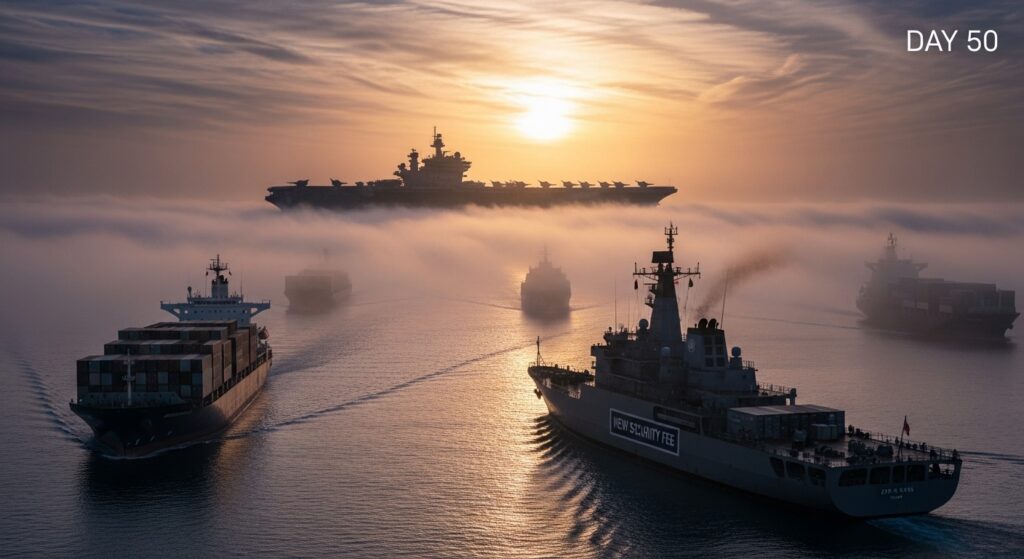
After 50 days of escalating tension between the US and Iran, the political situation in general is really very unstable. On the surface, it looks like there has been a small step taken towards de-escalation as Iran has conditionally reopened the strategically important Strait of Hormuz. However, a more thorough investigation reveals a tangled web of conflicting statements, the continuation of blockades, and proxy wars which may ultimately lead to the deterioration of the already fragile progress.
The main issue of the current standoff is a vigorous diplomatic contest. US President Donald Trump depicts almost a complete victory and even implies that there are no more obstacles to negotiations. At the same time, he maintains that the American naval blockade on Iranian ports which has already compelled 21 vessels to turn back under CENTCOM surveillance will remain in effect until the signing of a final agreement.
The Iranian side totally disagrees. Foreign Minister Abbas Araghchi said that commercial vessels can now go through the Strait, but there is a significant condition. Tehran plans to bypass traditional transit tolls in favor of a new legislative “security fee” for ship owners. Hostile military vessels, especially the American and Israeli ones, have of course been strictly banned. Iran has drawn a pretty definite line in the sand: if Washington keeps the port blockade, the waterway will be closed again.
The two sides actually seemed so far apart on nuclear capabilities that the misunderstanding got wider. Trump recently said Tehran had agreed to get rid of its stock of enriched uranium. Iran foreign ministry was very quick to deny this in a very firm way that the nuclear material is not going anywhere.
The reopening of the waterway had such a great impact on the global markets that it wiped out the diplomatic friction along its way. Wall Street reached new record highs at the same time as the price of Brent Crude oil, which was at one point so high $120 per barrel that it caused a panic, dropped to a little above $90. To further stabilize global energy supplies amid the conflict, the US Treasury extended maritime waivers for Russian oil purchases through mid-May.
European powers, on the other hand, have decided to act. The UK and France are putting together a joint naval operation for securing the shipping routes in the Gulf. British Prime Minister Keir Starmer shared this news. On the other hand, Trump refused to even entertain the idea of NATO’s involvement in the region. He dismissed the military alliance as a “paper tiger” and told them to stay away. Actually, President of the United States sees his visit to China, after mentioning the support of Xi Jinping for the opening of Hormuz, as a sort of breakthrough.
The intertwined wars are not only confined to the Gulf. The Trilateral cease-fire expedience is hanging by a thread in Lebanon. Trump has been vocally and vehemently calling for Israel to stop its northern offensive, saying “enough is enough.” Still, Israeli Prime Minister Benjamin Netanyahu stands his ground by saying that the whole aim to disarm Hezbollah is not over yet. Hostilities are still alive; though the ceasefire was announced, an Israeli air raid wounded a motorcyclist in southern Lebanon-causing death and this is just one of the many killing that the death toll is inching towards 2,300 since early March.
Lebanese President Joseph Aoun is looking forward to Lebanon becoming a peaceful country without being stuck in the conflict of proxies. That mixture of direct and facetious points makes Southern Lebanon a challenging environment for a cease-fire that is already very tenuous. Regional analysts are of the view that the fighting had started as a local conflict but it has grown as a resistance movement led by Iran’s allies against Western influence.
Nonetheless, Houthi supporters in Yemen have turned out in Sanaa with placards that exhorted war. If the Saudi-led coalition’s demands are not met, the Houthis will be forced to consider going on the offensive to war on a full scale. The Kingdom of Saudi Arabia is heading into the situation at the Strait with a hopeful attitude and a little bit of caution, but those in the government in Riyadh are pointing out that the economic recovery in the region is still very much at risk. Once more, the entire world is watching anxiously. Not only are defense manufacturers such as Boeing experiencing huge increases in their workload, but also political leaders worldwide are exchanging their habitual visionary ultimatums, so the settling of this 50-day crisis is once again poised ambiguously.