
By Daniel Frost
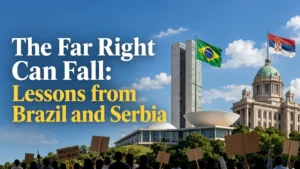
Whenever you see right wing movements gaining steam around the world, liberal establishments usually fall back on the same tired playbook: handwringing about the dangers of authoritarianism and earnest appeals to stick with boring centrists, saying anything to hold back the tide. There is this air of resignation, like reactionary politics is just something people have to endure, a dark wave nobody can stop. But the stories unfolding in Brazil and Serbia totally puncture this myth of inevitability. Whether you look at the celebration packed streets of Brasília or the energetic polling stations in Belgrade, what really stands out is this: far right populism does not have to last forever. It is not some unstoppable force when ordinary people organize and push back, not just with words, but real action.
Take Brazil. The reelection of Lula da Silva, notching his fourth presidential win at the age of 81, slammed the brakes on a global far right playbook. This was not just another election. Lula pulled off a political comeback for the ages, trailing after the first round but rallying enough support to beat Flávio Bolsonaro by four million votes. The younger Bolsonaro was not running alone; he had help from Washington insiders and foreign backers hoping to get his father, Jair Bolsonaro, back in power. But despite all that, Lula’s victory showed there is a ceiling to reactionary politics, which run up against hard limits when people actively challenge them.
What made the difference for Lula this time was not leaning on morality or legal purity. Sure, he could have kept hammering away at the family’s scandals of the Bolsonaros, their criminal records, their threats to democracy. But between the first and second rounds, Lula’s campaign decided to pivot. Instead of just warning voters about authoritarian dangers, he started talking about bread and butter issues: jobs, cost of living, help for families actually struggling. Promises like instituting a five day workweek, making weekend public transit free, expanding social welfare, and cracking down on online gambling were not just campaign fluff, they gave people something real to hold onto.
Far right populism is not an unstoppable force when ordinary people organize and push back with real, material policy action.
This approach did not just score political points; it poked right at the heart of how modern right wing populists operate. These movements thrive on stirring up cultural anxiety, fanning outrage on social media, and selling stories of existential peril, all to cover for economic plans that, in reality, gut public services and cut taxes for the rich. But once you shift the conversation back to daily concerns like food prices, bus fares, or the chance to make a living wage, all that manufactured outrage loses its focus. Add in Brazil’s record setting youth mobilization and digital organizing, and you get a blueprint for how to beat far right demagogues: offer people something tangible, not just fear mongering and culture wars.
Meanwhile, in Serbia, you saw something just as powerful play out. Aleksandar Vučić, the country’s longtime ruler, suffered a staggering loss, and it was not masterminded behind closed doors. Instead, what sparked the change was a disaster: the collapse of a railway canopy in Novi Sad that killed sixteen people. It shocked the country and became a bitter symbol of all the corruption, neglect, and crumbling infrastructure Serbians had put up with under Vučić’s watch.
Instead of letting rage fade into cynicism, young people got organized. They spent two years building coalitions with teachers, farmers, academics, and working class folks, forming the Student List. And they kept the focus tight: holding institutions accountable, exposing corruption, fighting for public goods. The movement was broad enough to cut through the ruling party’s election tricks and intimidation. When Vučić finally conceded, it was more than just an election loss, it was the collapse of a whole system built on fear and patronage.
Reactionary governments survive when political systems get stuck; real change comes from politics that focus on how wealth gets shared and public infrastructure is built.
Looking at Brazil and Serbia together, the real lesson jumps out: reactionary governments do not survive because people love them. They survive because political systems get stuck, voters get frustrated or checked out, and people stop believing change is possible. These movements do not flourish on their own, they rely on the failures of centrist governments to provide for ordinary people, leaving them to struggle alone in the market chaos. When mainstream parties just manage decline and cut public investment, voters turn toward strongmen offering easy answers, often at someone else’s expense.
But winning an election is just stage one. There is a mountain of work left after the cheering stops. Lula has to reckon with a parliament stacked with conservatives who will fight him on every major reform, especially anything that messes with big landowners or financial elites. In Serbia, those student activists have to transform from protest leaders into actual administrators, and they will face off against institutions warped by years of corruption and autocratic rule. Plus, you cannot ignore the constant risk of foreign meddling, with outside powers ready to step in if they think local governments will not play along.
What is the takeaway for democratic movements everywhere? Beating far right populism is never about lecturing people from a moral high horse or clinging to what is already broken. Real change comes from politics that focus on how wealth gets shared, building up public infrastructure, and inviting people back into political life. Complacency is dangerous; win once, get comfortable, and you will find old reactionary forces knocking at the door again. The only way to keep them out is by making permanent, visible improvements in ordinary people’s lives and keeping grassroots activism alive. That is how you build a society that shrugs off fear politics, for good.
About the Author
Daniel Frost is a Foreign affairs columnist specializing in global geopolitics, European security, and strategic policy.